

Padel Global Search Report 2026
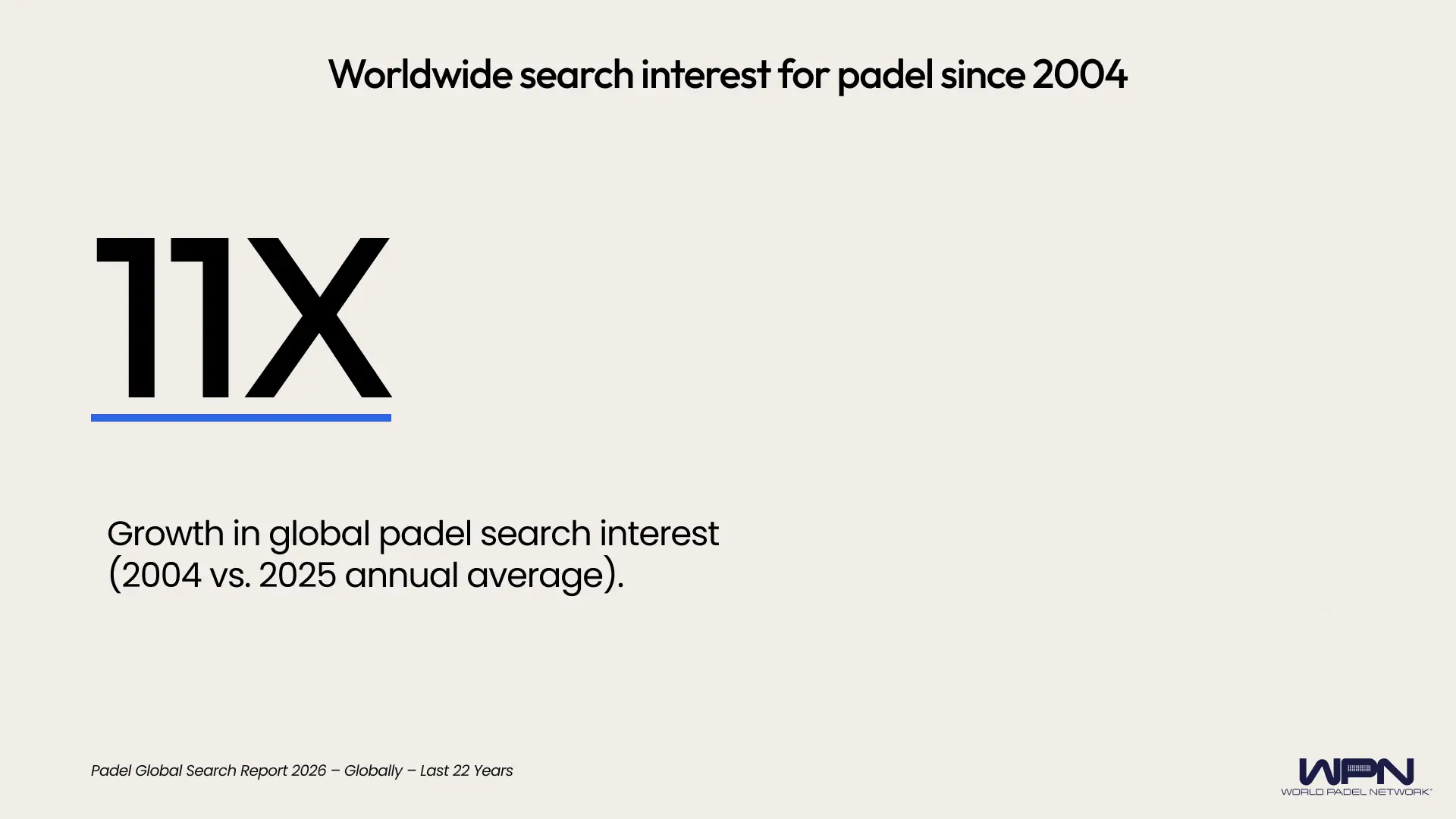
Growth in global padel search interest (2004 vs. 2025 annual average).
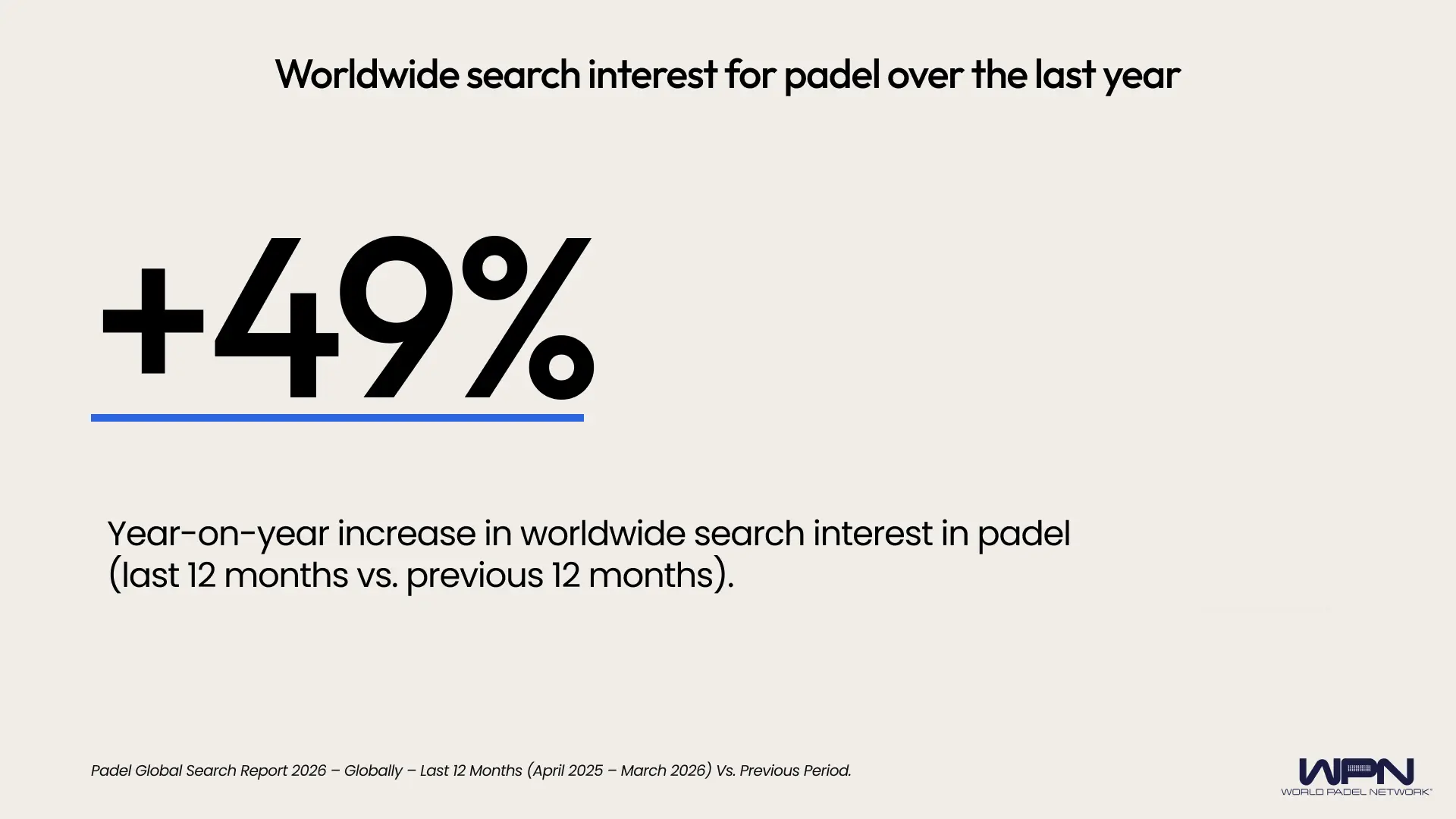
Increase in worldwide search interest in padel (last 12 months vs. previous 12 months).
New countries entering the global top 20 for padel search interest.

By Jamie Rowe
Date Published: 12th April, 2026
43-min read
Share:
CONTENTS
Any questions or want to discuss the findings of this report? Get in touch.
A PDF with the key takeaways is available upon request for subscribers to The Cortado.
Each month, we’ll publish a deep dive into how padel is progressing in a specific country or region. Subscribe to The Cortado for access to these reports, key takeaways, and more.
Key Findings
The Padel Global Search Report 2026 shows how worldwide and international search interest in padel has evolved – and where it’s potentially heading next. Some of the key findings include:
- Global search interest in padel grew 1,026% between 2004 and 2025, comparing annual averages. Virtually all of that global growth is concentrated in the last five years.
- Worldwide interest rose 49% in the last 12 months vs. the previous 12 months.
- Six countries entered the global top 20 for the first time, including Indonesia – the first Southeast Asian market to break through. The geographic reach of the sport is expanding well beyond its European and Latin American heartlands.
- Padel outperformed pickleball in all 53 weeks in a direct global comparison. However, in the US, search interest for pickleball is 10X higher than padel. Tennis remains the dominant racket sport in search, at roughly 6x padel’s level on a global scale.
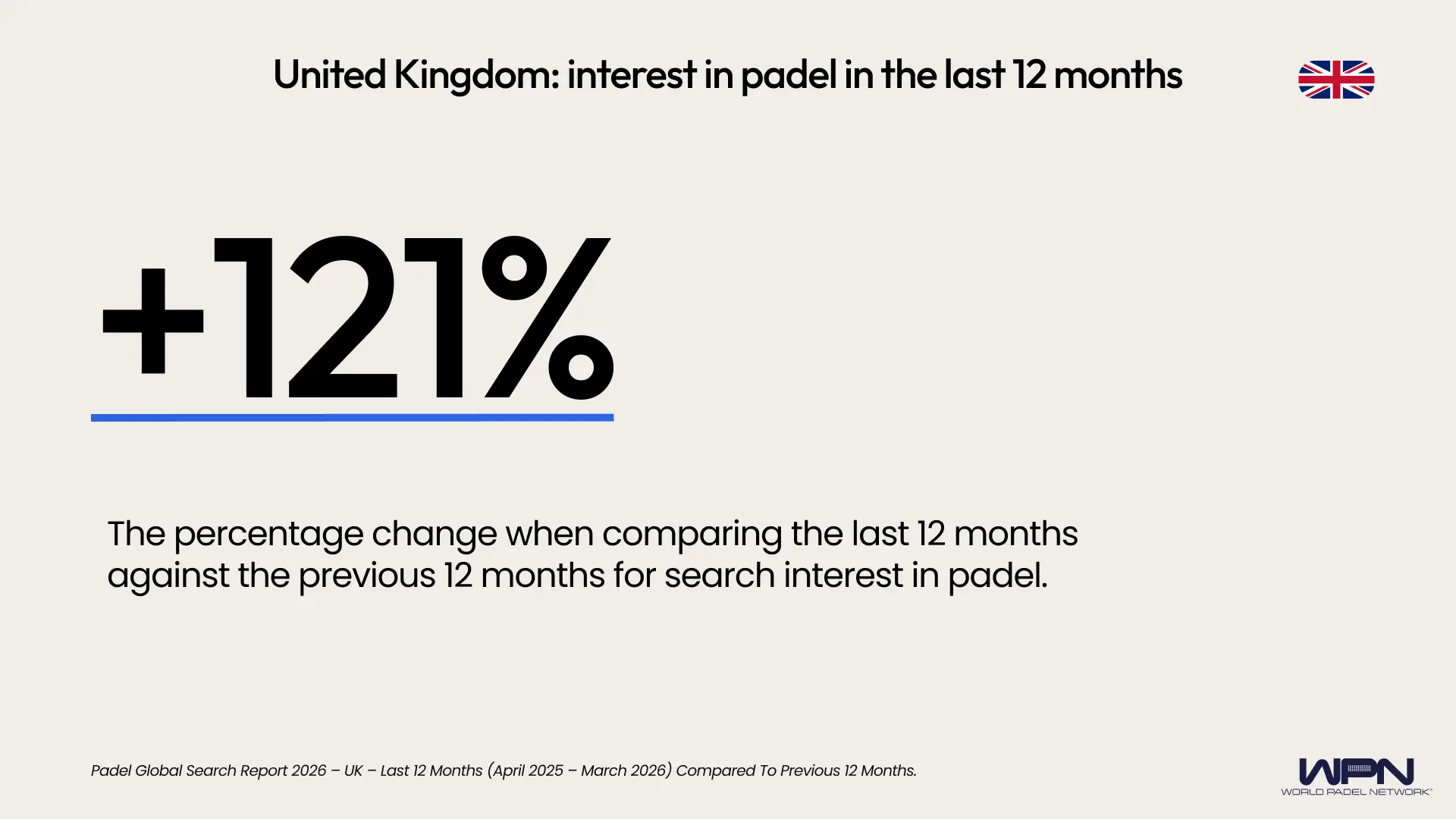
- Several countries had a large increase in search interest: United Kingdom (+121%) Australia (+102%), Ireland (+98%), Ukraine (+280%), Indonesia (+887%), India (+128%), and Pakistan (+198%).
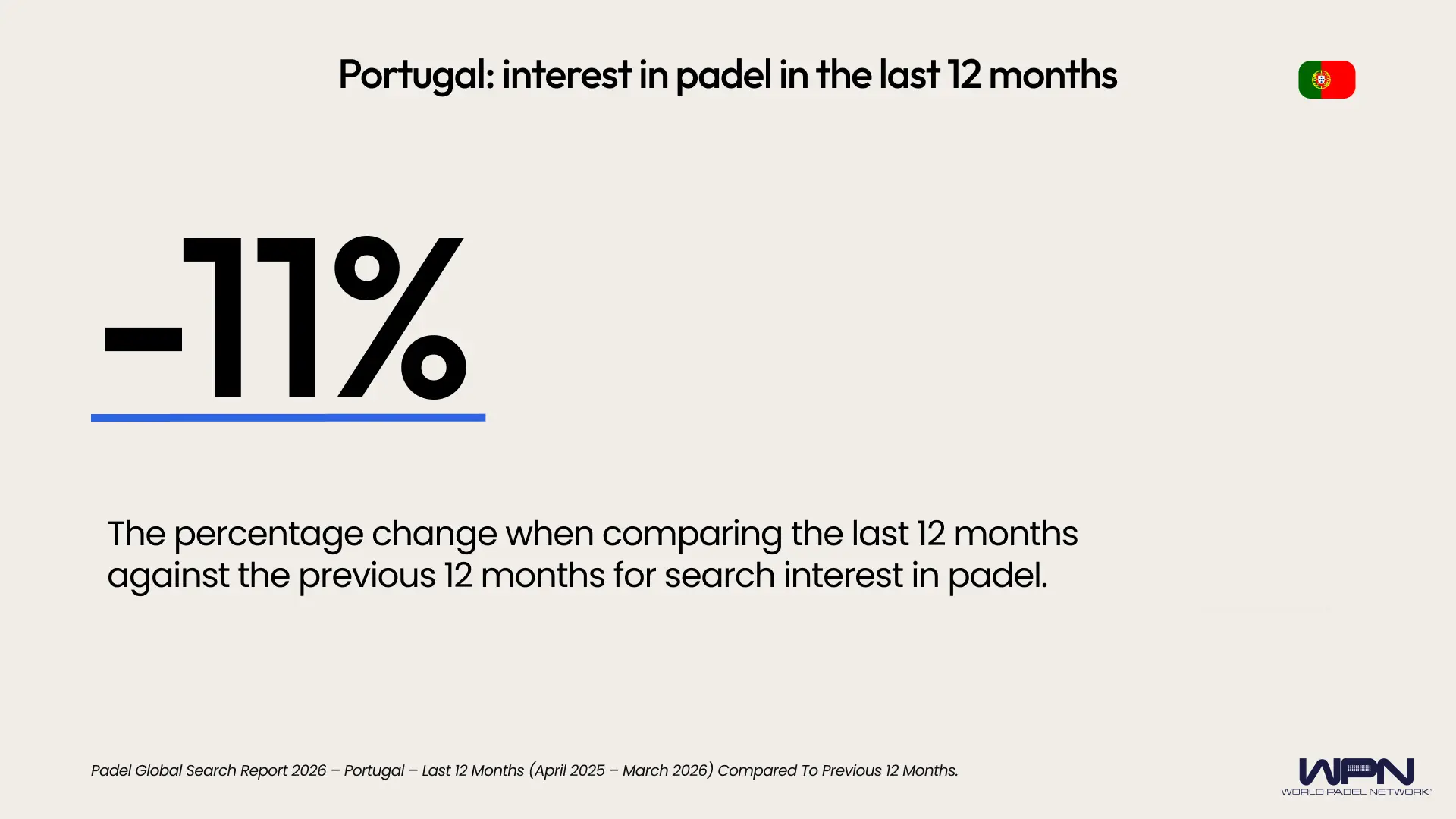
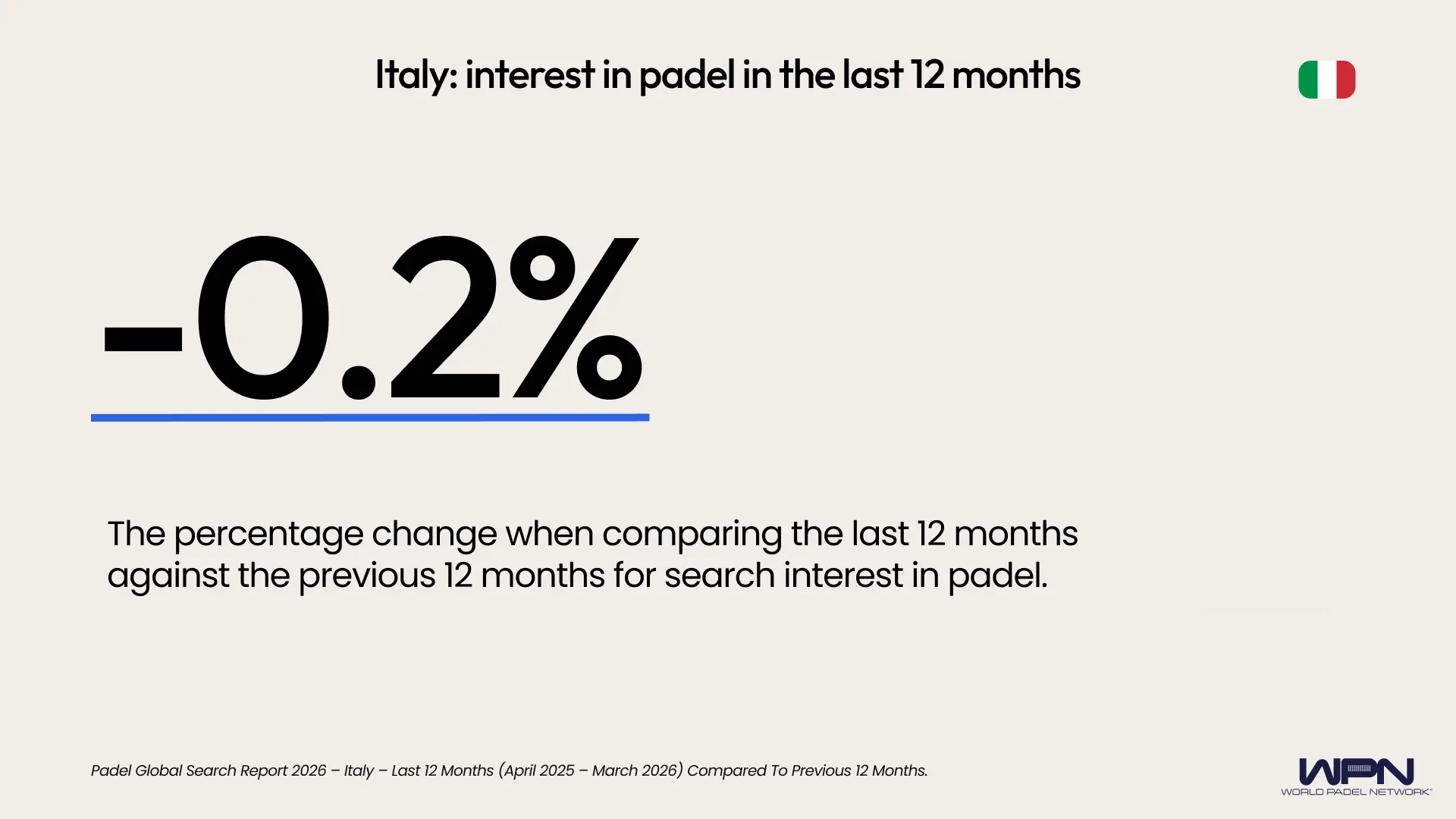
- Several countries saw little growth (particularly mature markets) or a decrease in search interest: Spain (+0.5%), Portugal (-11%), Italy (-0.2%), and Mexico (+12%).
Methodology
When someone searches for padel or related topics, it reflects interest and varying intent – informational, navigational, commercial, and transactional. It could be a first-time player looking for a local club, a coach researching coaching courses, someone looking to upgrade their racket, or an investor sizing up a new market. Multiplied across millions of searches in dozens of countries, these queries form a consistent and accessible measure of how public interest in padel is changing around the world. That is the basis of this report.
The data in this report come from Google Trends, a tool which tracks how often a given term is searched relative to total search activity. Rather than providing raw search counts, Google Trends returns an index score between 0 and 100. A score of 100 represents the peak level of interest for that term within the selected time period and geography; a score of 50 means interest was half that peak. In other words, these scores show direction and scale – whether interest is growing, declining, or holding steady – rather than exact numbers.
Throughout this report, the data were collected using “Padel” as a Topic in Google Trends. This is a specific setting that captures searches related to the sport of padel as a whole, regardless of exact phrasing or language – so it includes queries in French, Swedish, and other languages. This provides a more complete and internationally representative picture than tracking a single keyword.
Different sections of this report draw on data across different time ranges. Long-term analysis uses data from 2004 onwards, which Google Trends returns at monthly intervals. The last-12-months analysis uses weekly data, providing finer detail on recent shifts. Regional comparisons show where padel search interest is highest as a proportion of all searches in each country – meaning a smaller country with strong padel culture can score higher than a larger country with more total searches. As such, you may be surprised by some of the countries listed in the “Top 20” section below.
It is worth noting what the data do not show. Google Trends does not tell us how many people searched for padel in absolute terms (unfortunately). It does not capture searches on other search engines, direct visits to padel websites, or offline interest. And because all values are relative, index scores from separate queries cannot be directly compared unless they were pulled in the same search – and on this front, the tool is limited. These are important caveats, and they are acknowledged throughout the report where relevant. Nevertheless, Google searches still account for the vast majority of searches globally and – as of early 2026 – still dwarf searches on fast-growing LLMs, such as Claude and ChatGPT.
A note on data variability: Google Trends does not return fixed index scores. Each time a query is run, the tool resamples from its data and renormalises the results. This means that running the same query on different dates can produce slightly different scores — typically within a few points. For this report, all regional comparison data were pulled in a single session to ensure internal consistency. Readers attempting to replicate the exact figures may see minor variations. The relative rankings and directional patterns — which country leads, which are growing, which are stable — are robust to these fluctuations. Where a country sits within one or two points of another in the index, the ranking between them should be treated as approximate rather than definitive.
About The Researcher
Jamie Rowe is the Founder of World Padel Network® – a trusted global padel platform connecting players, clubs, coaches, businesses, communities, and more across the sport. He writes about padel market trends and global growth worldwide, and publishes The Cortado – a free weekly padel industry briefing, delivered every Sunday. He is, of course, a regular padel player.
Jamie’s background in digital marketing and search engine optimisation informs the analytical approach behind this report on search trends.
From Niche to Global: Padel Search Interest Since 2004
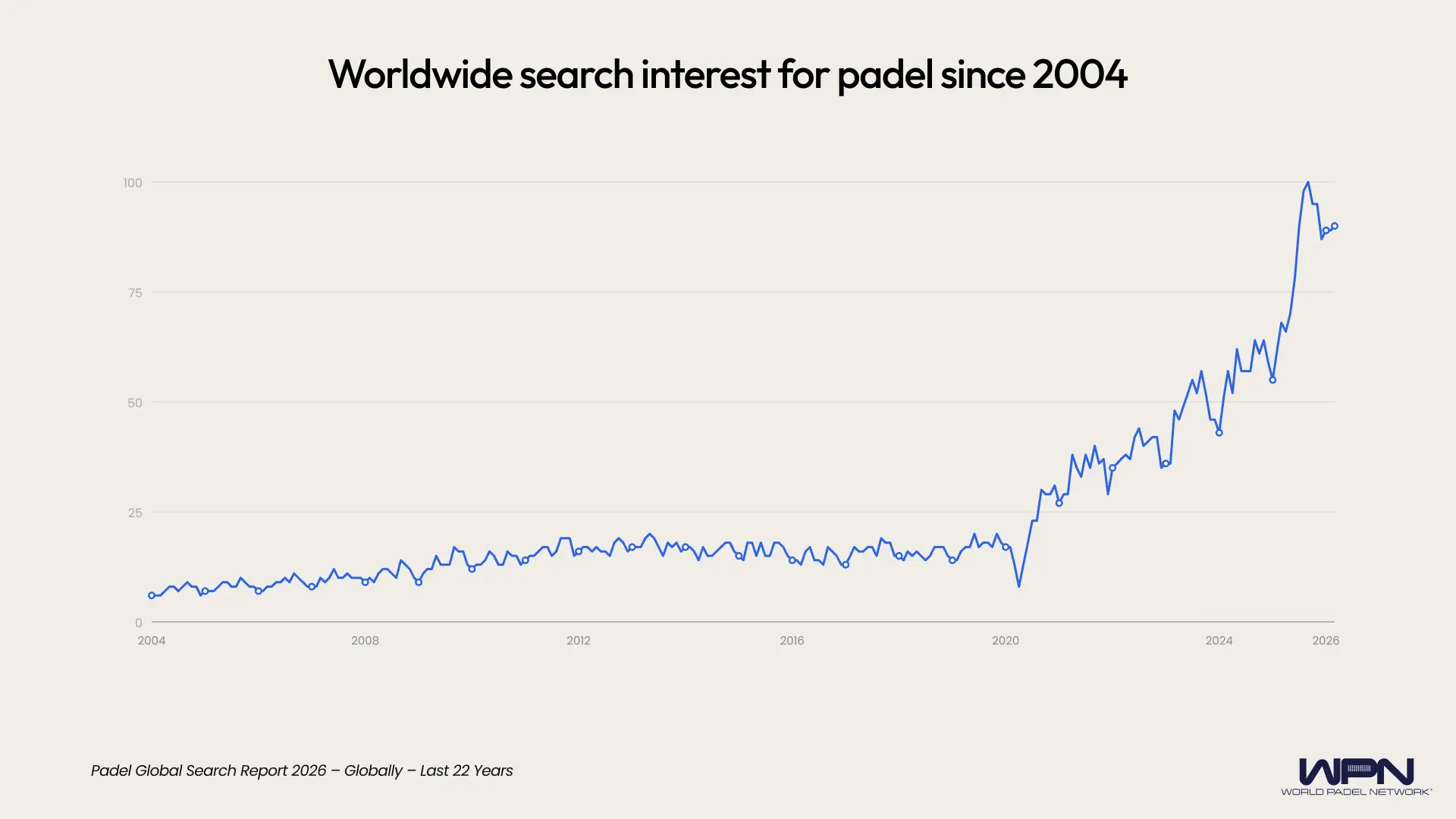
Over two decades of Google Trends data tell a clear story – padel spent 15 years as a quietly stable search term (at least on a global scale) before entering a period of sustained, accelerating growth that continues today.
From January 2004 to the end of 2019, worldwide search interest in padel rarely exceeded 20/100. For context, a score of 20/100 means the term attracted just one-fifth of the search activity it would later reach at its peak. During this period, the data are essentially flat. Padel existed as a known sport in its traditional heartlands, particularly Spain and Argentina, of course, but had not yet registered meaningfully in global search behaviour.
The inflection point came in 2020, and it largely came from an unlikely catalyst. When pandemic lockdowns hit in early 2020, search interest dropped to 8/100 in April – the lowest point in years. But the recovery was rapid and, critically, it did not stop at pre-pandemic levels. By July 2020, interest had already surpassed its entire 2004 – 2019 range.
What is most notable about the years since is not just that growth happened, but that it has compounded. Year-on-year increases in average search interest tell the story: +63% in 2021, +15% in 2022, +21% in 2023, +19% in 2024, and +42% in 2025. The 2025 acceleration is particularly significant, and in September 2025, padel hit the highest level of worldwide search interest ever recorded.
Early 2026 data suggest this trajectory is holding. January through March 2026 returned scores of 89, 93, and 96/100 – comfortably above the equivalent months in any previous year.
A consistent seasonal pattern is also visible across the full dataset. September tends to mark the annual peak in search interest, with December and January as the annual lows. This aligns with the return from summer and the start of the competitive season in European markets, which currently drive the largest share of global padel search activity it seems.
What is most notable about the years since the pandemic is not just that growth happened, but that it has compounded. The 2025 acceleration is particularly significant, and in September 2025, padel hit the highest level of worldwide search interest ever recorded.
KEY TAKEAWAY
The Last 12 Months: A New Baseline for Global Padel Interest
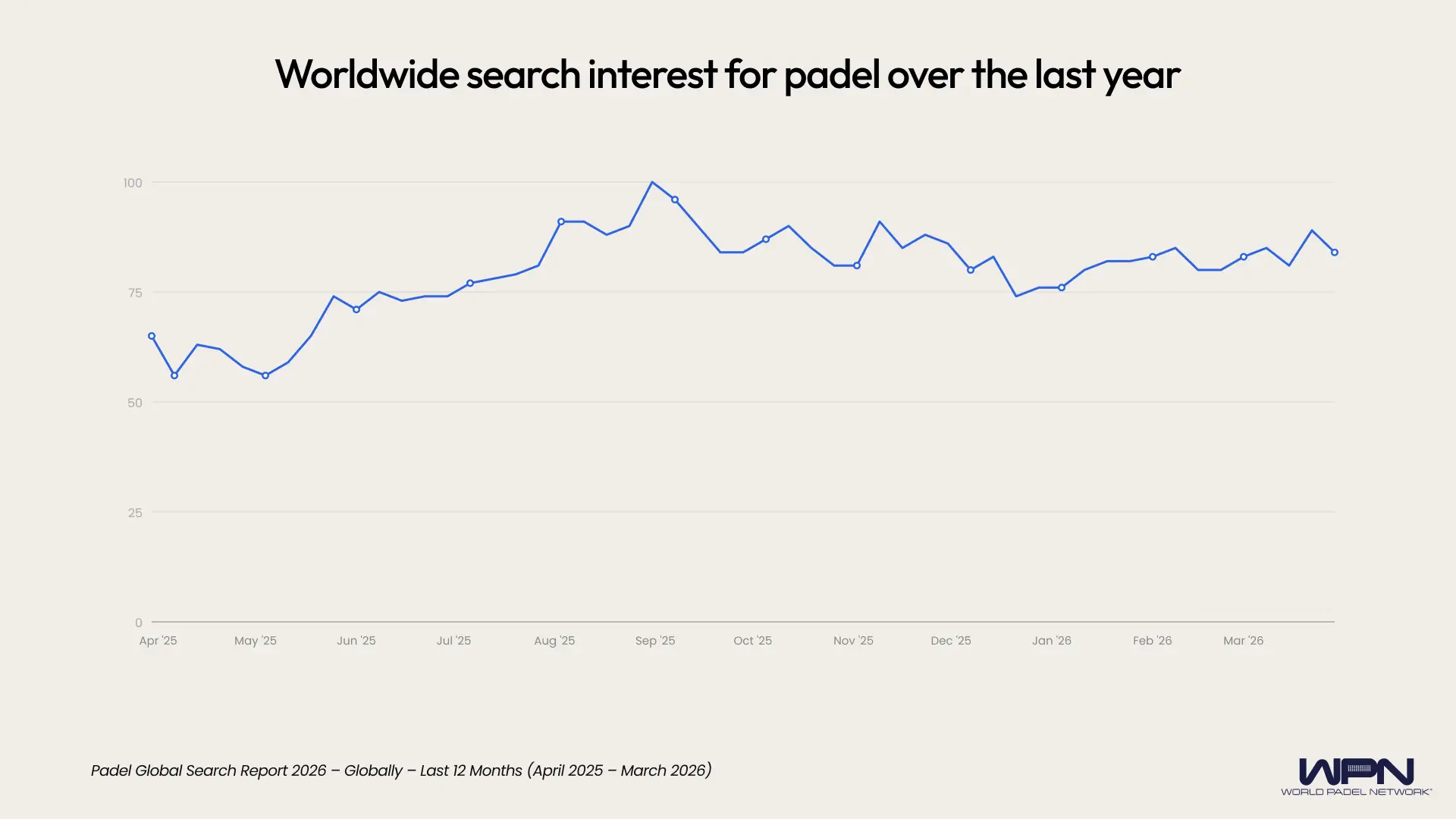
Weekly Google Trends data from late March 2025 to March 2026 confirms what the long-term view suggests – padel search interest is not just growing, it has settled at a level that would have been unthinkable to many a few years ago.
The peak came in the week of 31 August 2025, when worldwide search interest hit the highest weekly score in the dataset. But the more telling story is not the peak itself; it is how high the floor has risen around it. The lowest-scoring week in the entire 12-month window was 56/100, recorded in early April 2025. To put that in perspective, a score of 56 would have been a record-breaking month as recently as 2024. The sport’s baseline has shifted too.
That shift is visible across the full period. Of 53 weeks tracked, 33 scored 80/100 or above – that is 62% of the year spent at or near the top of the scale. Eight weeks reached 90 or higher. This is sustained, broad-based interest, not a series of isolated spikes driven by individual events creating lots of “hype”.
A clear seasonal pattern runs through the data. Monthly averages climbed steadily from April 2025 to September 2025. The customary December dip followed, but it was shallow: interest softened before recovering.
Looking at quarterly averages reinforces the picture. The gap between the peak quarter and the quarters either side of it is narrow – suggesting that August–September 2025 established a new sustained level of interest rather than a one-off high point.
Year-on-year growth remains strong. The final four weeks of the dataset averaged 85/100, compared to 62/100 for the earliest four weeks – a 38% increase. The compounding growth trend identified in the 22-year dataset is continuing into 2026.
Where the World Searches for Padel: The Top 20 Countries
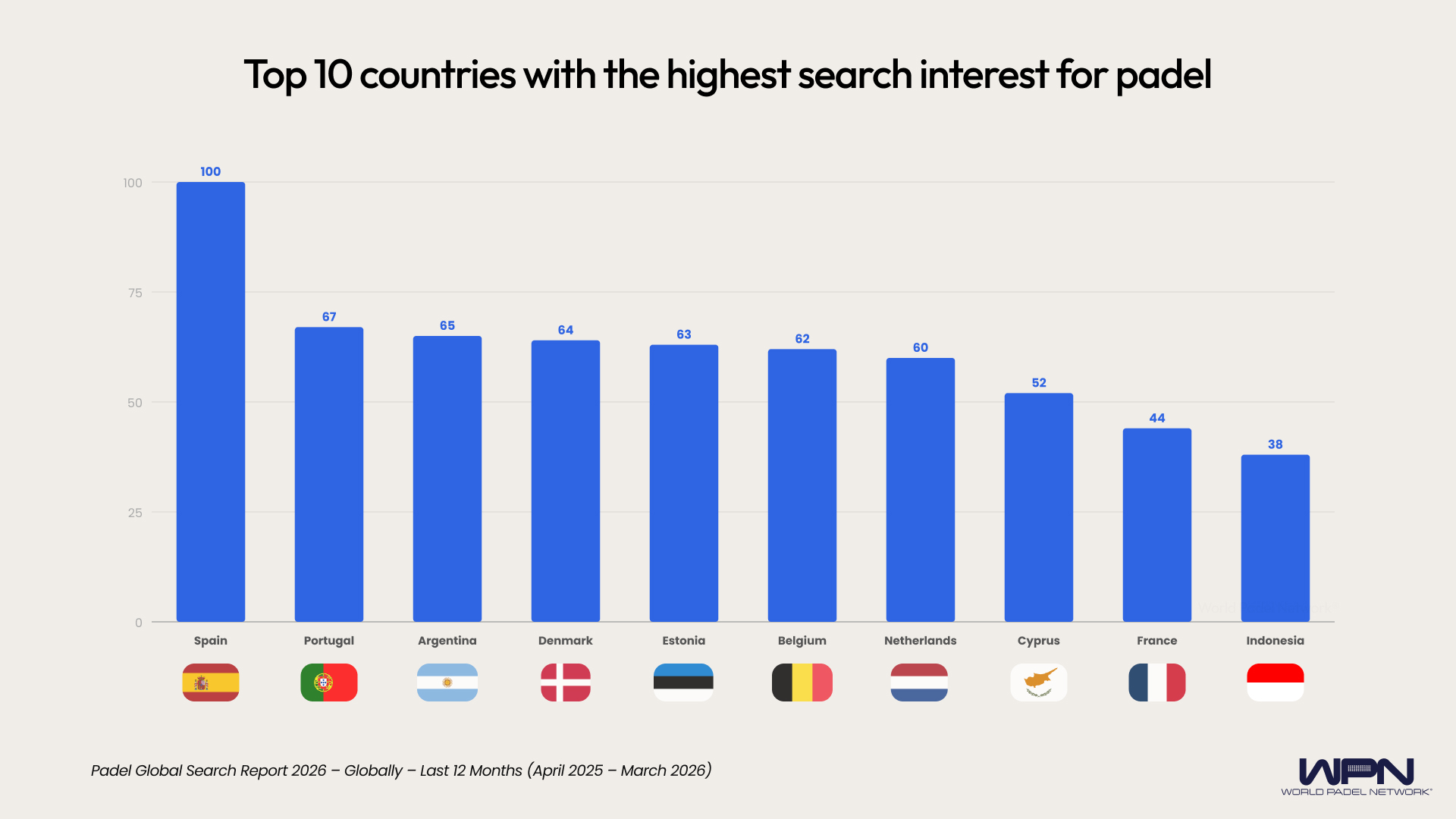
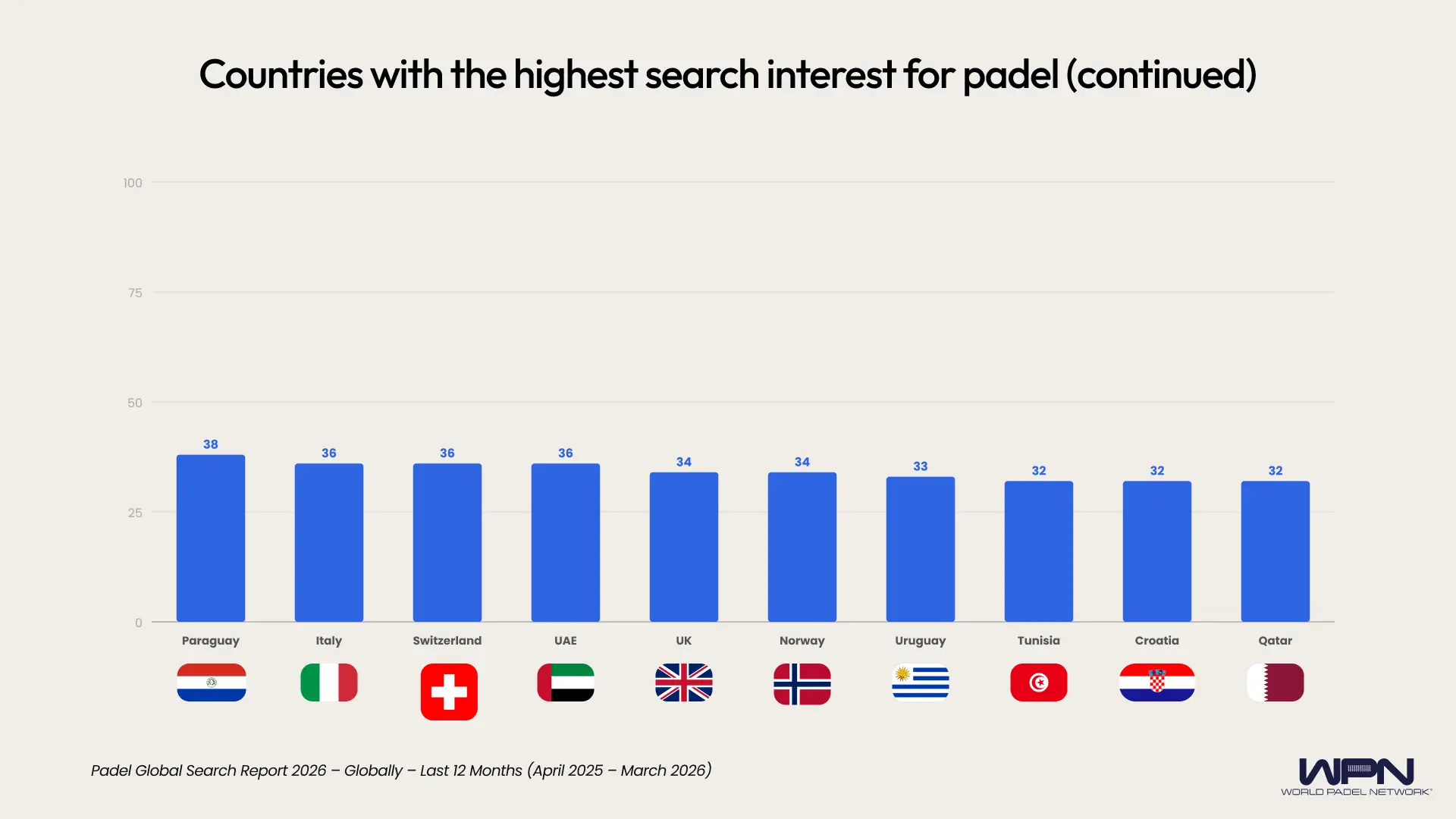
To nobody’s surprise, Spain remains the clear leader in global padel search interest, scoring the highest over the past 12 months – consistent with its position as the sport’s largest and longest-established market. But the picture beneath the top spot has changed significantly, and the story of this section is less about who leads and more about how quickly the rest of the world is catching up.
In the all-time data, the gap behind Spain was vast. The second-ranked country scored less than 40% of Spain’s index. In the past 12 months, that gap has narrowed considerably. Portugal (67), Argentina (65), Denmark (64), Estonia (63), Belgium (62), and the Netherlands (60) all sit at or above 60/100. The sport is no longer dominated by a single market with distant followers – it is becoming genuinely multi-country.
Six countries have entered the top 20 for the first time in the 12-month data: Cyprus (52), Indonesia (38), Switzerland (36), the United Kingdom (34), Tunisia (32), and Croatia (32). None appeared in the all-time top 20 before.
Among these new entrants, Indonesia stands out. It is the first Southeast Asian country to break into the top 20 – a signal that padel is gaining traction beyond its traditional European and Latin American heartlands. It is too early to draw firm conclusions from a single data point, but it is a market worth watching. Cyprus’s arrival is also notable – the highest-ranked new entrant by some distance.
At the other end, some previously prominent countries have dropped out. Sweden, for example, has been overtaken by faster-growing markets. This tracks, as padel in Sweden saw a rapid rise and rapid fall. Chile, Finland, Kuwait, and Panama have also fallen out of the top 20. This does not necessarily mean interest is declining in these markets in absolute terms; it suggests other countries are potentially growing faster.
A broader pattern is visible across the middle of the table. Denmark, Belgium, the Netherlands, France, Switzerland, the United Kingdom, Norway, and Croatia form a dense cluster of Northern and Western European markets scoring in the mid-range. Padel is now firmly established across this region – not as a novelty, but as a sport with sustained and measurable public interest.
We explore these countries individually below, giving a top-level view. Later this year, we’ll release comprehensive reports on individual countries, and exclusive early access and exclusive key takeaway documents are given to subscribers to The Cortado.
Padel, Pickleball, and Tennis: A Global Search Interest Comparison
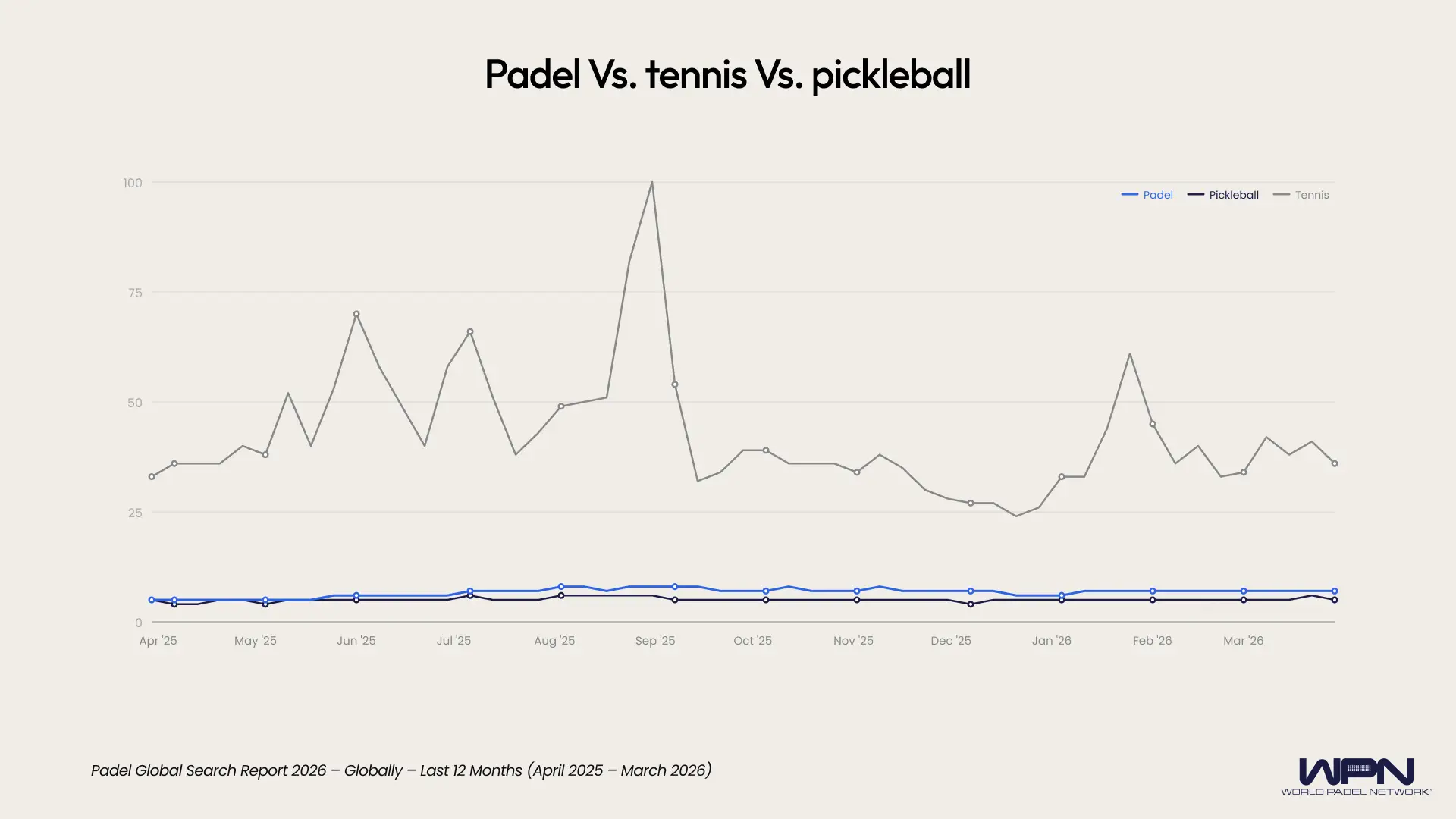
One of the most frequent questions in the padel industry is how the sport compares to pickleball – and, inevitably, to tennis. The results over the past 12 months are instructive (and humbling).
Before looking at the numbers, here’s an important note on how to read this section: Because all three sports are compared within a single Google Trends query, the index is scaled to the highest point across all three – in this case, tennis during the US Open week (100/100). That means padel and pickleball appear as single-digit scores on this chart, which looks low at first glance. It is not. As earlier sections of this report show, padel search interest measured on its own terms reached 90–100/100 over this same period. The comparison tells us about the relative size of each sport’s search demand, not the absolute level.
Padel equalled or exceeded pickleball in every single week of the past 12 months. Given how much attention pickleball receives in media coverage, this is a useful corrective: on a global level, more people search for padel than for pickleball.
Tennis, as expected, remains the dominant racket sport in search terms. It averaged 42.6/100 across the year – roughly six times padel’s level. But tennis search interest is heavily event-driven. It peaked at 100/100 in the week of 31 August 2025, coinciding with the US Open, and dropped as low as 24/100 over Christmas.
Padel, by contrast, is remarkably steady. Its weekly scores ranged from 5/100 to 8/100 across the entire year – a three-point range. That consistency reflects a sport whose search demand is driven by sustained, underlying interest rather than a schedule of key events. People are searching for padel because they want to play it, find a club, or learn about it – not necessarily because a major tournament is on television.
Tennis still leads by a significant margin, but padel is the clear second racket sport globally – ahead of pickleball in every week of the past year.
KEY TAKEAWAY
A closer look: interest in padel vs. pickleball
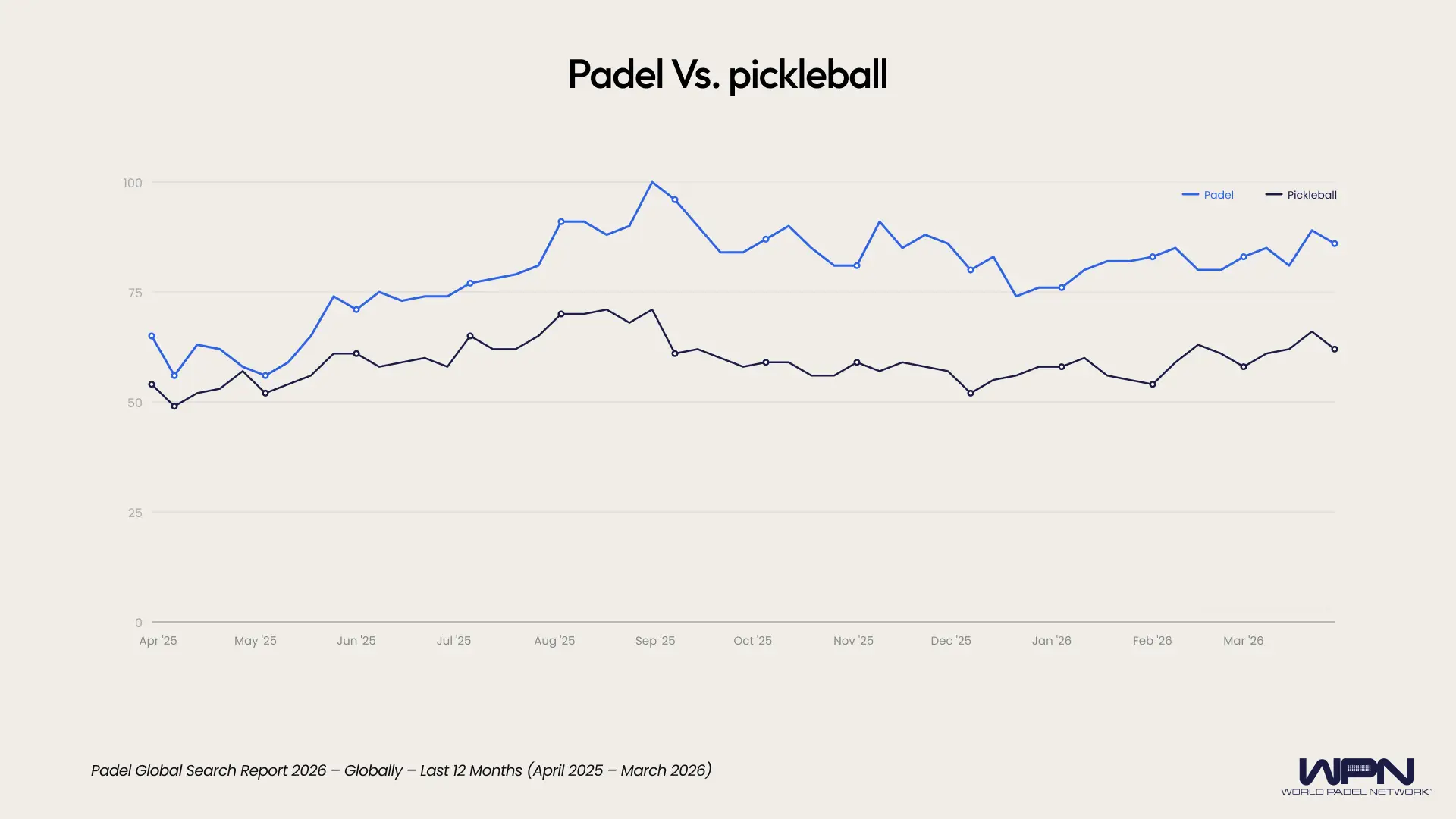
The three-way comparison above shows where padel and pickleball sit relative to tennis. But because tennis dominates the scale, both sports appear tiny, making it hard to see the detail between them. Comparing just padel and pickleball directly gives a much clearer picture of how the two sports compare head to head.
Over the past 12 months, padel led pickleball in all 53 weeks. The scale of that lead grew as the year progressed. In April 2025, the two sports were relatively close – padel averaged 60/100 while pickleball sat at 53/100. By the peak week of 31 August 2025, when padel hit 100/100, pickleball scored 71/100.
What stands out is the difference in trajectory. Padel’s scores moved through a wide range across the year – from the high 50s in April to 100 in late August – reflecting strong seasonal momentum and continued growth. Pickleball, by contrast, was remarkably flat. It fluctuated between 49 and 71/100 across the full 53 weeks, with no clear upward or downward trend. Its average barely shifted from month to month.
This matters because it suggests the two sports are in different phases. Padel is still on a growth curve – its search interest is climbing year on year, with seasonal peaks pushing higher each cycle. Pickleball’s global search interest appears to have stabilised, at least for now. That does not mean pickleball is declining – it remains a major racket sport, particularly in the United States – but on a worldwide basis, padel is the sport with more upward momentum. It’s worth noting that in the US, the story is flipped – pickleball dominates in search interest compared to search interest in padel by 10X.
Over the past 12 months, padel led pickleball in all 53 weeks in global search interest. However, in the US, the story is flipped – pickleball dominates in search interest compared to search interest in padel by 10X.
KEY TAKEAWAY
The Cortado
The padel world in brief. Everything you need, nothing you don’t – directly to your inbox as one digestible, curated briefing.
Free. Every Sunday.
By country: interest in padel over the last 12 months
The global figures tell one story. The country-level data tells dozens of different ones. When you break worldwide search interest down by country, what emerges is not a uniform pattern of growth but a landscape of markets at very different stages – some mature, some accelerating fast, and some appearing on the map for the first time.
The sections that follow look at individual countries in more detail – examining the shape of their growth, where they stand today, and what the trajectory suggests about where the sport is heading next. Note that we’ll release country-specific reports over the coming months, along with reports covering countries not listed below.
The global figures tell one story. The country-level data tells dozens of different ones. When you break worldwide search interest down by country, what emerges is not a uniform pattern of growth but a landscape of markets at very different stages.
KEY TAKEAWAY
Spain
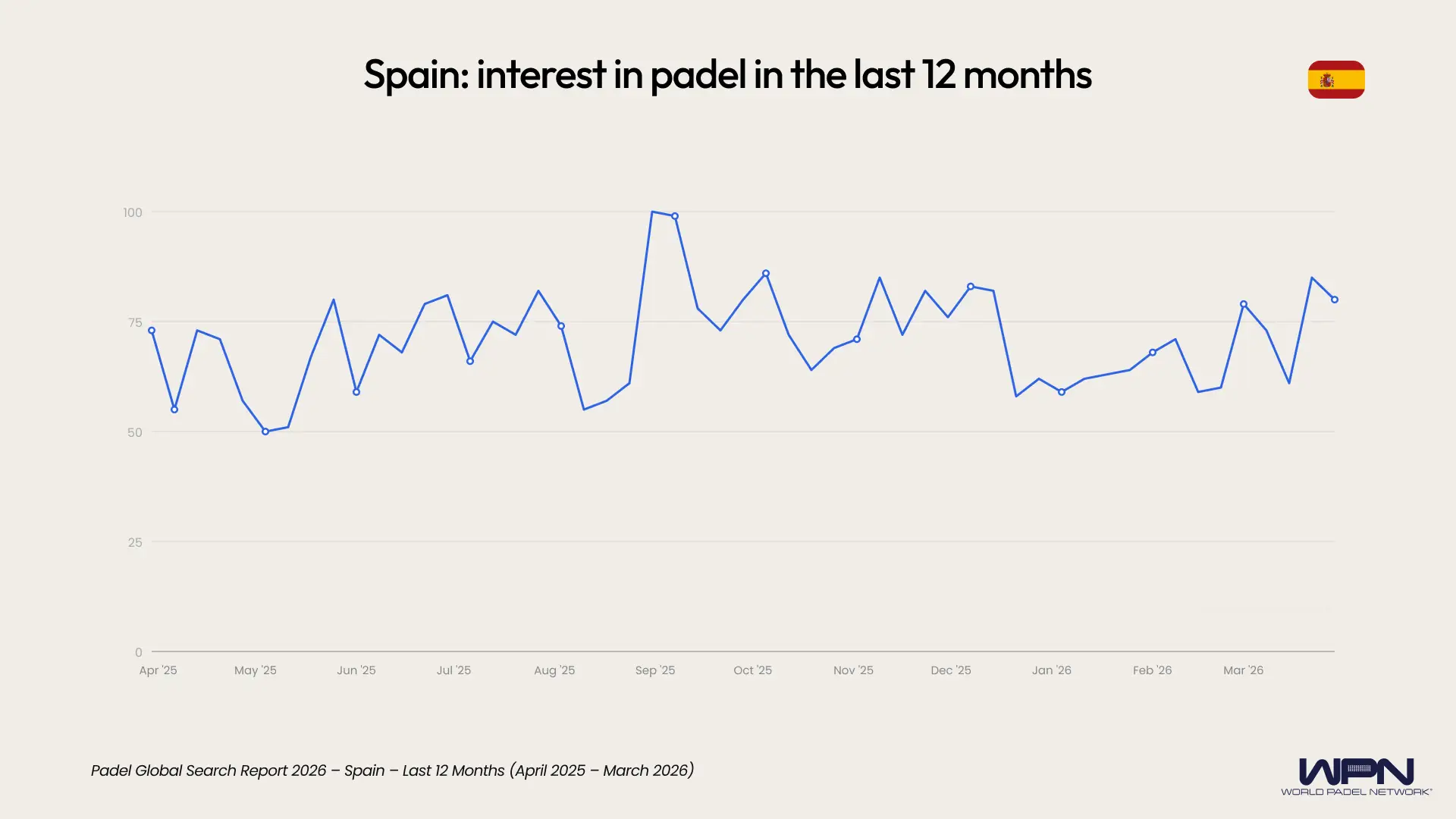
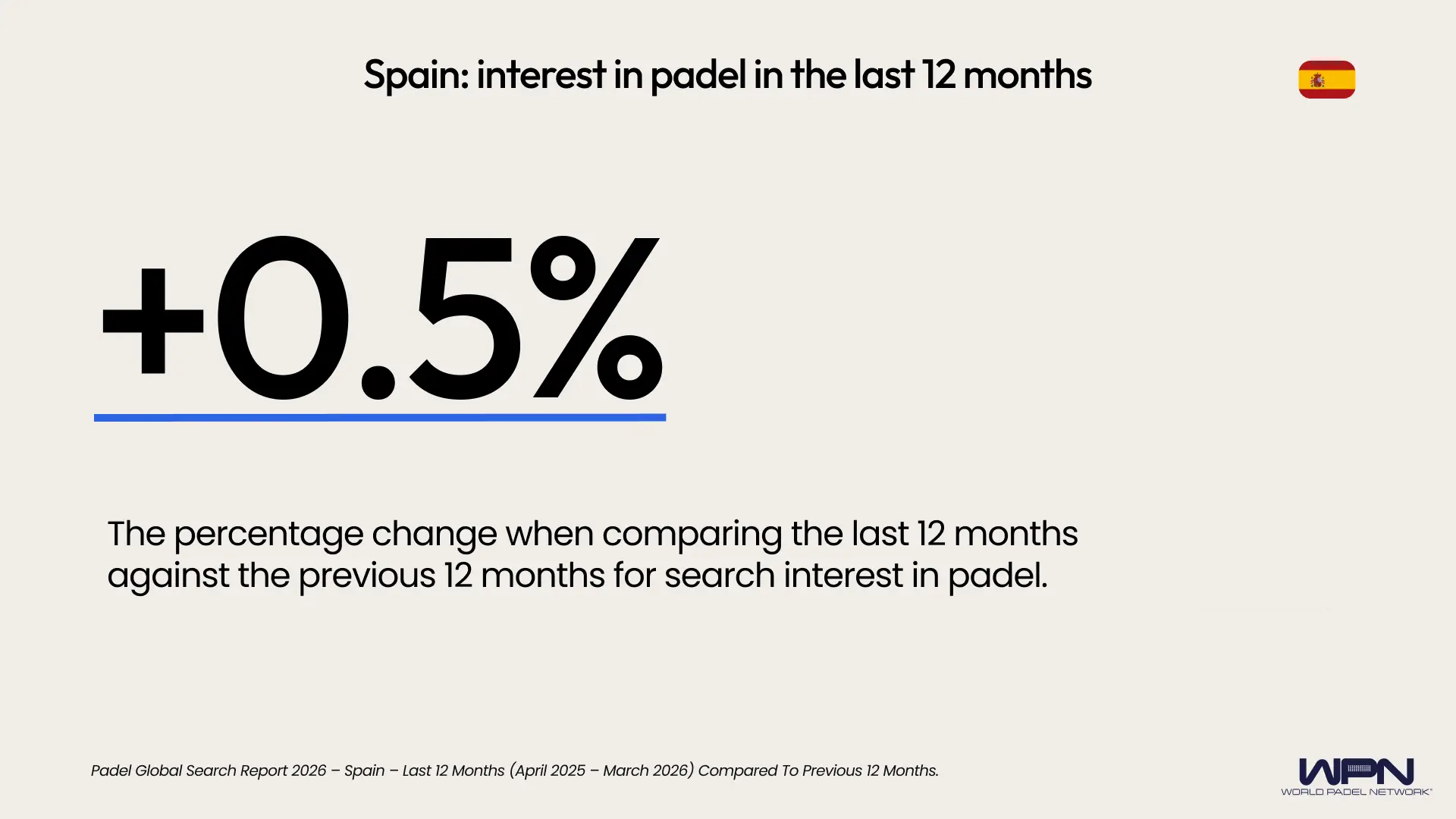
Spain scores 100/100 in the regional rankings and has done for as long as Google Trends data has existed for padel. No other country comes close over the full 2004 – 2026 period. This is the sport’s home market – the country where padel has been embedded in sporting culture for decades – and the search data reflect that.
Spain’s data are more volatile than the worldwide trend. Weekly scores ranged from 50 to 100/100 – a 50-point band, compared to the 44-point range in the global data. This is characteristic of a mature market where interest reacts more acutely to seasonal rhythms and the competitive calendar. The Christmas and New Year period saw the most pronounced dip, with interest dropping to 58 – 62/100 across late December 2025 and early January 2026 before recovering through February and into March.
Two things stand out. First, Spain does not rely on a single annual spike – it sustains elevated interest across autumn and into spring, with two or three distinct peaks rather than one. Second, even the lowest weeks are high by any other country’s standards. Spain’s floor is another country’s ceiling.
United Kingdom
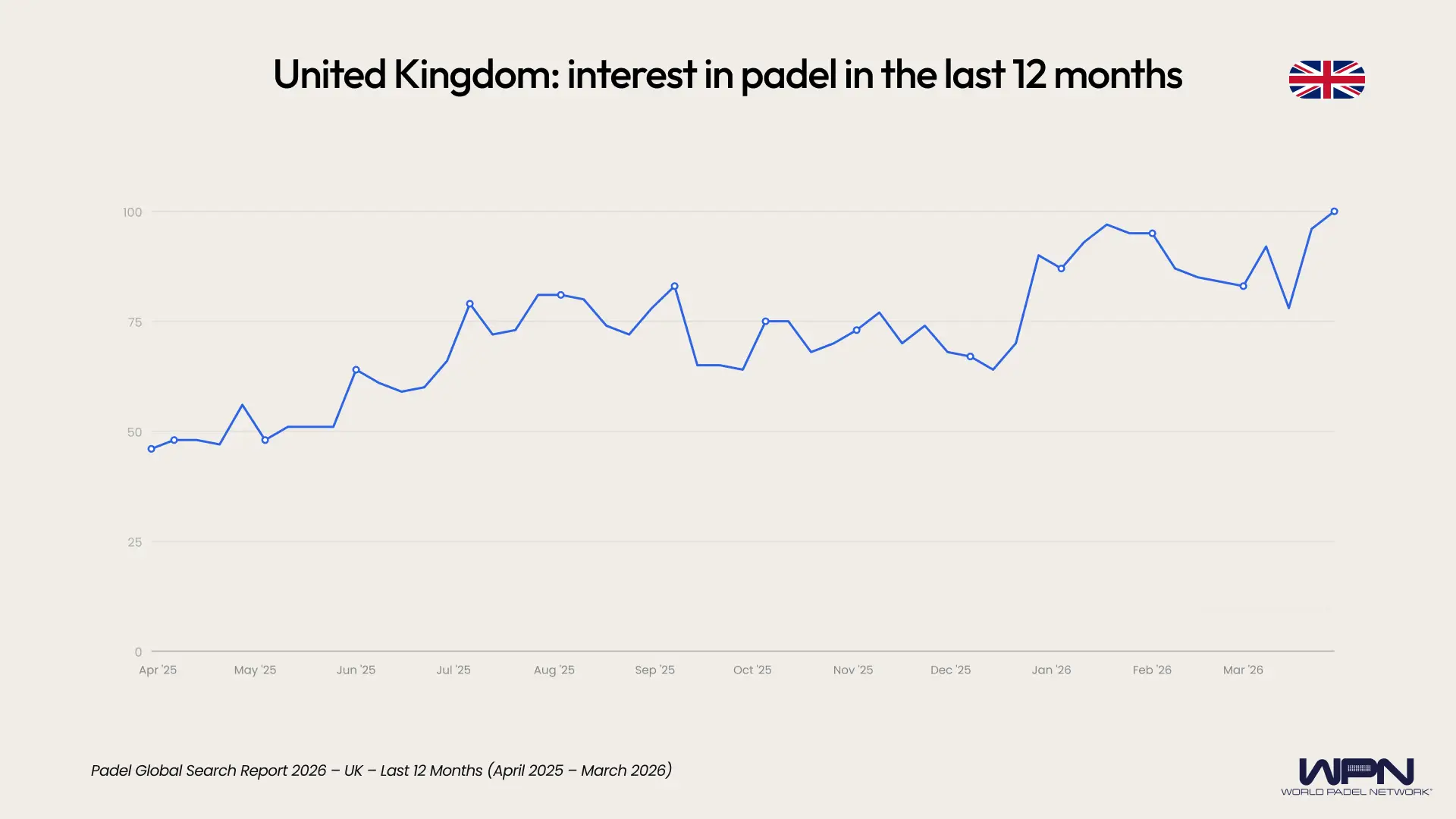
The United Kingdom scored just 4/100 in the all-time regional data – barely a blip across two decades. In the past 12 months, however, it sits at 34/100 on the global comparison. But those figures understate what is happening inside the market itself. Measured on its own terms, the UK’s padel search data tell one of the most striking growth stories in the dataset.
The trajectory is the clearest part of the story: the UK line trends consistently upward. Weekly scores averaged around 50/100 in April 2025, climbed into the mid-to-high 70s through July and August, and then surged into the high 80s and 90s in Q1 2026. The floor rose with it – the lowest reading in the first month was 46/100; by February 2026, even the weakest week (84/100) would have been a record just six months earlier.
The seasonal pattern is inverted compared to Spain and the global trend. Where most markets peak in September and dip over Christmas, the UK did the opposite. Interest jumped from 70/100 in the week of 21 December to 90/100 the following week, then climbed to a peak of 97/100 in the week of 18 January 2026. There was no December dip at all. This suggests UK padel interest is driven by different dynamics – most likely New Year fitness resolutions and the appeal of an indoor sport during winter months, when outdoor options are limited.
Search interest in padel in the UK saw an impressive increase of 121% when comparing the last 12 months against the previous 12 months.
The seasonal pattern is inverted compared to Spain and the global trend. Where most markets peak in September and dip over Christmas, the UK did the opposite. There was no December dip at all. This suggests UK padel interest is driven by different dynamics – most likely New Year fitness resolutions and the appeal of an indoor sport during winter months, when outdoor options are limited.
KEY TAKEAWAY
United States
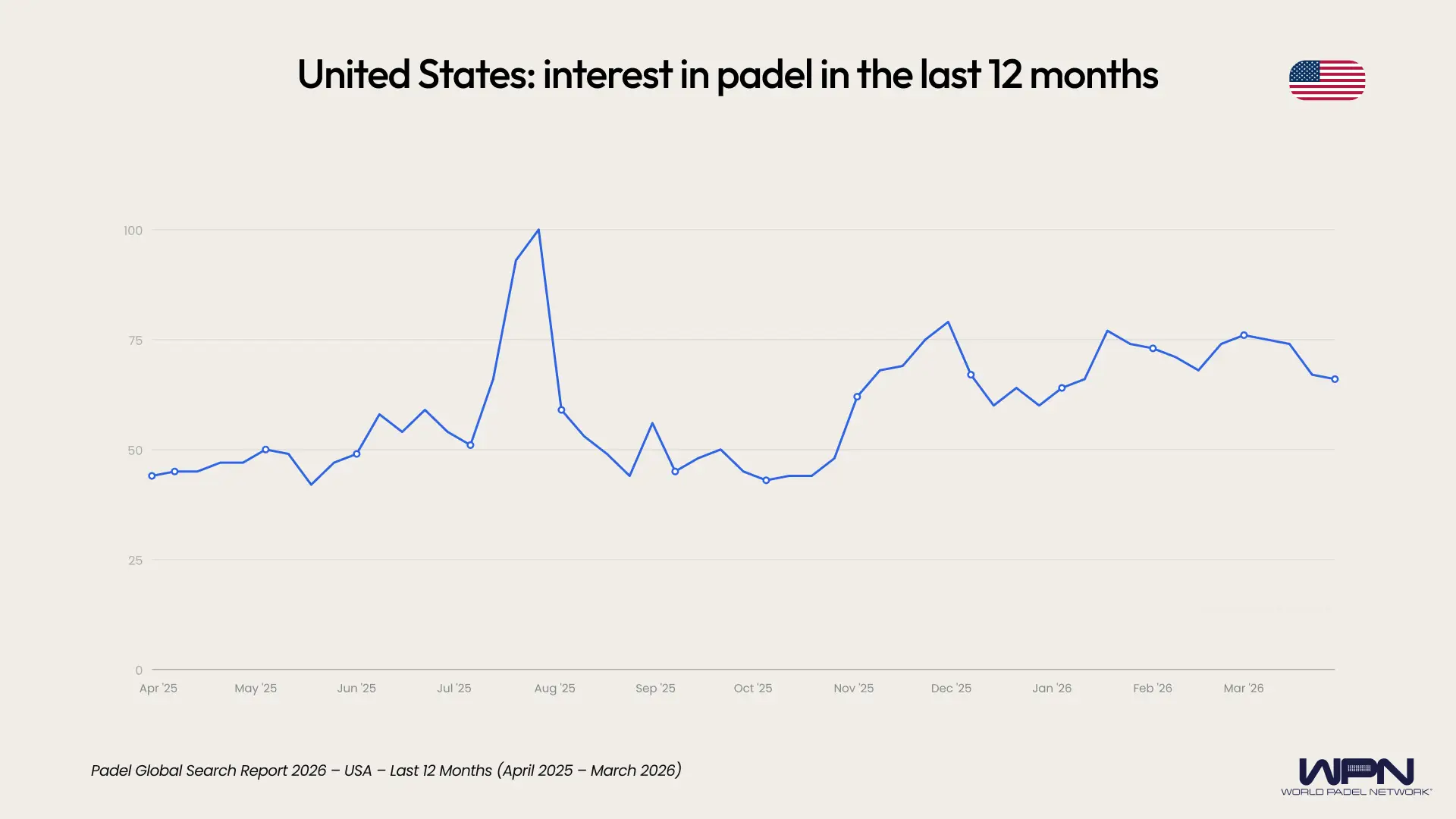
The United States scored just 3/100 in the all-time regional data – one of the lowest readings among countries with any measurable padel interest. For most of the past two decades, padel barely registered in American search behaviour. The last 12 months suggest that is changing, though the pattern looks different from any European market in this report.
The US data splits into two distinct phases. From late March to October 2025, interest was volatile and relatively low, with a dramatic but isolated spike to 100/100 in the week of 27 July 2025. That spike has the hallmarks of an event-driven surge rather than organic growth. By September and October, interest had settled back to previous levels.
Then, in November, something shifted. Interest climbed from 48/100 in the last week of October to 62, 68, 69, 75, and 79/100 across five consecutive weeks – a 65% increase in just over a month. Unlike the July spike, this was not a single-week event followed by a retreat. Interest held at the elevated level through December, January, and into March 2026, averaging around 70/100 across that five-month stretch.
The US does not follow the European seasonal pattern. There was no September peak and no meaningful December dip. The July spike aside, the real story is the November inflection and the sustained growth that followed – suggesting that padel awareness in the US may be transitioning from sporadic, event-driven curiosity to something more durable. With only 3/100 in the all-time data and now consistently scoring in the 60s and 70s week to week, the US is still a market at the very beginning of its growth curve it seems.
France
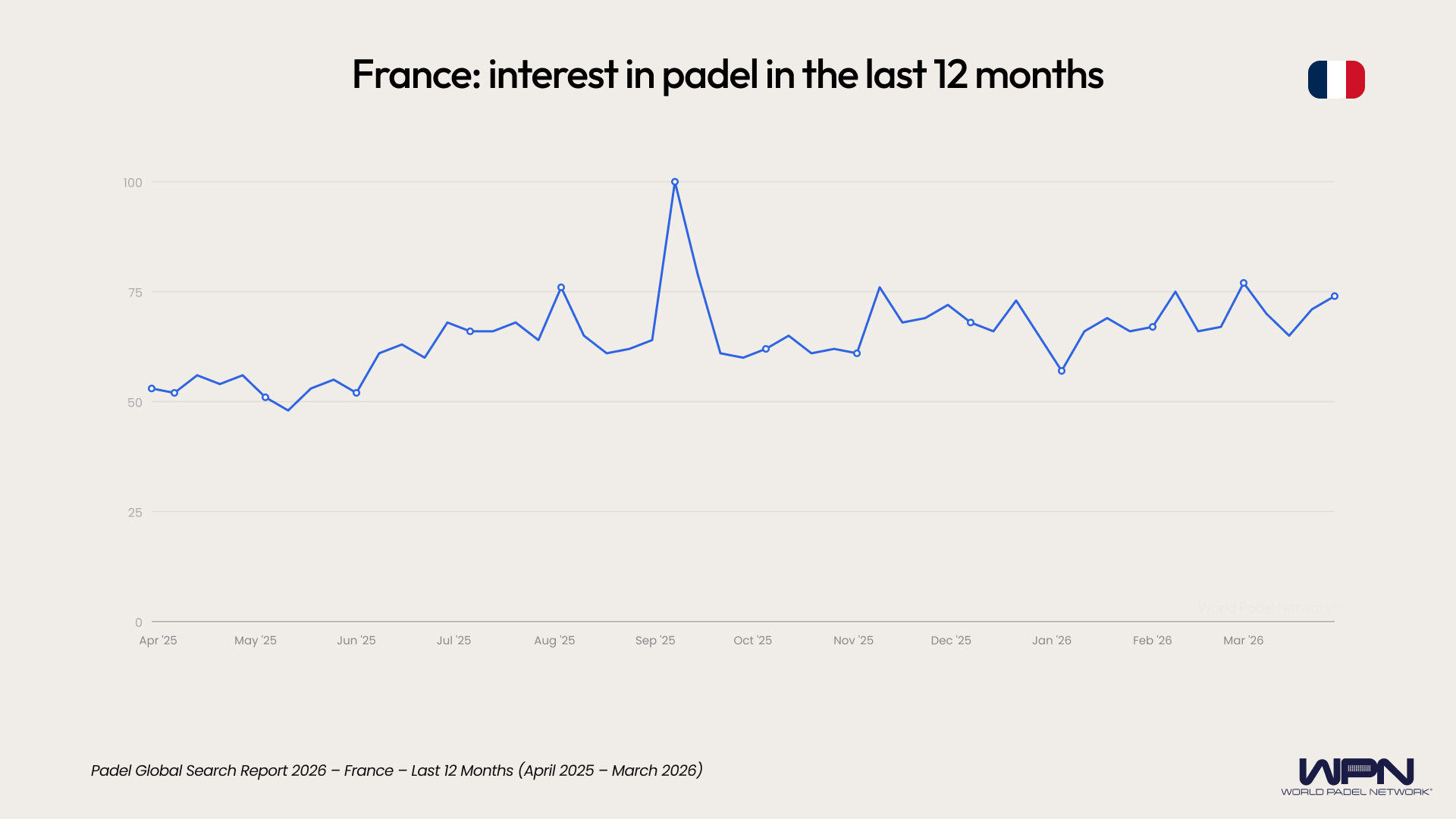
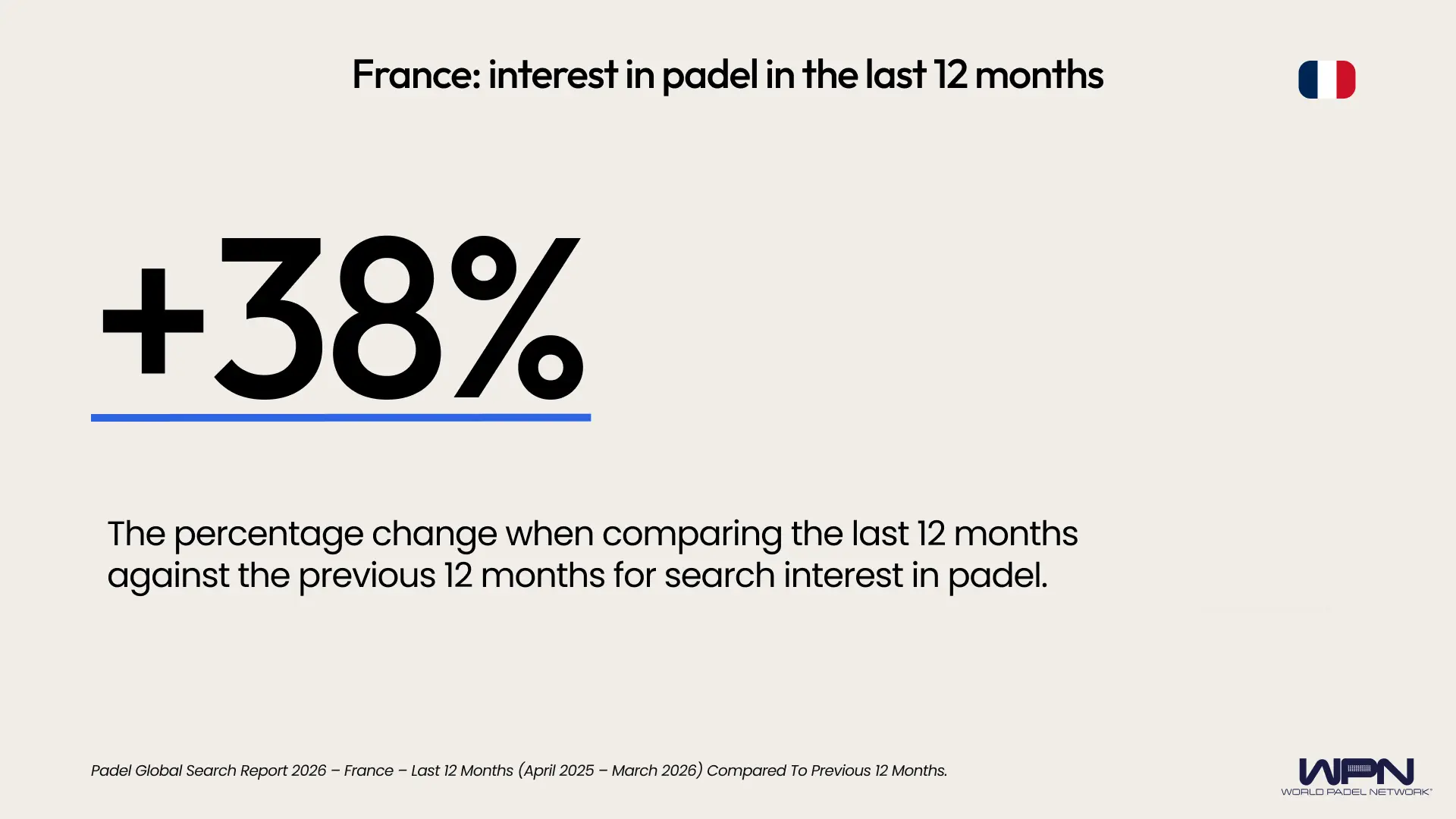
France scored 11/100 in the all-time regional data and 44/100 in the 12-month country rankings – placing it in the middle tier of European padel markets. But the internal picture is more interesting than those headline figures suggest. France’s data over the past year tell the story of a market that has quietly stepped up to a new level and stayed there.
The year began modestly. March and April 2025 averaged in the low-to-mid 50s, consistent with a market still building momentum. By June, weekly scores had lifted into the 60s, and from October 2025 onwards, interest settled into a band of high 60s to low 70s that it has barely left since.
That consistency is the defining characteristic of France’s data. There is no surge, no spike-and-retreat. This is the profile of a market where padel is becoming embedded in sporting culture rather than riding a wave of novelty.
The one exception was the week of 7 September 2025, when interest spiked to 100/100 – jumping from 64/100 the previous week and dropping back to 79/100 the week after. The sharpness of the spike points to a specific event, most likely a major padel tournament (perhaps the Paris Major), rather than a seasonal shift. Remove that single week and the underlying trend is remarkably smooth.
France also showed no Christmas dip. While Spain’s interest dropped sharply over the holiday period, France posted some of its strongest December readings – 73/100 and 65/100 across the final two weeks of the year. This suggests padel in France has moved beyond seasonal dependency and is becoming a year-round activity.
Portugal
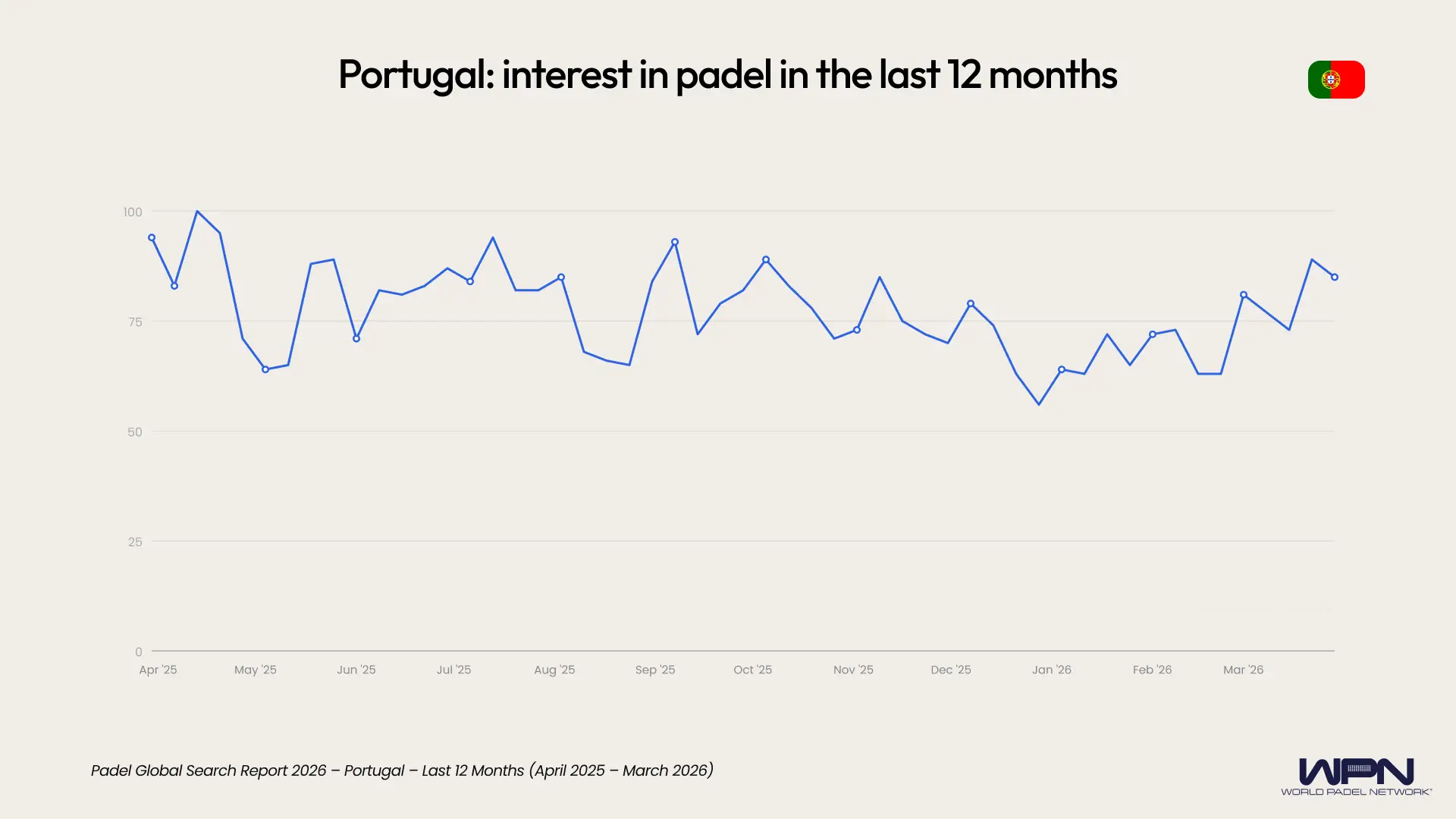
Portugal ranks 2nd in the 12-month global comparison at 67/100, behind only Spain – up from 34/100 in the all-time data. As Spain’s neighbour and the other Iberian padel market, this is perhaps unsurprising. But the shape of Portugal’s data over the past year is distinct from Spain’s in several ways.
The most immediately striking feature is the average. At 77.3/100, Portugal recorded one of the highest internal averages of any country examined in this report.
Portugal’s peak came in the week of 13 April 2025, when interest hit 100/100. That is unusual. In almost every other market we have examined, the annual peak falls in late August or September. Portugal’s highest reading arrived in spring, with a secondary peak in mid-July and a third in early September. The seasonal pattern here is less concentrated than Spain’s autumn surge – interest runs high across a wider portion of the year.
Like Spain, Portugal’s data are volatile. Weekly scores ranged from 56 to 100/100 – a 44-point band – with sharp swings from week to week. This is characteristic of a mature market where interest reacts to the calendar and local events.
Most striking is the fact that search interest actually declined (-11%) when comparing the last 12 months against the previous 12 months.
Italy
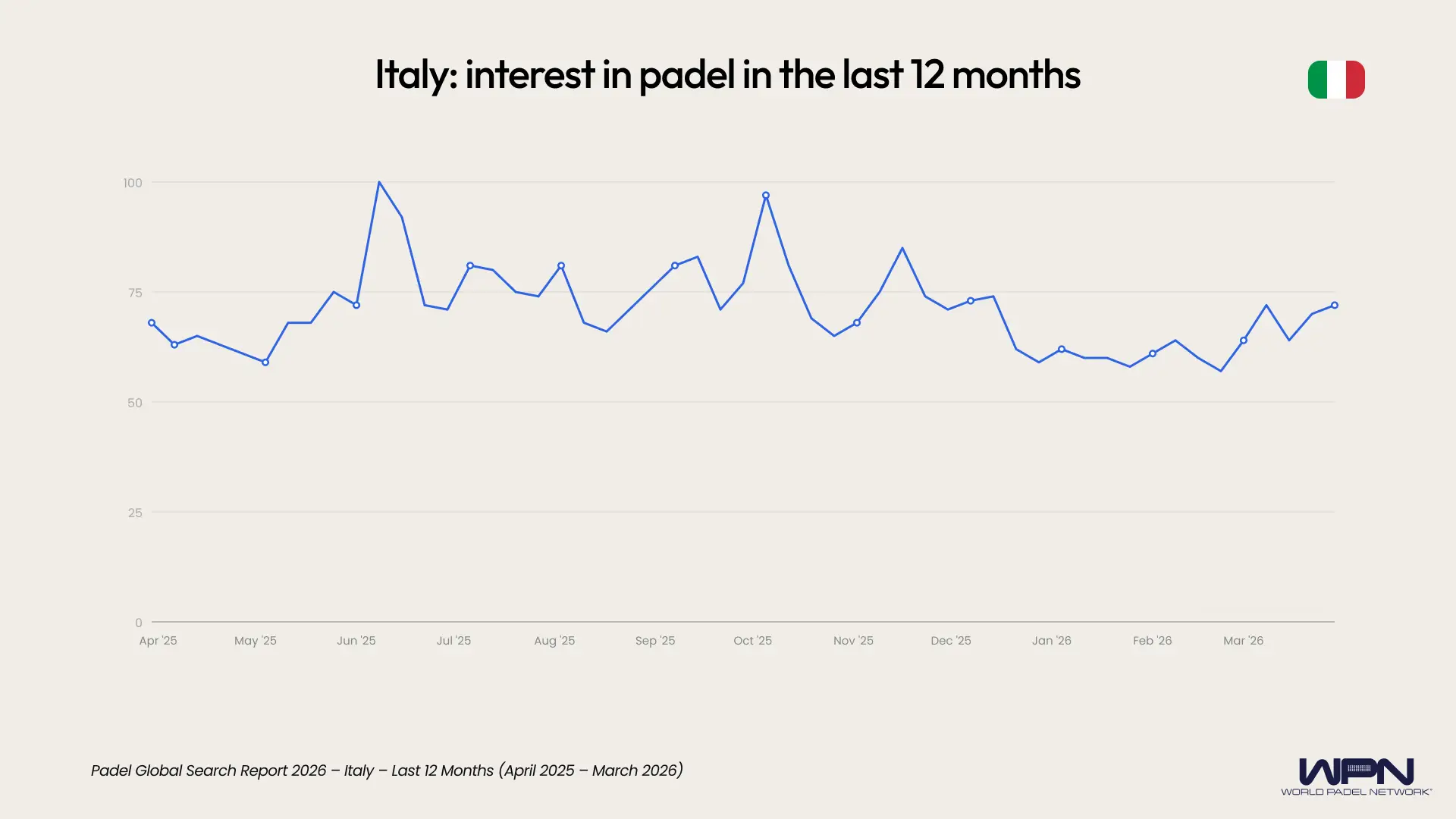
Italy scored 20/100 in the all-time regional data and 36/100 in the 12-month global comparison – figures that place it in the middle of the pack. But as with several other countries in this report, the domestic picture is significantly stronger than the global ranking suggests.
Within Italy, average search interest over the past 12 months was 70.9/100. This is a market with deep, sustained padel engagement.
Italy’s most distinctive feature is its summer-to-autumn strength. Search interest hit 100/100 in the week of 8 June 2025, with a secondary peak of 97/100 in early October. The June peak aligns with the start of the summer padel season; the October peak coincides with the autumn competitive restart.
The winter softening is more pronounced than in France or the UK, suggesting Italian padel interest is more weather-dependent. That said, March showed clear signs of recovery, climbing back to a monthly average of 68.4/100 with the final week reaching 72/100. The spring upturn appears to be underway.
Italy’s profile resembles Portugal’s – a mature, established padel market where the sport is already embedded in the culture.
Even at its lowest, Italy never fell below 57/100. The sport’s baseline is high, the seasonal rhythm is clear, and the summer-to-autumn strength points to a market where padel runs across most of the calendar year.
United Arab Emirates
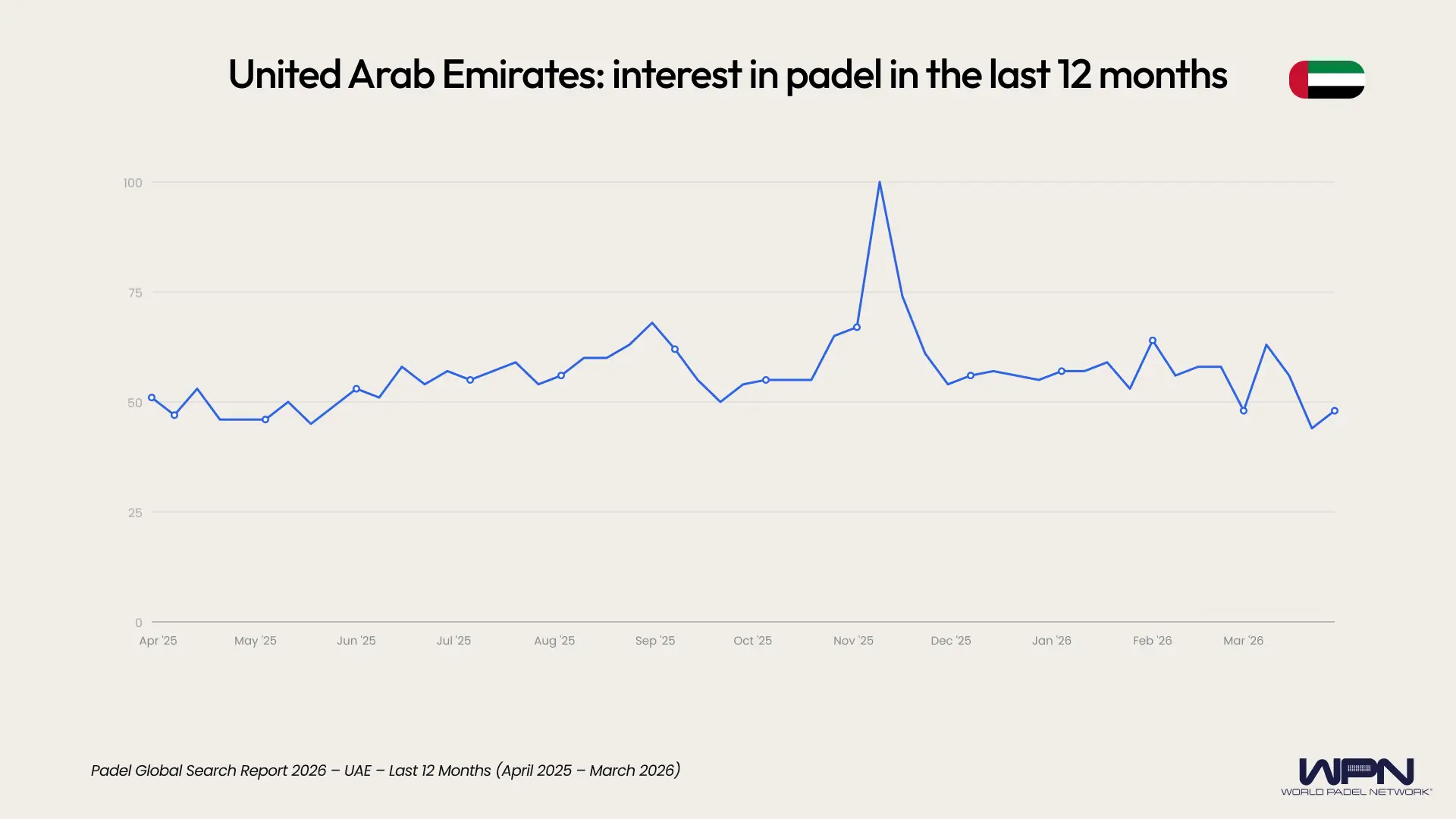
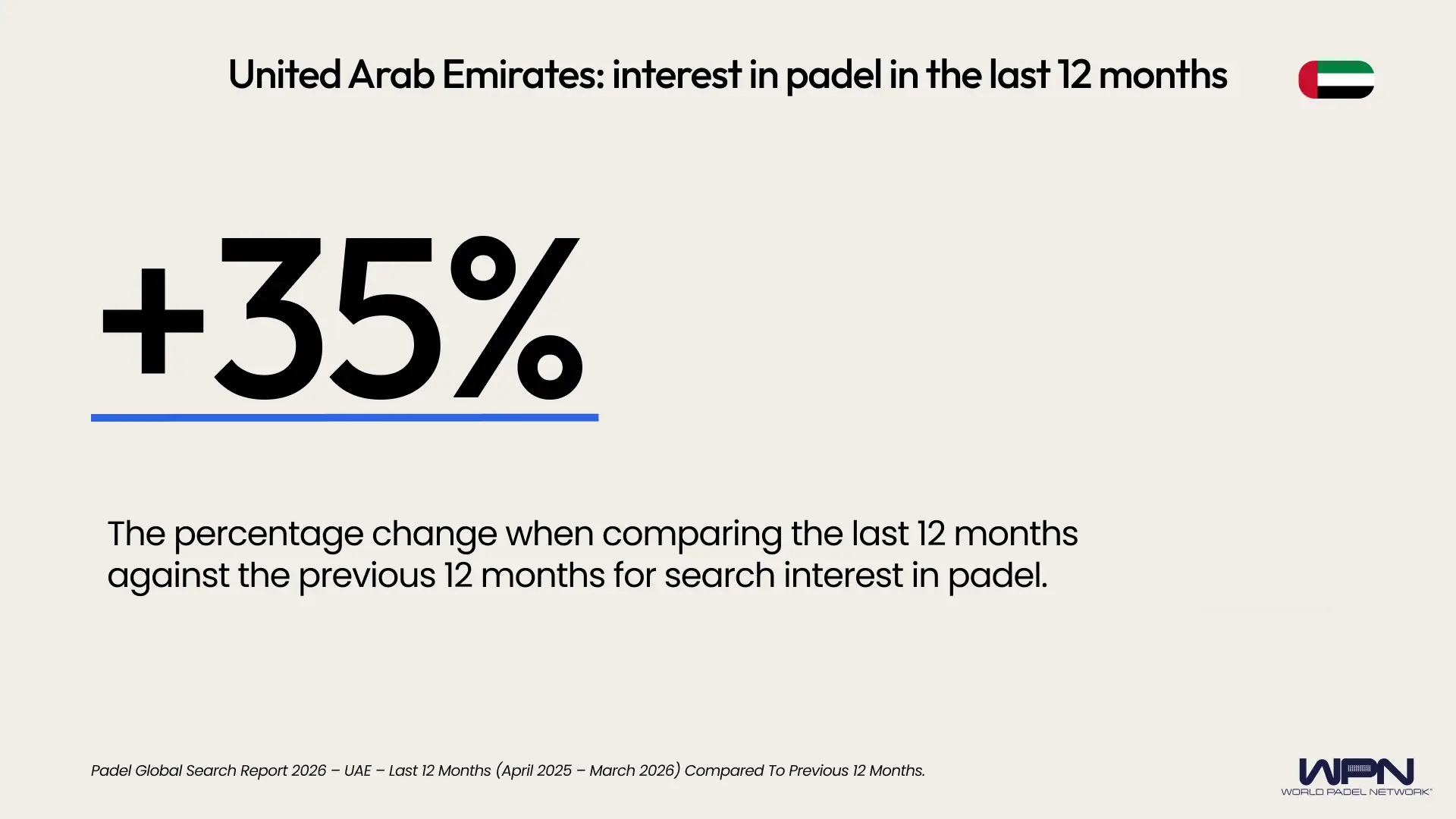
The UAE ranked 14th globally in the 12-month comparison at 36/100 and scored 12/100 in the all-time data. It is a market where padel has a clear presence – but the domestic search data tells a different story from the growth curves seen in the UK, US, or France.
The average for the year was 56.4/100. That is not a sign of weakness necessarily – it is the profile of a market where padel has an established, loyal audience but has not yet broken through to the broader mainstream.
The anomaly is impossible to miss. In the week of 9 November 2025, interest surged to 100/100 – the only reading above 77 in the entire dataset. The sharpness of the spike points to a specific event, almost certainly a major padel tournament or exhibition (likely the Dubai P1). Remove that single week and the underlying data is remarkably flat.
Outside the spike, weekly scores oscillated in a narrow band. There are no sustained climbs or dips, no clear seasonal surge, and no extended periods of elevated interest. The cooler months (November – February) averaged 61.3/100 compared to 57.0/100 for June – September, but the difference is modest. Given the UAE’s extreme summer heat, a sharper seasonal split might be expected – but padel in the UAE is overwhelmingly played indoors, which dampens the climate effect. The slight winter lift likely reflects the return of the expat population and the broader social and sporting season.
The picture that emerges is of a market where padel is established and stable rather than expanding rapidly. Growth here may be more about depth – frequency of play, spending, facility quality – than about breadth, with new players discovering the sport through search. For club operators and investors in the UAE, the data suggest a mature, consistent demand base rather than an untapped wave of new interest. It is, of course, worth noting the challenging situation in the Middle East that is ongoing at the time of writing this report.
Ukraine
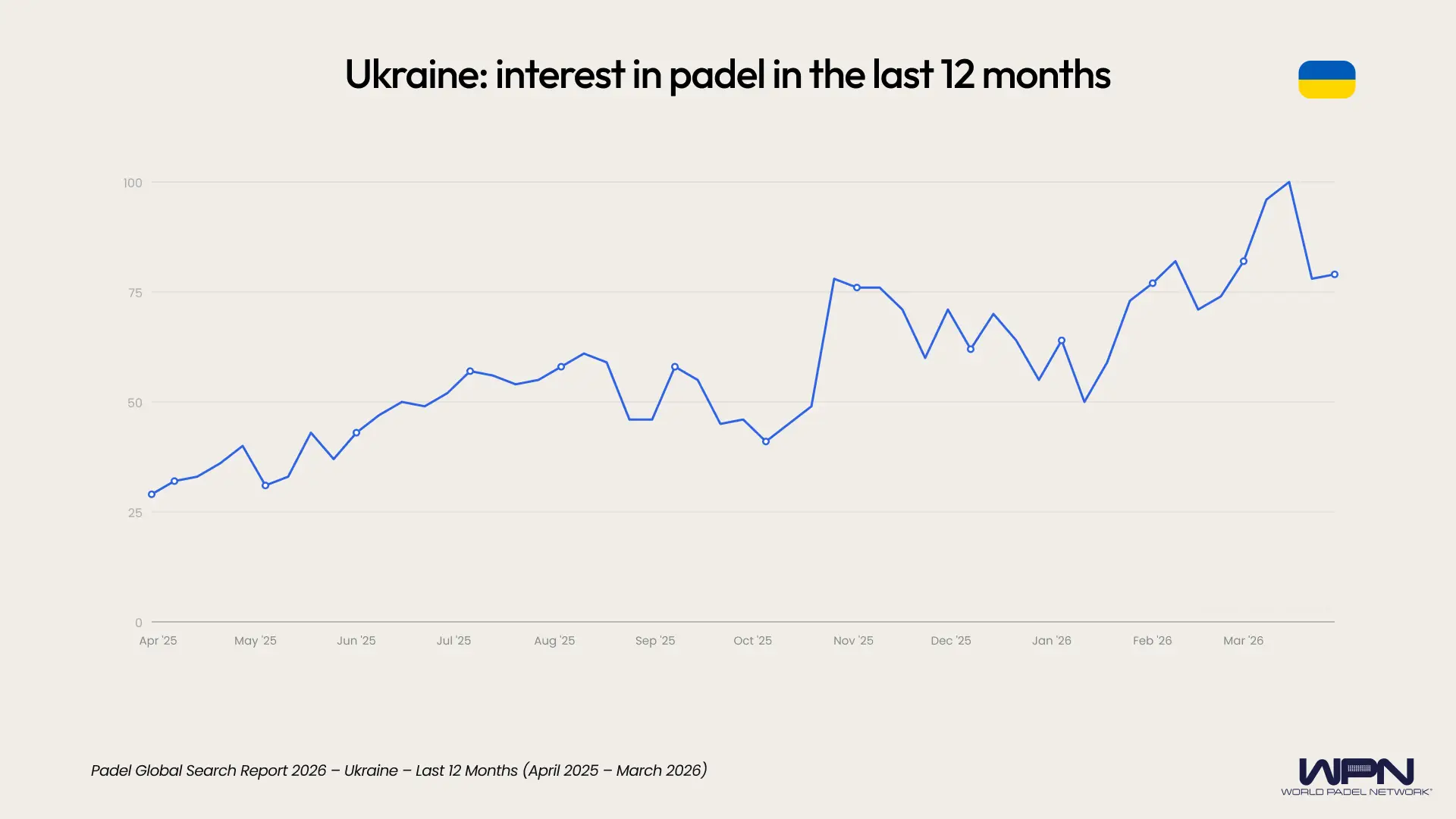
Ukraine scored just 7/100 in the all-time regional data – among the lowest of any country with measurable padel search interest. The last 12 months tell a dramatically different story though.
The trajectory is steep and sustained. Weekly scores opened at 29/100 in late March 2025, climbed gradually through the spring and summer, then stepped up sharply in late October – jumping from 49/100 to 78/100 in the space of two weeks. From that point onwards, interest continued climbing through the winter and into spring 2026.
The peak came in the week of 15 March 2026 at 100/100. Where other markets peaked in late summer or autumn 2025 and then settled, Ukraine is still accelerating.
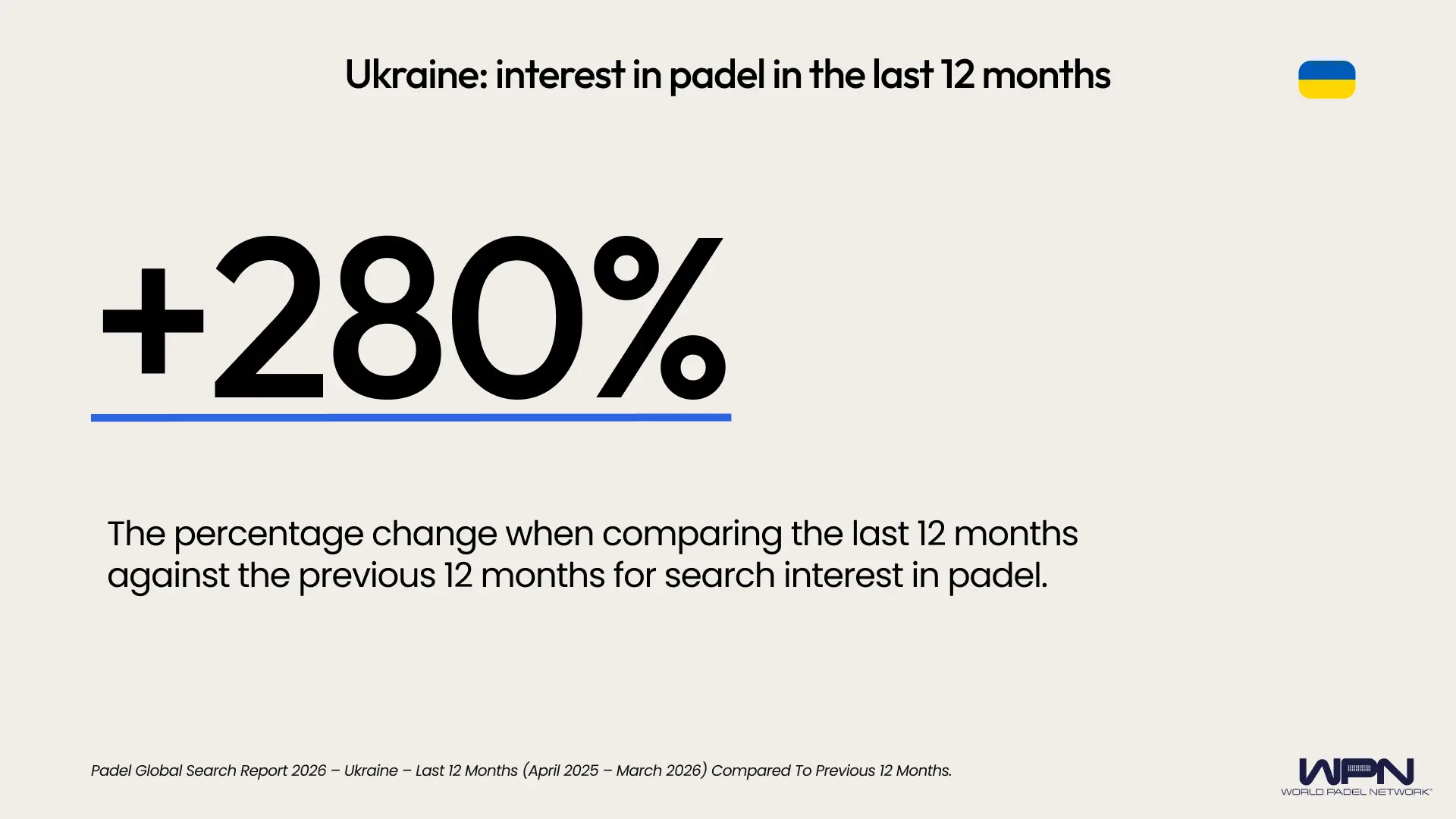
The huge growth in the last 12 months compared to the previous 12 months (+280%) is telling.
Ukraine’s growth is all the more striking given the context in which it is occurring – at war, defending itself from Russia. That padel search interest is surging in a country navigating the extreme challenges it currently faces suggests genuine, organic demand – not a market being driven by hype or heavy investment. This is a country discovering the sport, and the search data suggest that discovery is happening fast.
Ireland
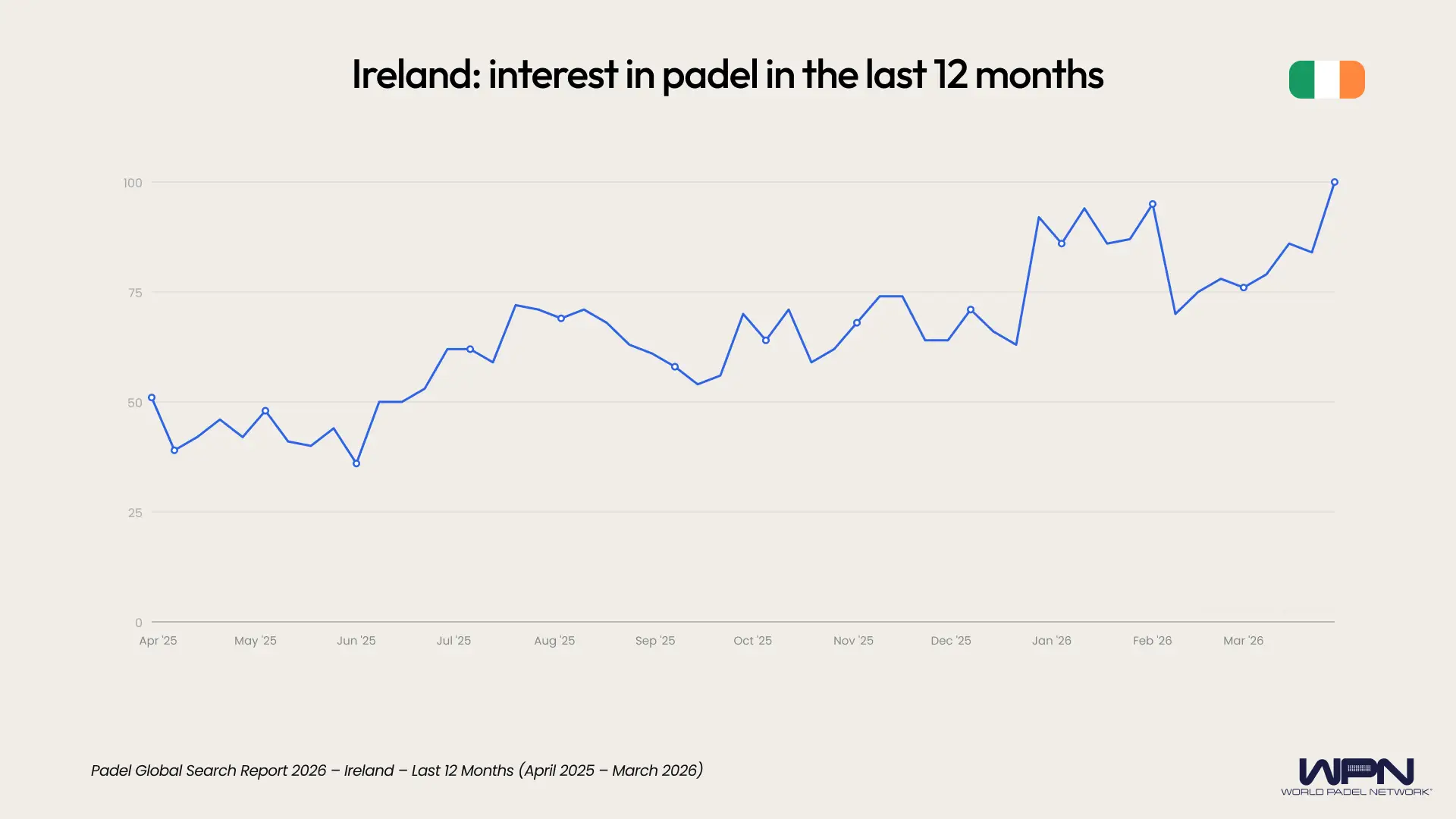
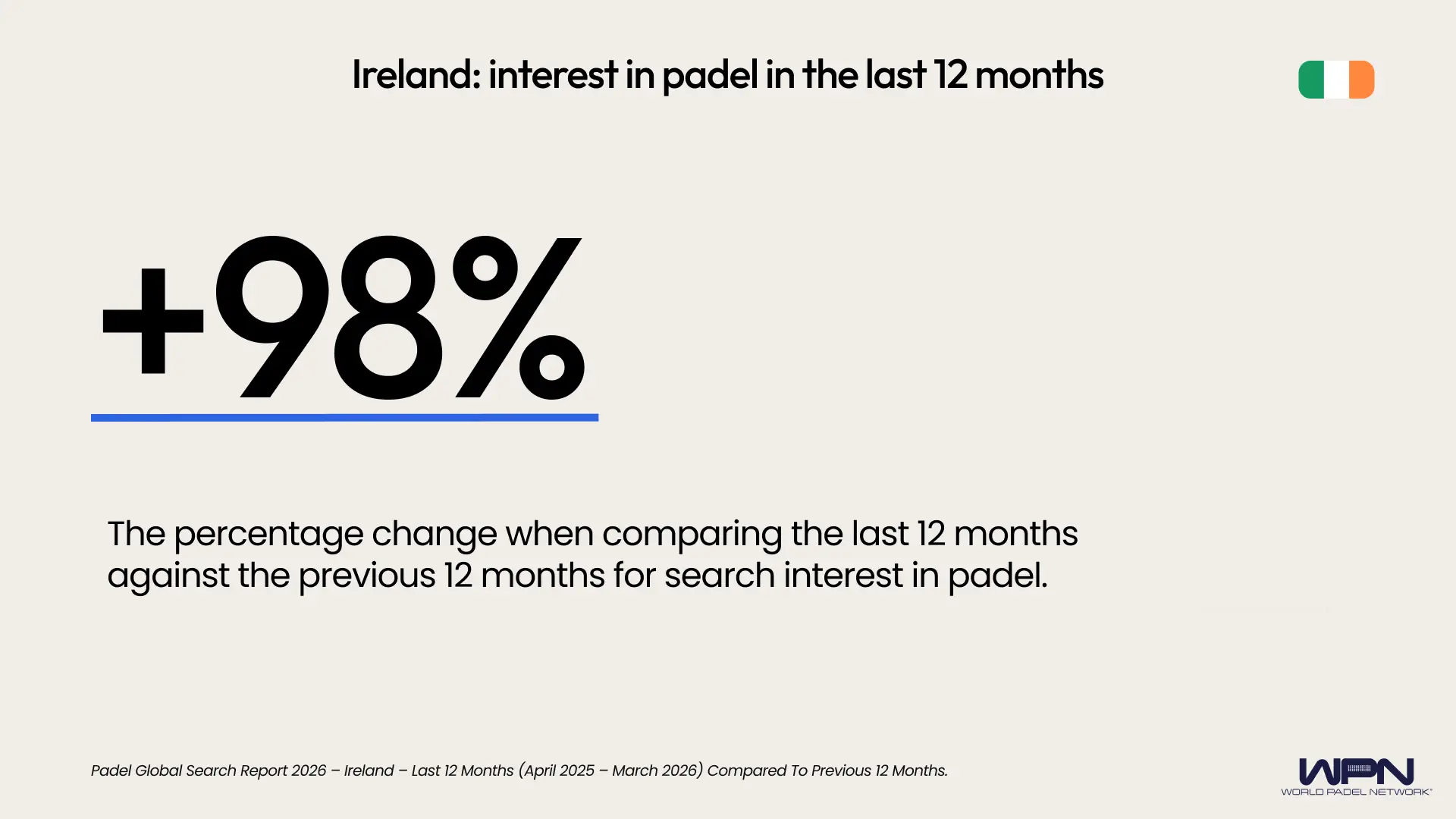
Ireland scored just 4/100 in the all-time regional data and 25/100 in the 12-month global comparison. Like the UK, it spent most of the past two decades as a blank spot on the padel map. And like the UK, the last 12 months suggest that is changing fast.
The trajectory follows a clear upward arc. April and May 2025 averaged in the mid-40s. By July and August, weekly scores had climbed into the 60s and low 70s.
The seasonal pattern mirrors the UK closely. There was no December dip. Interest accelerated over Christmas and peaked in the winter months. This points to the same dynamics at play: New Year fitness resolutions and the appeal of padel as an indoor sport during the darker and colder months.
Ireland and the UK appear to be on parallel trajectories – both emerging markets with seasonal patterns, both still accelerating at the close of the dataset. For a market that barely registered in padel search data two years ago, Ireland’s Q1 2026 readings suggest a sport that is gaining serious traction.
Australia
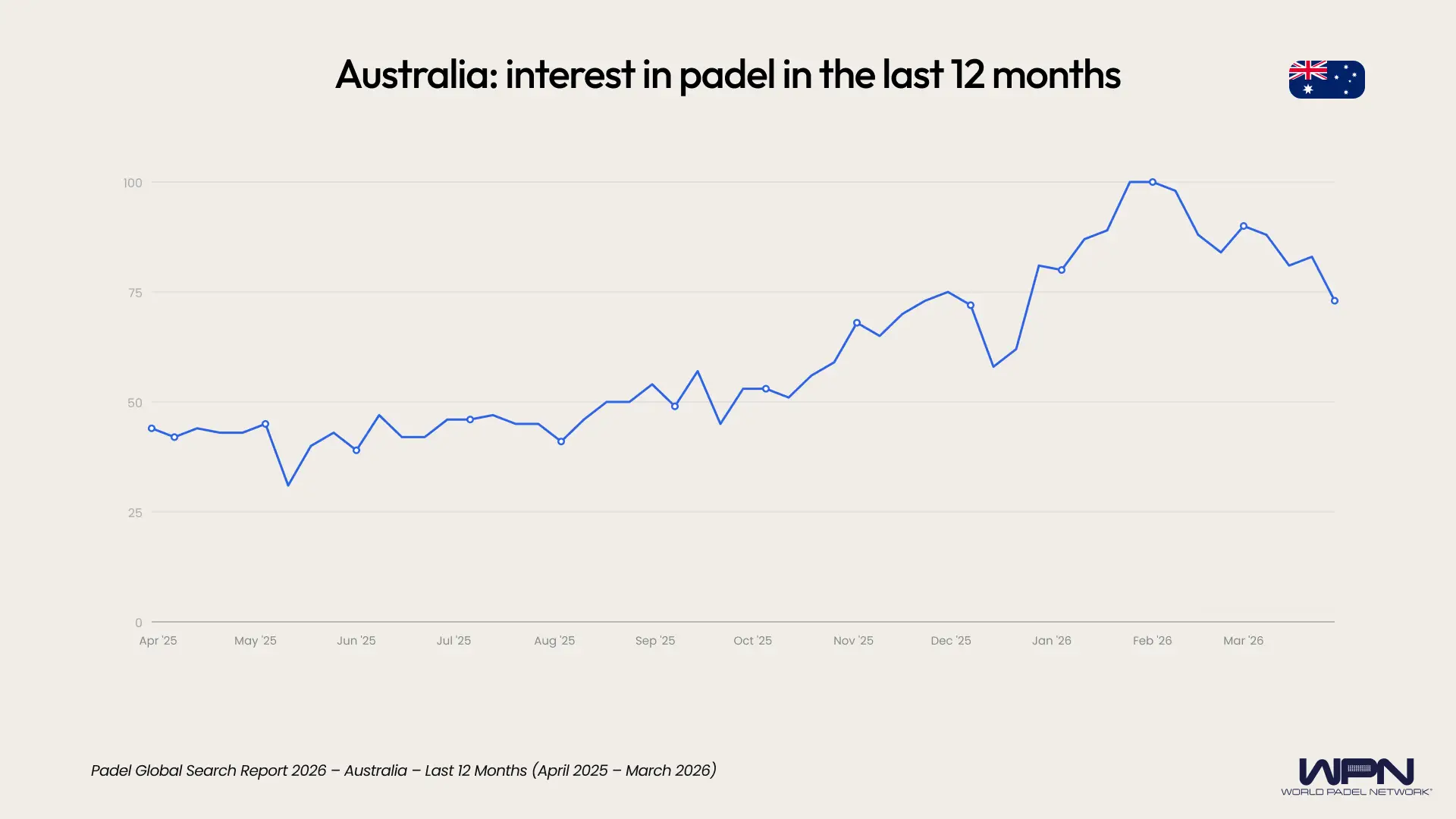
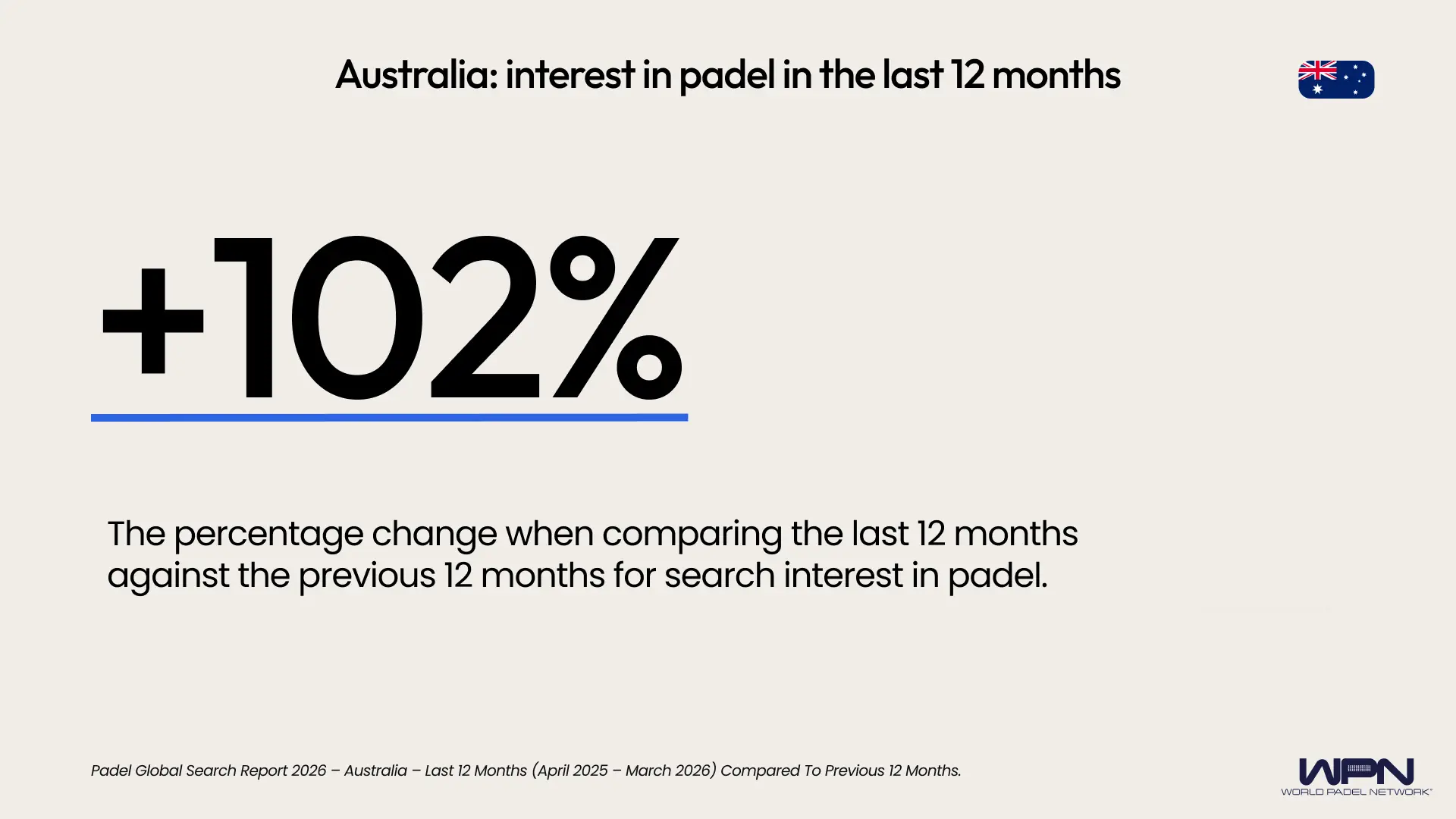
Australia scored just 7/100 in the all-time regional data – one of the lowest readings of any country examined in this report. Over the past 12 months, it has undergone one of the sharpest transformations in the dataset.
The year began quietly. April through June 2025 averaged around 42/100, with weekly scores fluctuating in a narrow band between 31 and 47. Through July to October, interest drifted upward into the low-to-mid 50s – gradual, steady, unremarkable. Then November arrived and the picture changed. Weekly scores jumped from 60/100 to the high 60s and low 70s, and kept climbing. By January 2026, interest had reached the 90s, peaking at 100/100 in the week of 25 January.
That January peak is significant because of what it reveals about the dynamics driving padel interest in Australia. In every European market in this report, the seasonal peak falls between August and October – the start of autumn and the return to indoor sport. Australia’s seasons are inverted. January is the middle of summer. The peak aligns with warmer weather, longer days, outdoor activity, and the New Year period – a combination that appears to be fuelling discovery of the sport in much the same way that autumn does in Europe, just six months offset.
The strength of January and February is striking. Q1 2026 averaged approximately 88/100 – on par with the UK’s strongest quarter and well above most European markets at the same point. Even as March brought scores back into the 70s and 80s as autumn approached, the final week (73/100) remains well above anything recorded in the first half of the year.
Australia shows clear padel interest growth. Its seasonal pattern – peaking in the Australian summer rather than the European autumn – suggests a market developing on its own terms rather than simply mirroring European trends. The late March cooling may indicate a seasonal dip heading into winter, making the next 12 months particularly interesting to watch.
The Netherlands
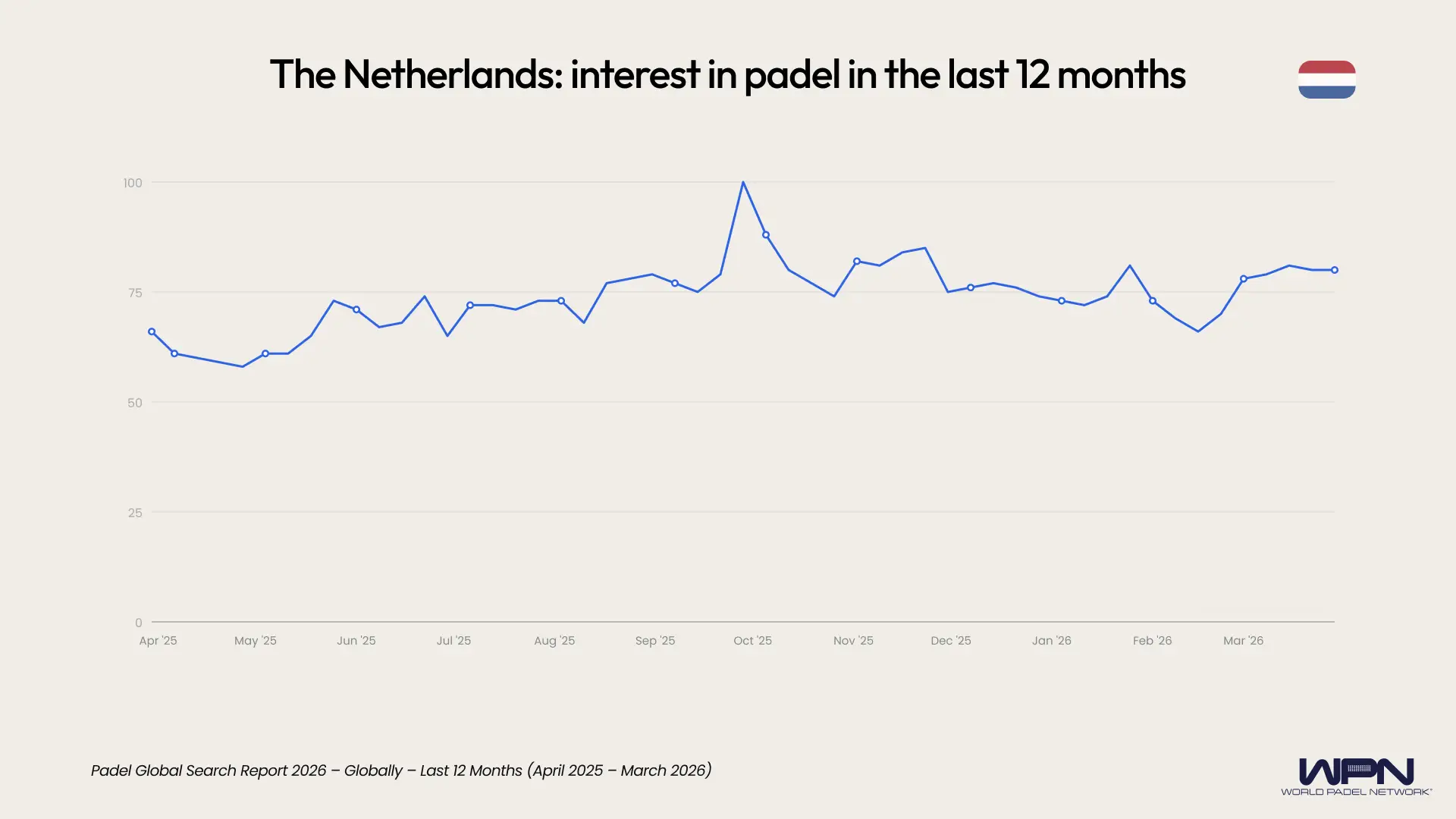
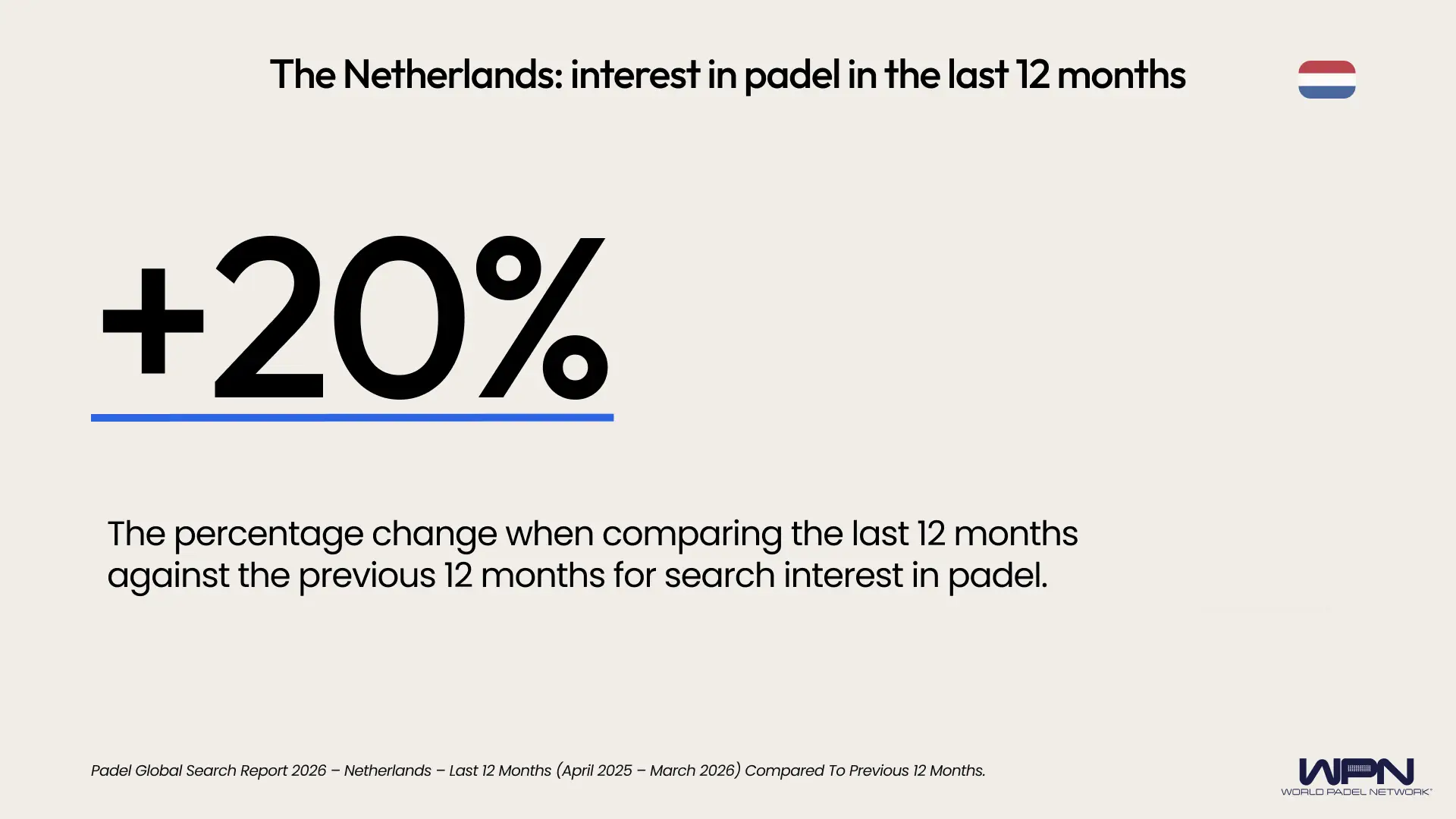
The Netherlands recorded one of the most dramatic moves in the global rankings. But the domestic search data tells a calmer story than the ranking shift might suggest.
Outside of a single spike, weekly scores oscillated in a band of 58 – 88/100 across the full 12 months, with no sustained surges and no sharp declines. This is not a market in the middle of a dramatic breakout – it is one that has already broken out and settled into a steady rhythm.
The spike came in the week of 28 September 2025, when interest hit 100/100 – jumping from 67/100 the previous week and dropping to 75/100 immediately after. The sharpness points to a specific event (likely the Rotterdam P1) rather than a seasonal shift. Remove that single week and the underlying trend is smooth and stable.
Seasonal variation is mild. Autumn and early winter readings (November averaged around 81/100) sit above the spring figures (April averaged around 60/100 and May around 65/100), but the difference is modest. There was no meaningful December dip – scores held in the mid-70s through the holiday period and into January. Padel search interest in the Netherlands runs year-round with little interruption.
The Netherlands’ profile resembles France’s – a market where padel has moved past the discovery phase and become embedded. The growth that matters here may no longer show up as a rising search line, but as increasing depth: more clubs, more regular players, higher engagement.
Denmark
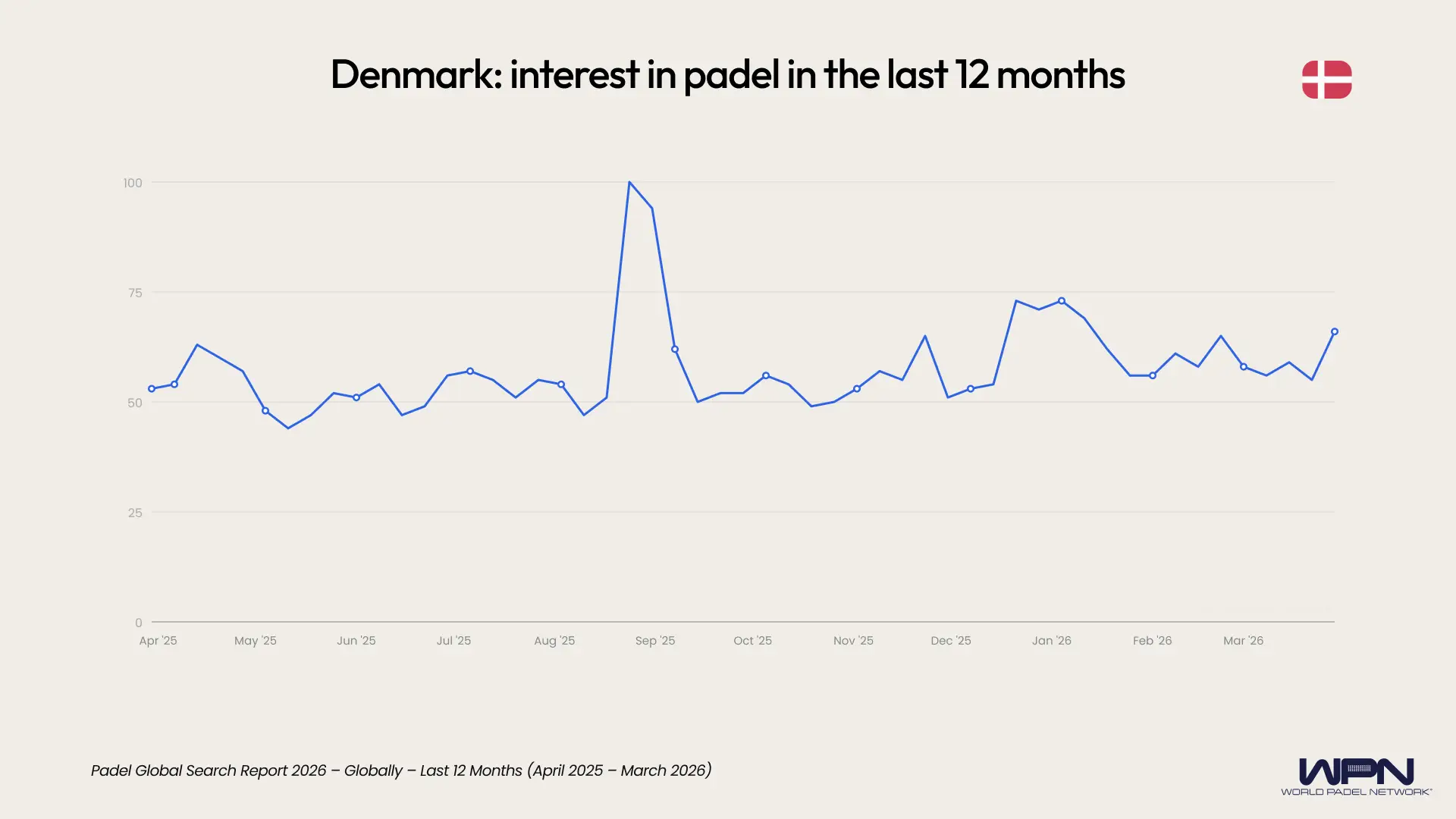
Denmark sits 4th in the 12-month global comparison at 64/100. It is one of the Scandinavian markets where padel took hold early, and the global ranking reflects that established presence. But the domestic search data over the past year paints a picture of a market that has levelled off rather than one still climbing.
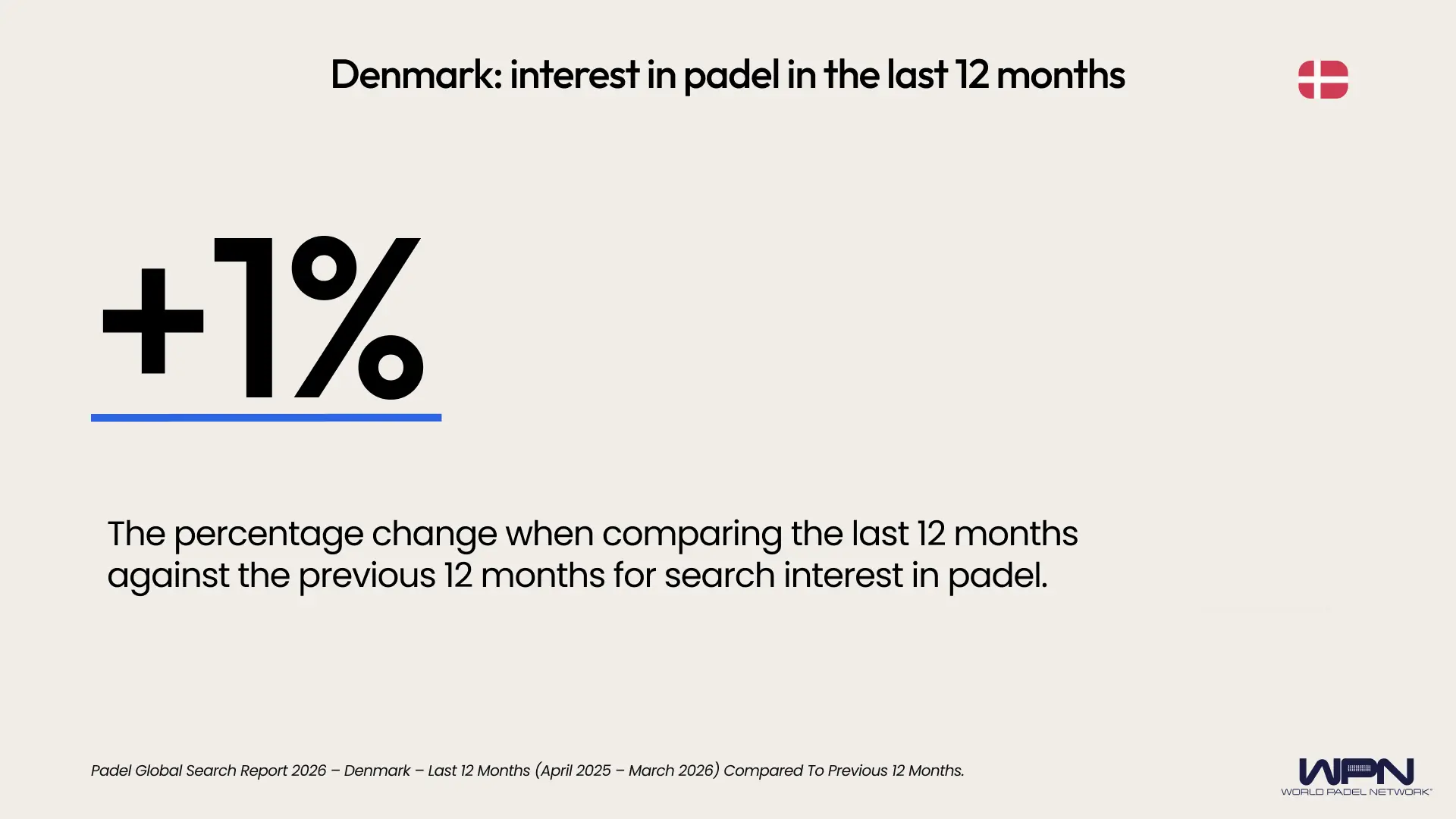
The average for the year was 57.5/100. For most of the 12-month period, weekly scores moved in a narrow band of 44 – 66/100, with no sustained upward or downward trend. The trend is flat, with an increase in search interest of just 1% when comparing the last 12 months against the previous 12 months.
The peak came in late August 2025, when interest surged to 100/100 in the week of 24 August, followed by 94/100 the following week. By mid-September, scores had dropped back to the low 50s. The two-week spike has the hallmarks of a specific event. Remove those two weeks and the underlying data are still flat.
One feature worth noting is a modest winter lift. December and early January produced a cluster of higher readings before interest settled back into the mid-to-high 50s through February and March. This echoes the winter-peaking pattern seen in the UK and Ireland, though the effect is much milder. Denmark’s climate makes indoor sport an obvious draw during the darker months, and this may be registering as a slight seasonal bump.
Denmark’s profile sits between the established maturity of Spain and Italy and the flat stability of the UAE. The sport is clearly embedded – a 64/100 global ranking confirms that – but the domestic data suggest padel awareness in Denmark has levelled off, at least for now. As with the Netherlands, the next phase of growth may be less about new people discovering the sport and more about deepening engagement among those already playing.
Argentina
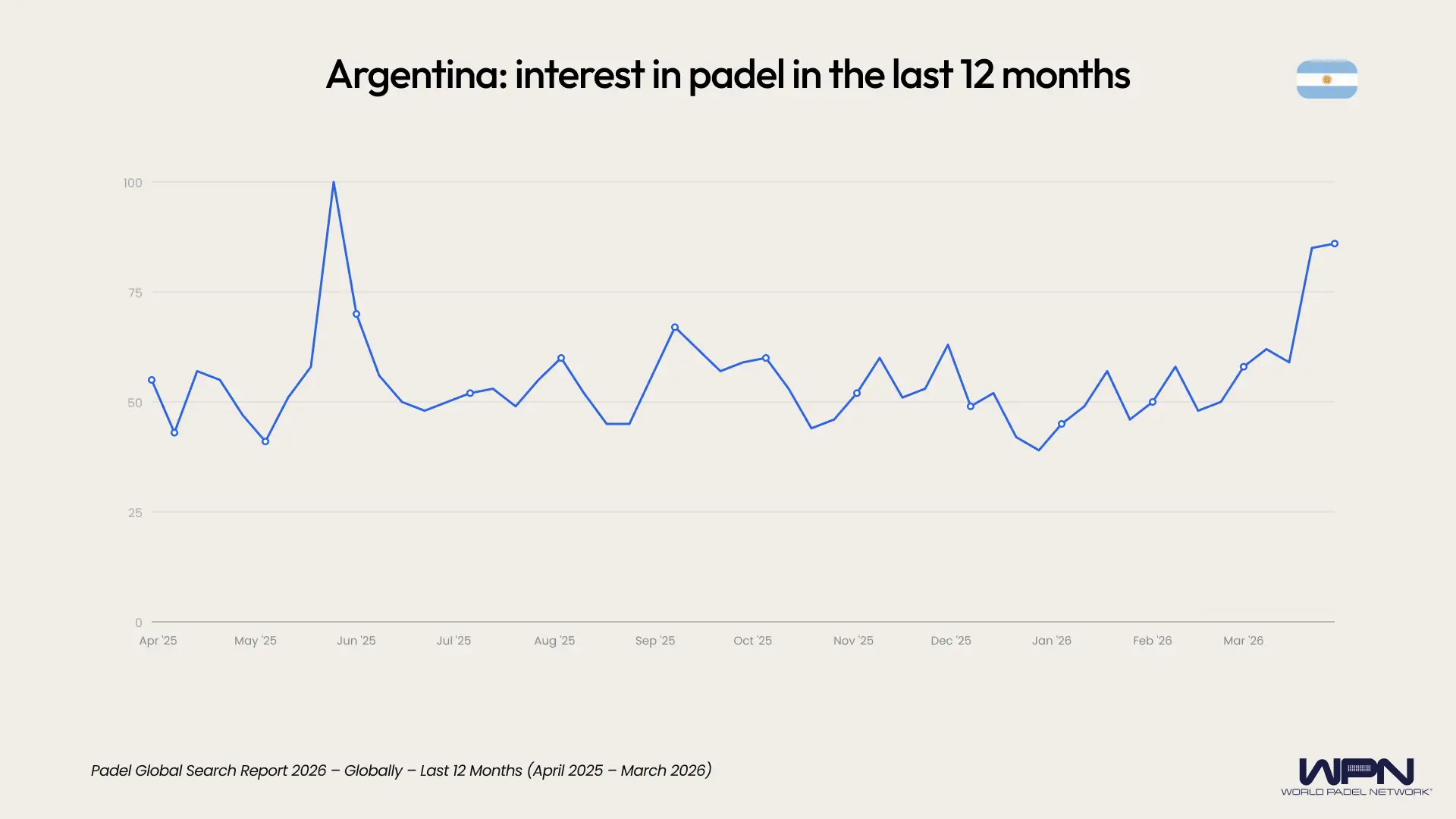
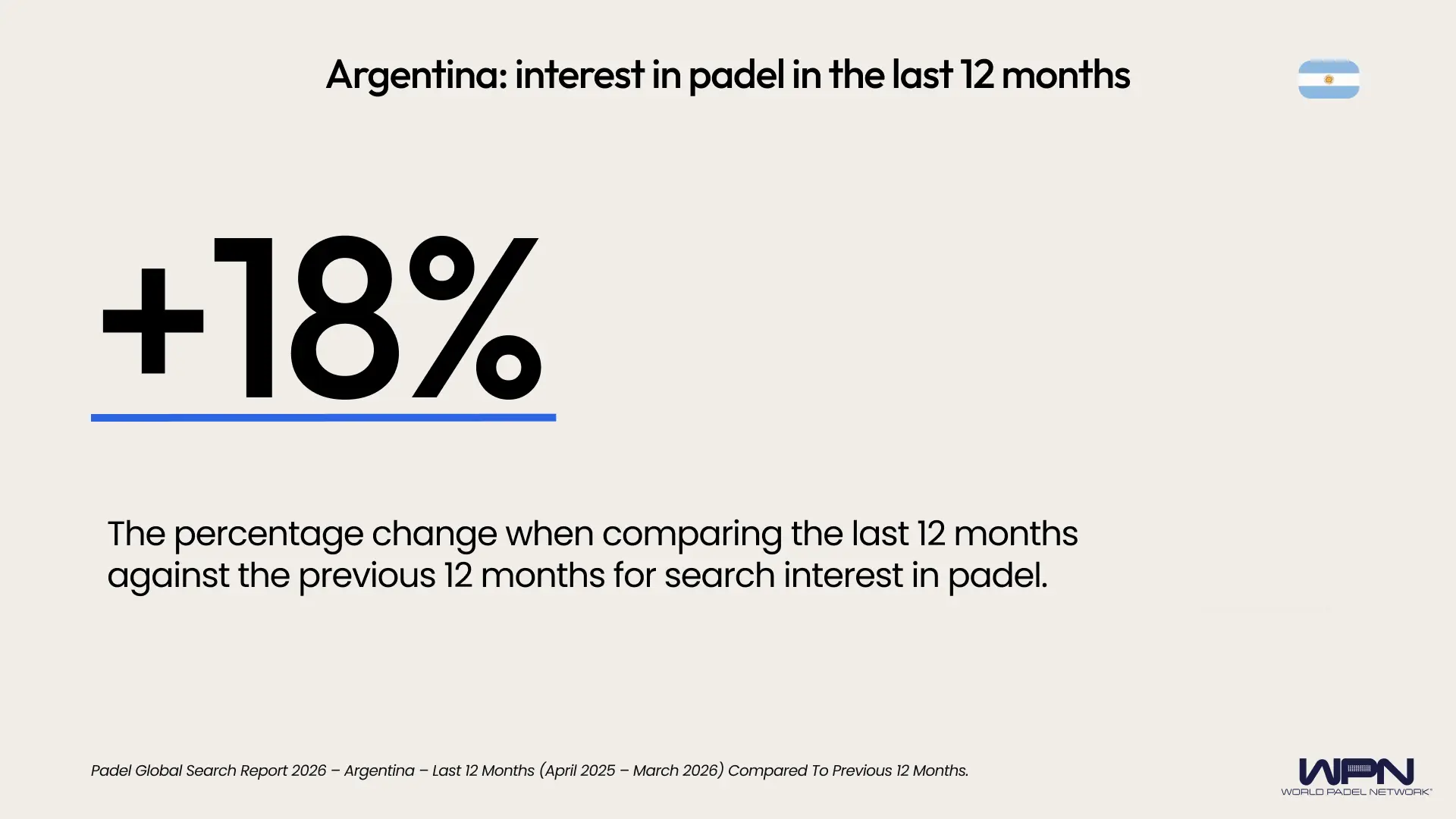
Argentina is one of padel’s two founding markets alongside Spain. Padel has been part of the country’s sporting culture for decades, and it ranks 3rd in the all-time global comparison at 32/100, rising to 65/100 over the last 12 months. But the domestic search data presents a picture that may surprise readers expecting a Spain-like profile (see above).
The average for the year was 55.2/100 – a relatively low domestic average for a traditional padel market. That likely says less about the health of padel in Argentina than it does about the nature of search behaviour in an established market. When a sport has been embedded in a country’s culture for decades, fewer people need to search for it – they already know where to play. Much of the search data here may reflect discovery and curiosity, which in Argentina’s case may have peaked long before Google Trends data even became available (2004).
The data are volatile. Weekly scores ranged from 40 to 100/100 – a 60-point band. The peak came in the week of 25 May 2025 at 100/100, a sharp isolated spike that jumped from the mid-50s the previous week and dropped back to 70/100 immediately after. This almost certainly corresponds to a major padel event (probably the Buenos Aires P1).
Argentina’s seasonal pattern reflects its Southern Hemisphere calendar. December and January – the middle of summer – produced the lowest readings of the year, with December averaging just 46/100 and the deepest trough hitting 40/100 in the final week of the year. This is the most pronounced seasonal dip of any country in the report, suggesting that despite padel’s indoor availability, the Argentine summer and holiday period draws attention elsewhere.
The most striking feature is at the end of the dataset. The final two weeks of March 2026 surged to 90 and 81/100 – the highest non-spike readings of the entire year, and dramatically above the surrounding months. March marks the start of autumn in Argentina, which is the seasonal equivalent of September in European markets. If this uptick holds, it would suggest Argentina is entering its peak padel season with significantly more search interest than the same period a year ago.
The next few months will reveal whether those closing readings represent a new level or a short-lived spike for this long-established market.
Belgium
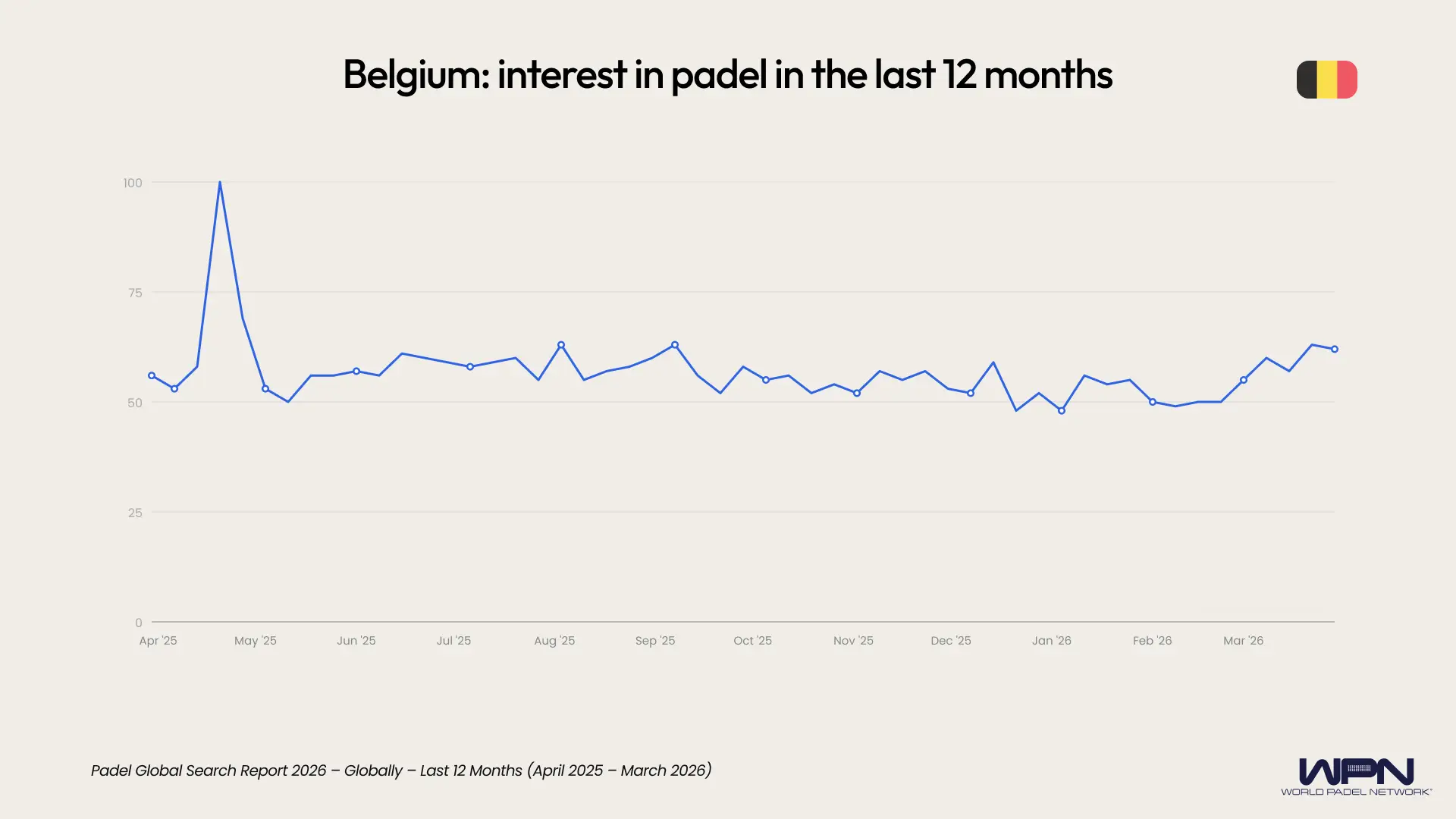
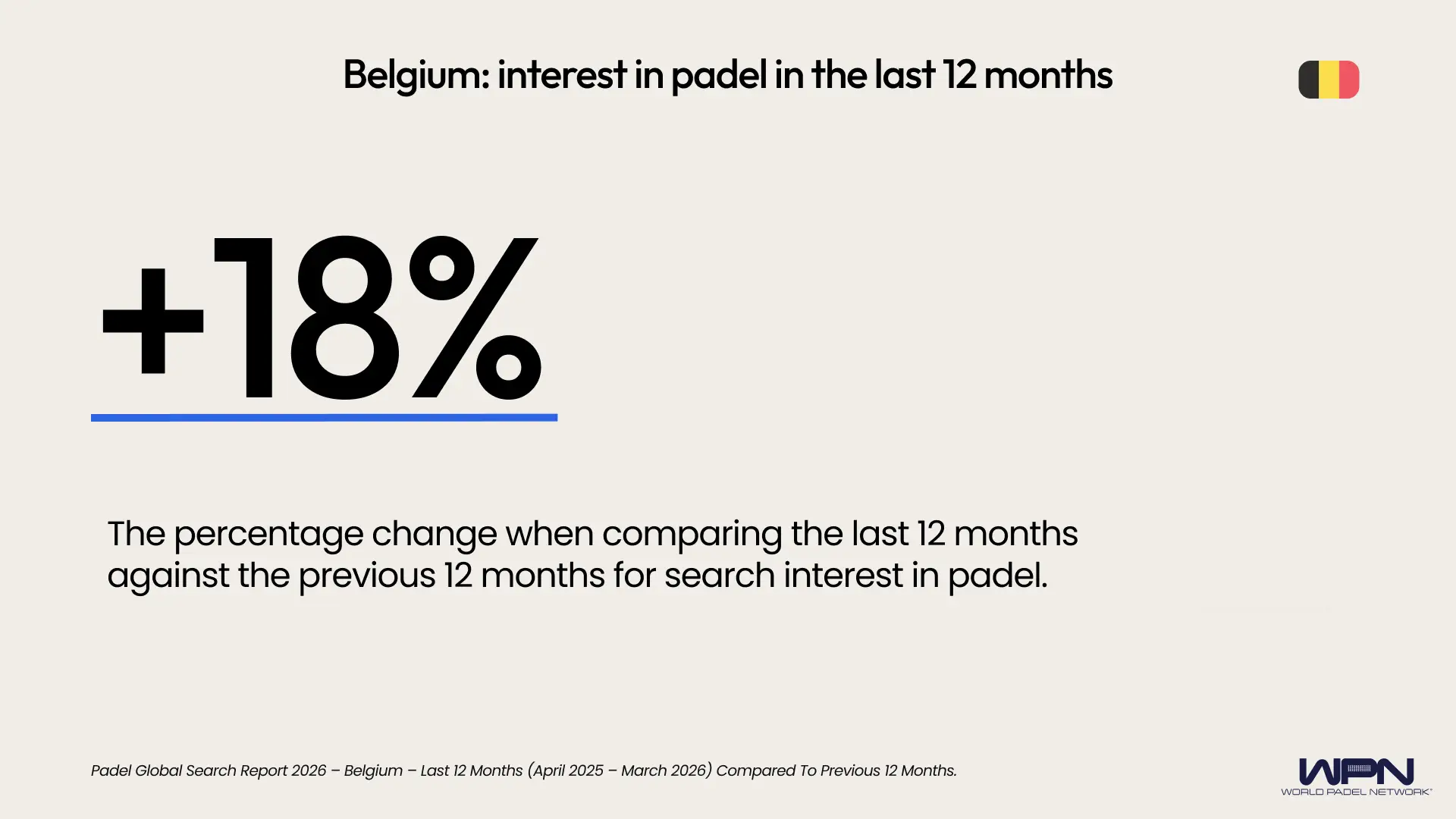
Belgium was one of the biggest movers in the global rankings, coming in at 6th globally. But as with the Netherlands and Denmark, the domestic data tell a story of consolidation rather than continued acceleration.
The average for the year was 56.8/100. Outside of one isolated spike, weekly scores moved in a remarkably tight band of 48 – 69/100, with the vast majority of weeks landing between 50 and 60.
The spike came in the week of 20 April 2025, when interest hit 100/100 – jumping from 58/100 the previous week and dropping to 69/100 the week after, before settling back to the mid-50s. The sharpness points to a specific event (probably the Brussels P2). Remove that single week and the data are level.
There is no clear seasonal pattern. Autumn, winter, and summer all produced similar readings. There was no December dip, but there was no winter surge either – unlike the UK and Ireland, Belgium showed no sign of padel interest accelerating over the colder months. February 2026 was the quietest stretch, with four consecutive weeks averaging 50/100.
A mild uptick in March 2026 could signal the start of a spring lift, but it is too early to call a trend from four weeks of data.
Belgium’s profile sits alongside the Netherlands and Denmark as a Northern European market where padel’s big breakthrough has already happened. The sport has a stable, consistent audience generating steady search demand, but the growth curve that drove the global ranking surge appears to have flattened.
Estonia
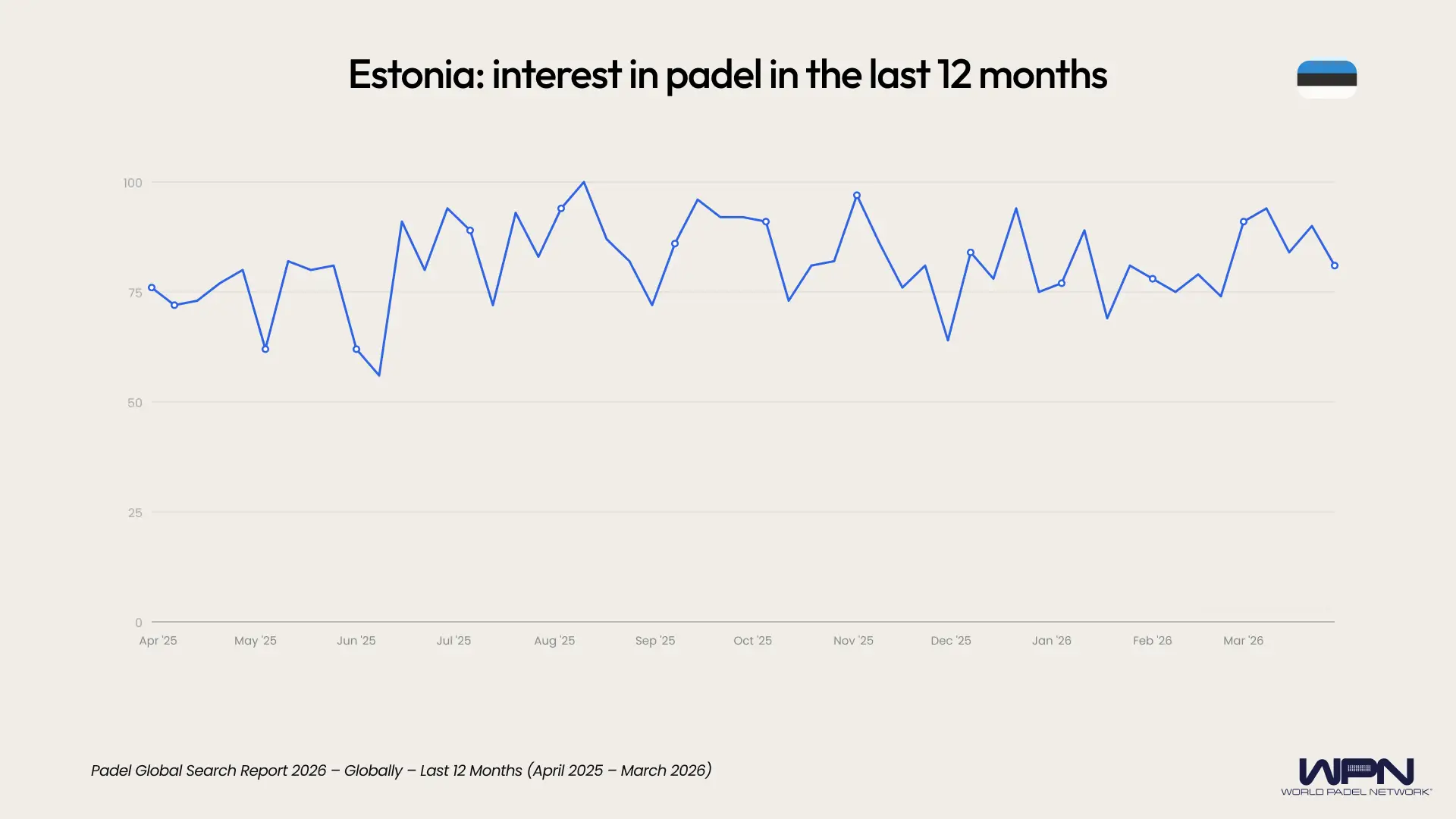
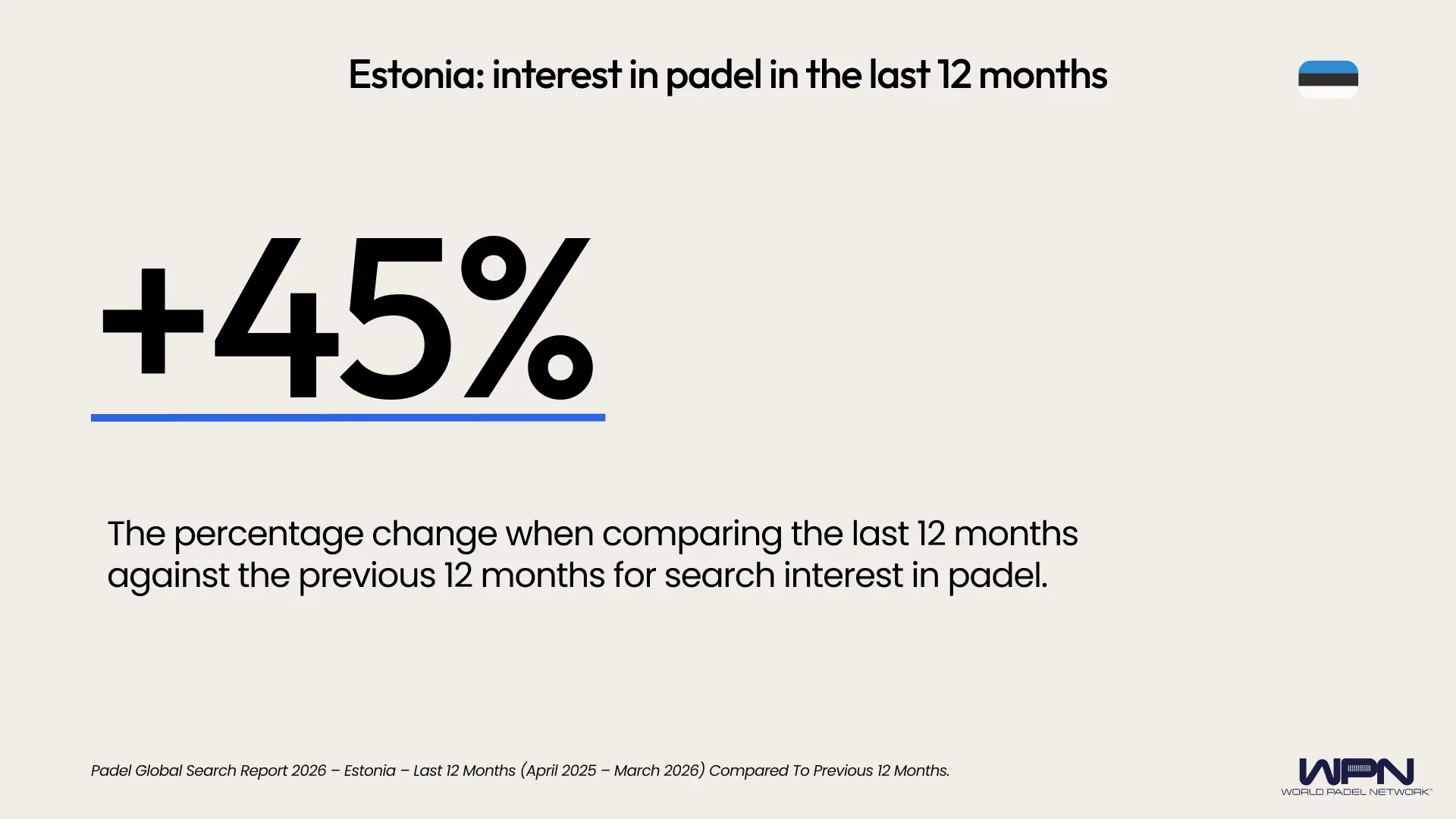
Estonia recorded a significant gain in the global rankings over the past 12 months and held a very high internal average.
At 81.7/100, Estonia’s average search interest over the past year sits above many other countries. For a country with a population of around 1.3 million, this level of sustained search intensity is exceptional. Even the lowest reading of the year, 56/100 in early June, is higher than the yearly average of most countries in this report.
The peak came in the week of 10 August 2025 at 100/100, but unlike many markets, Estonia’s data does not revolve around a single high point. Scores of 90 or above appeared in every month from June through December 2025, and again in March 2026 – scattered across the year rather than clustered around one season. September 2025 averaged 91.5/100. November opened at 97/100. December produced a week at 94/100. There is no clear seasonal pattern here – interest runs high year-round.
The data are volatile, with large week-to-week swings. A reading of 96/100 one week might be followed by 87/100 the next. This is characteristic of a small country, where relatively small absolute changes in search volume translate into noticeable index movements. The volatility does not undermine the overall picture – it simply means individual weeks should be read as part of the broader trend rather than as standalone signals.
Estonia is one of the smallest countries examined in this report. The question it raises for the industry is what is driving this level of search interest in a Baltic market of 1.3 million people – and whether neighbouring countries like Latvia and Lithuania might follow a similar path.
Cyprus
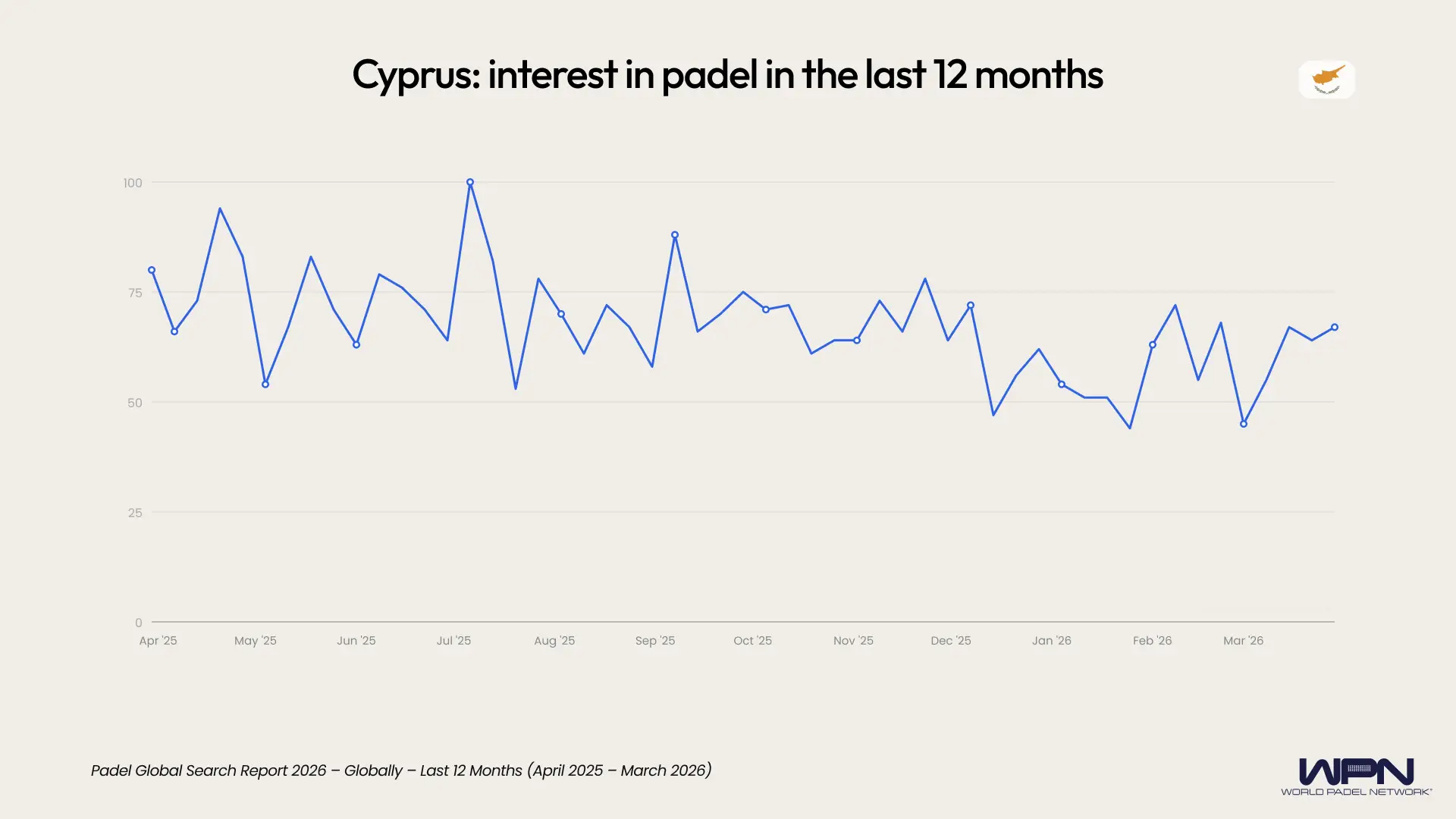
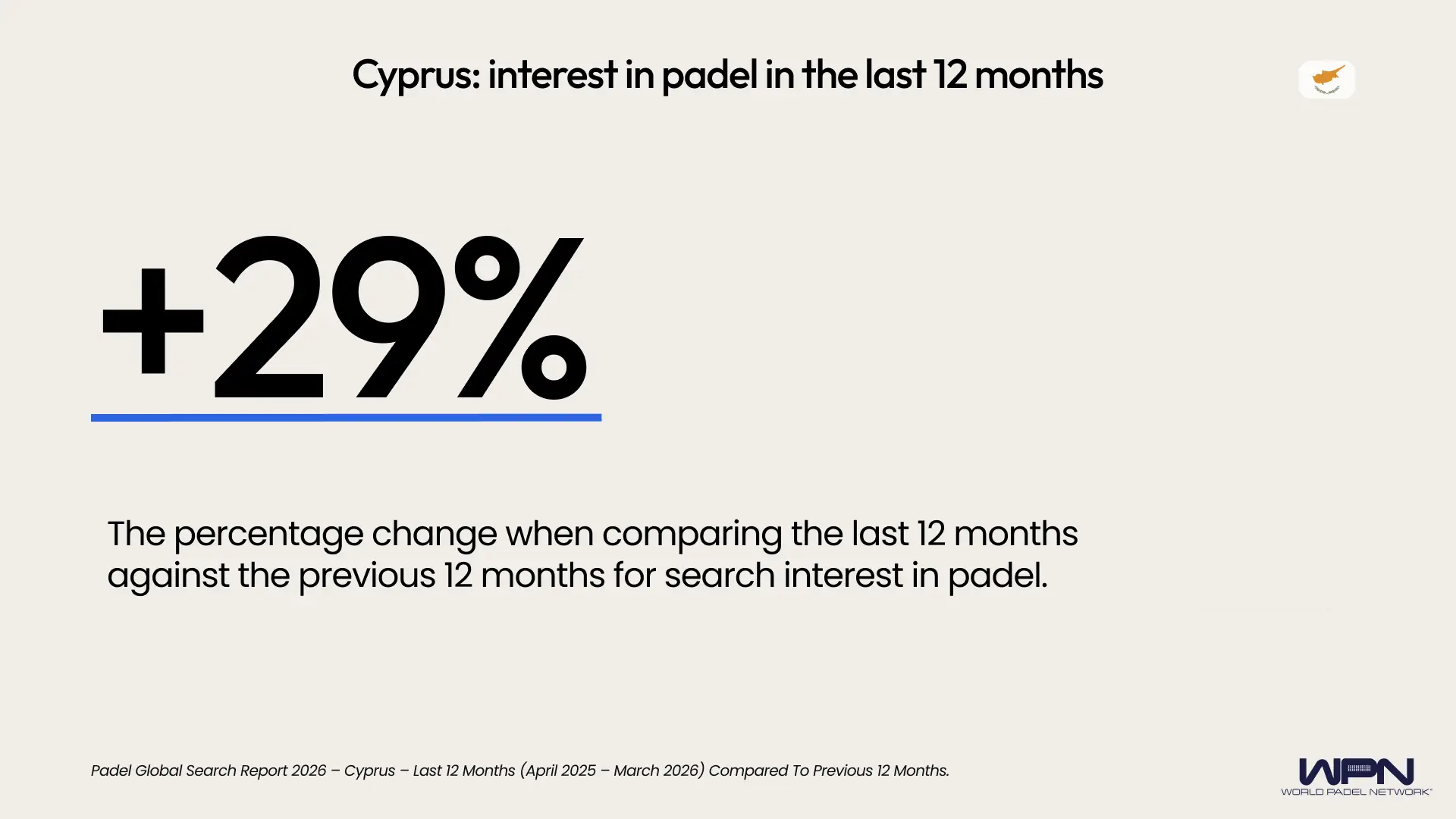
Cyprus is one of six countries to enter the global top 20 for the first time, scoring 52/100 in the 12-month comparison – the highest-ranked new entrant by some distance. It is also one of the most volatile datasets in this report.
The first half was strong. April 2025 opened with readings in the 60s to 90s. The peak of 100/100 came in early July. Across April to September, the monthly averages consistently sat in the high 60s to high 70s. This period coincides with Cyprus’s warmer months and peak tourism season – and in a country where a significant share of padel activity may be driven by visitors as well as residents, that connection is worth noting.
The second half tells a different story. From October onwards, interest drifted downward. Monthly averages dropped from the high 60s in October and November to the low 60s in December, then to 50/100 in January 2026 – the weakest month in the dataset. February and March recovered modestly into the mid-60s, but remained well below the levels seen in the first half.
The volatility – typical of a very small search base – is characteristic of Cyprus’s population of around 1.2 million, similar to Estonia. At that scale, small absolute changes in search activity produce large index swings. Individual weeks should be interpreted with caution.
What is clear is that padel has registered in Cyprus – its first appearance in the global top 20 confirms that. Whether the second-half decline reflects a seasonal pattern that will repeat annually, a tourism-driven first half that naturally fades, or an early-stage market finding its level, is a question the next 12 months will help answer.
Paraguay
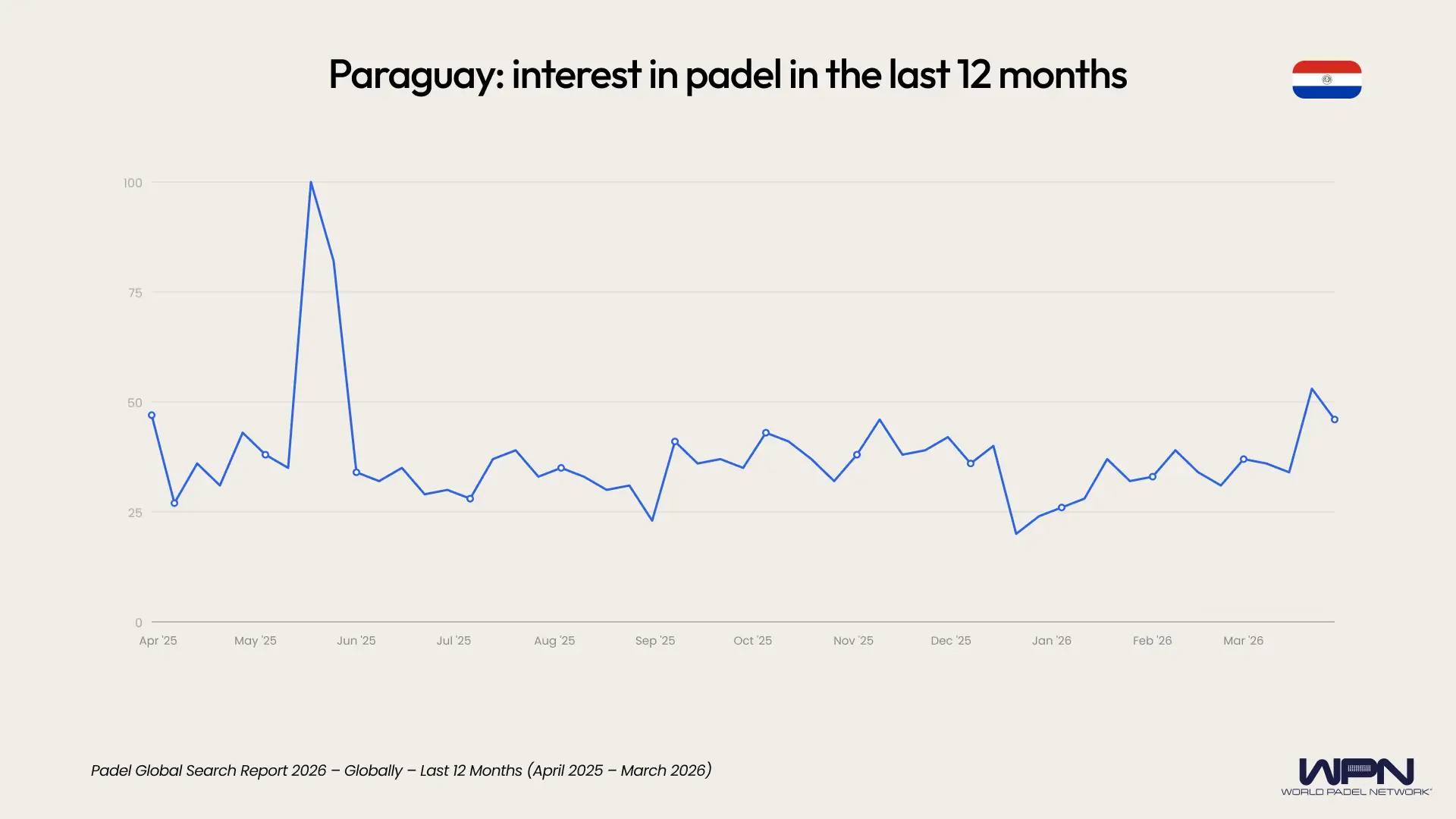
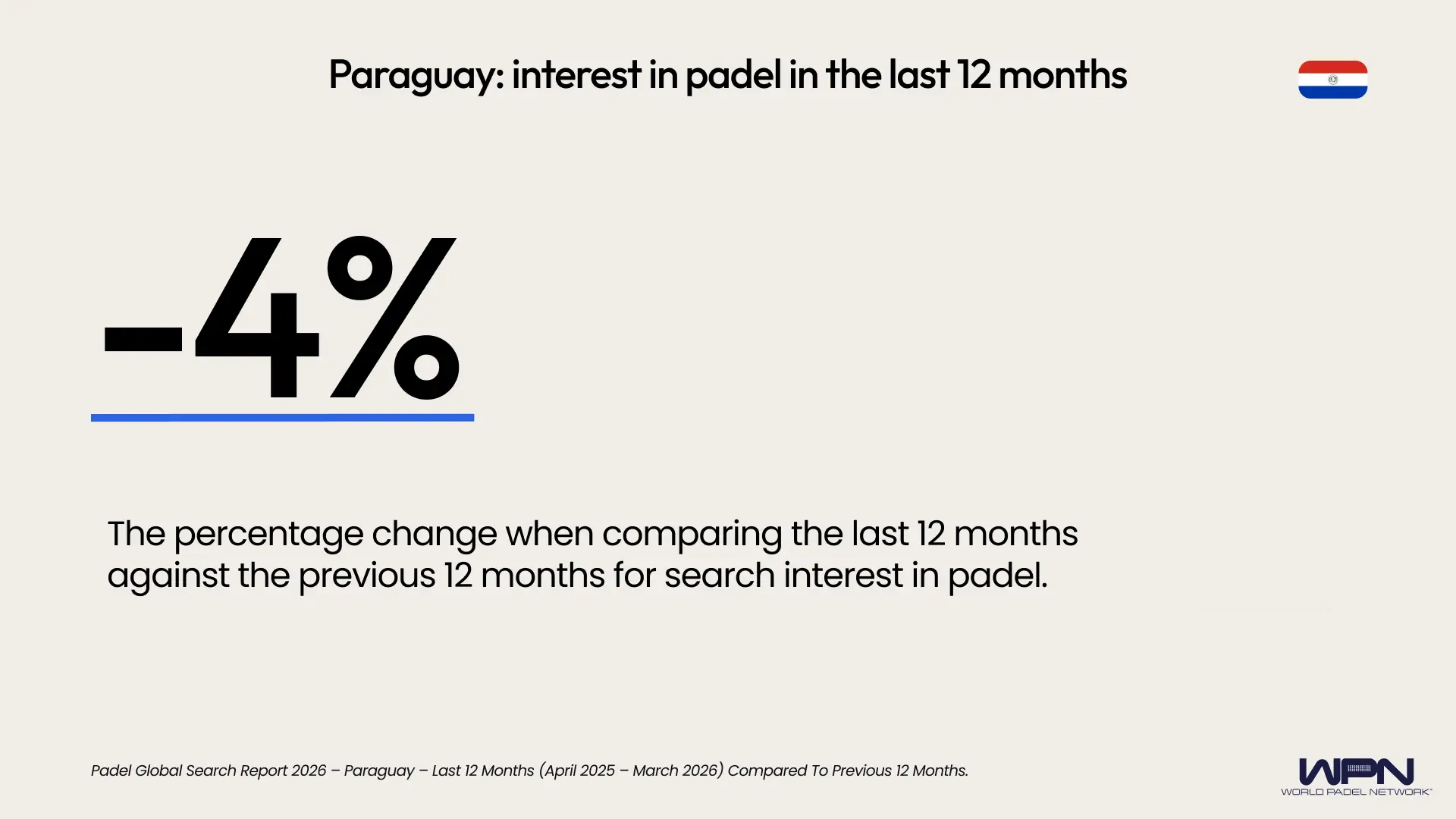
Like neighbouring Argentina, Paraguay is a country where padel has deep roots – and, like Argentina, the domestic search data runs lower than that heritage might suggest.
The average for the year was 37.3/100 – the lowest domestic average of any country examined in this report. Most weeks landed in a narrow band of 25 – 49/100, with little sustained movement in either direction. This is consistent with a market where padel is already well known and widely played, and where search activity reflects background-level awareness rather than the active discovery that drives higher readings in newer markets like the UK or Ireland.
The peak came in the week of 18 May 2025 at 100/100 – a sharp, isolated spike. The previous week scored 35/100; the following week dropped to 82/100 before returning to the 30s within a fortnight. This almost certainly corresponds to a major padel event – probably the Asunción P2. Remove that period and the overall trend is flat.
Paraguay’s seasonal pattern follows the Southern Hemisphere calendar. December and January – peak summer – produced the weakest readings of the year, with late December dropping to 20/100 and January averaging just 30.8/100. This mirrors what we saw in Argentina, though the dip is deeper relative to Paraguay’s lower baseline.
A modest uptick is visible in March 2026. This coincides with the start of autumn in Paraguay and could signal the beginning of a seasonal recovery, though the movement is small enough that a few more weeks of data would be needed to confirm.
Paraguay’s profile is one of stability. The sport is established, the audience is there, and the search data reflects a steady, low-intensity baseline rather than a growth story. For a market this mature, that is not a warning sign.
Indonesia
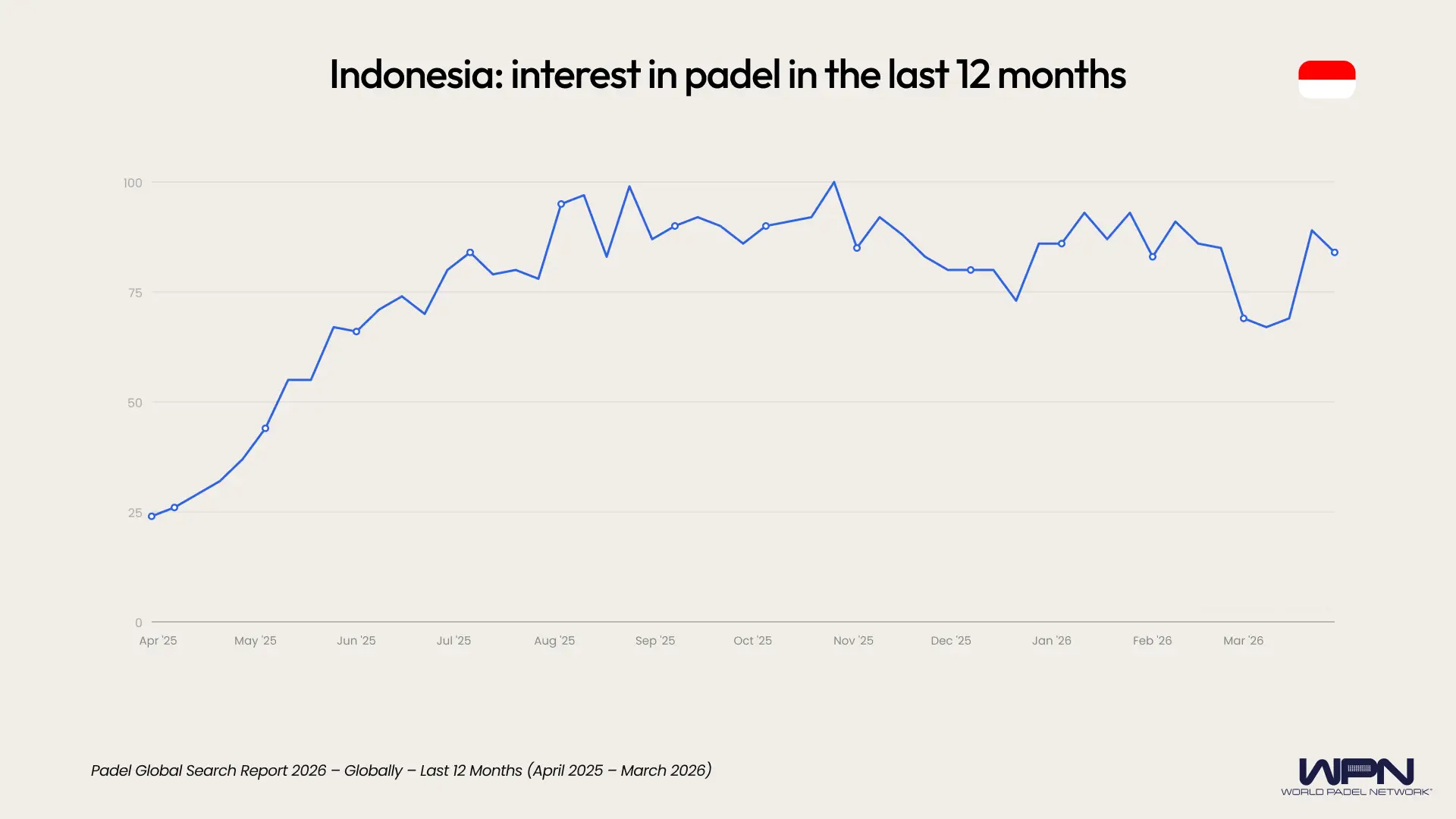
Indonesia is the first Southeast Asian country to enter the global top 20 for padel search interest, scoring 38/100 in the 12-month comparison – up from just 4/100 in the all-time data.
In late March 2025, weekly search interest within Indonesia sat at 24/100. By mid-May, it had more than doubled to 54/100. By the end of June, it was in the high 60s. By August, it had reached the 90s. The entire journey from near-zero to the index ceiling took less than five months – the steepest absolute climb of any country in this report.
There is not an event-driven spike followed by a return to baseline. It suggests a step-change. The peak of 100/100 came in the week of 26 October 2025.
The average for the year was 76.8/100 – for a market that was essentially invisible in the all-time data, this is a remarkable reading.
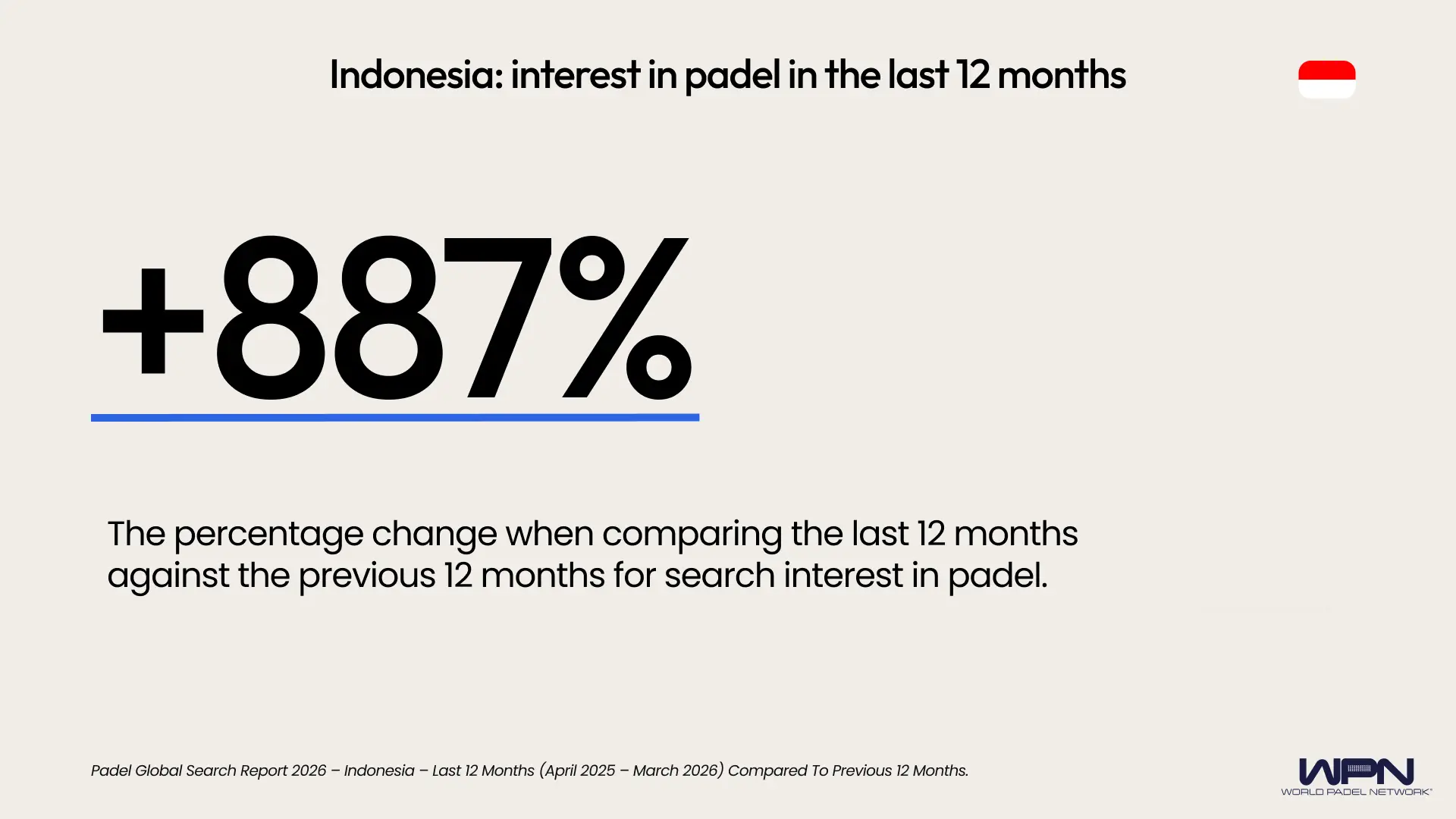
The percentage increase is an incredible 887% when comparing the last 12 months against the previous 12 months.
Indonesia sits near the equator and has no European-style seasonal variation. The data shows no autumn peak or winter dip – just a sustained, rapid climb followed by a high plateau. A slight softening in early March 2026 was followed by a recovery to 89 and 84/100, suggesting the plateau is holding.
The question Indonesia raises is whether this represents the beginning of padel’s expansion into Southeast Asia more broadly. With a population of over 275 million people, even modest penetration of padel awareness in Indonesia would represent a significant shift in the sport’s global footprint. The search data suggests that shift may already be underway.
Switzerland
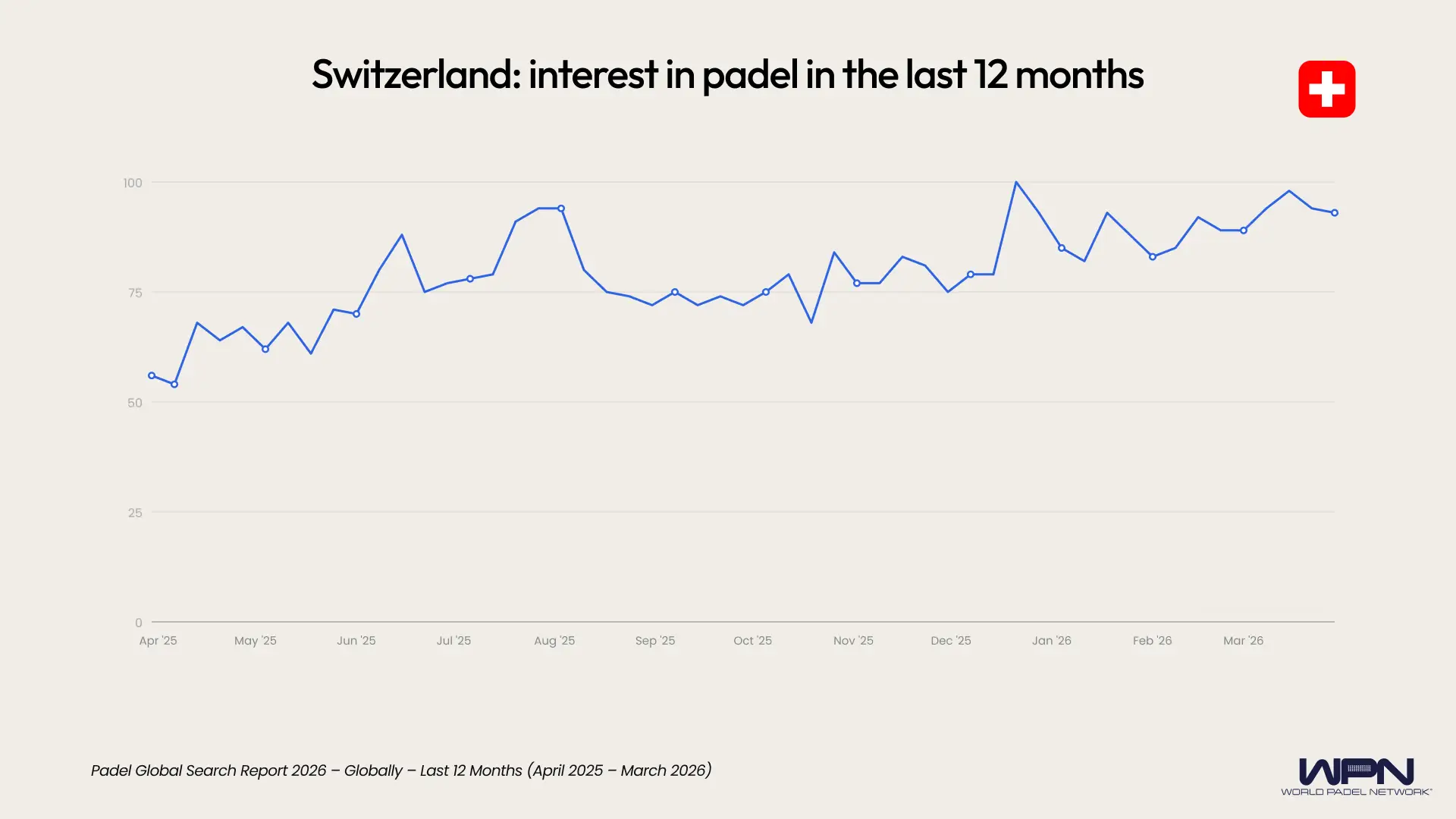
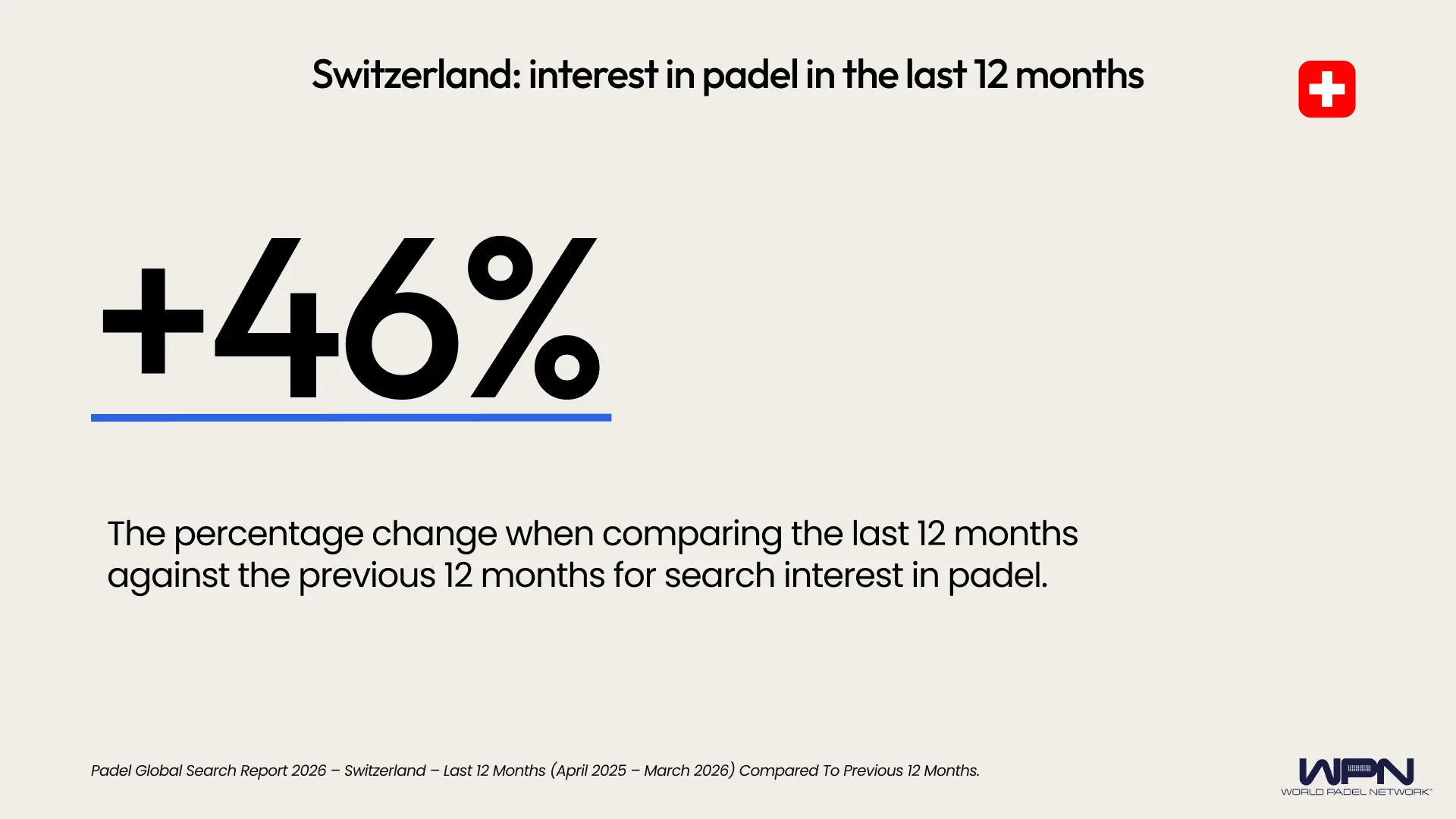
Switzerland scored just 8/100 in the all-time regional data and is one of six countries to enter the global top 20 for the first time at 36/100. The domestic data is more impressive than either figure suggests.
What makes Switzerland especially notable is not just the level but the way it was reached. Switzerland’s growth curve is a smooth, sustained climb from start to finish, with no isolated spikes, no event-driven distortions, and no significant retreats.
The trajectory tells the story. April 2025 averaged in the low-to-mid 60s. By June, weekly scores had moved into the high 70s and 80s. July and August peaked at 95 and 89/100. From September onwards, interest never dropped below 71/100 and continued to trend upward. The peak came in the week of 21 December 2025 at 100/100.
There was no December dip. In fact, December was one of the strongest months. This mirrors the pattern seen in the UK, Ireland, and France rather than the holiday-season softening observed in Spain, Portugal, and the Southern Hemisphere markets. In a country where much of the population lives at altitude and winters are long, padel’s appeal as an indoor sport likely plays a role.
Switzerland sits in an interesting position. It is growing like an emerging market but behaving like a maturing one – high baseline, consistent demand, no volatility. For a multilingual country of 8.8 million people that barely registered in padel search data two years ago, this is notable.
Qatar
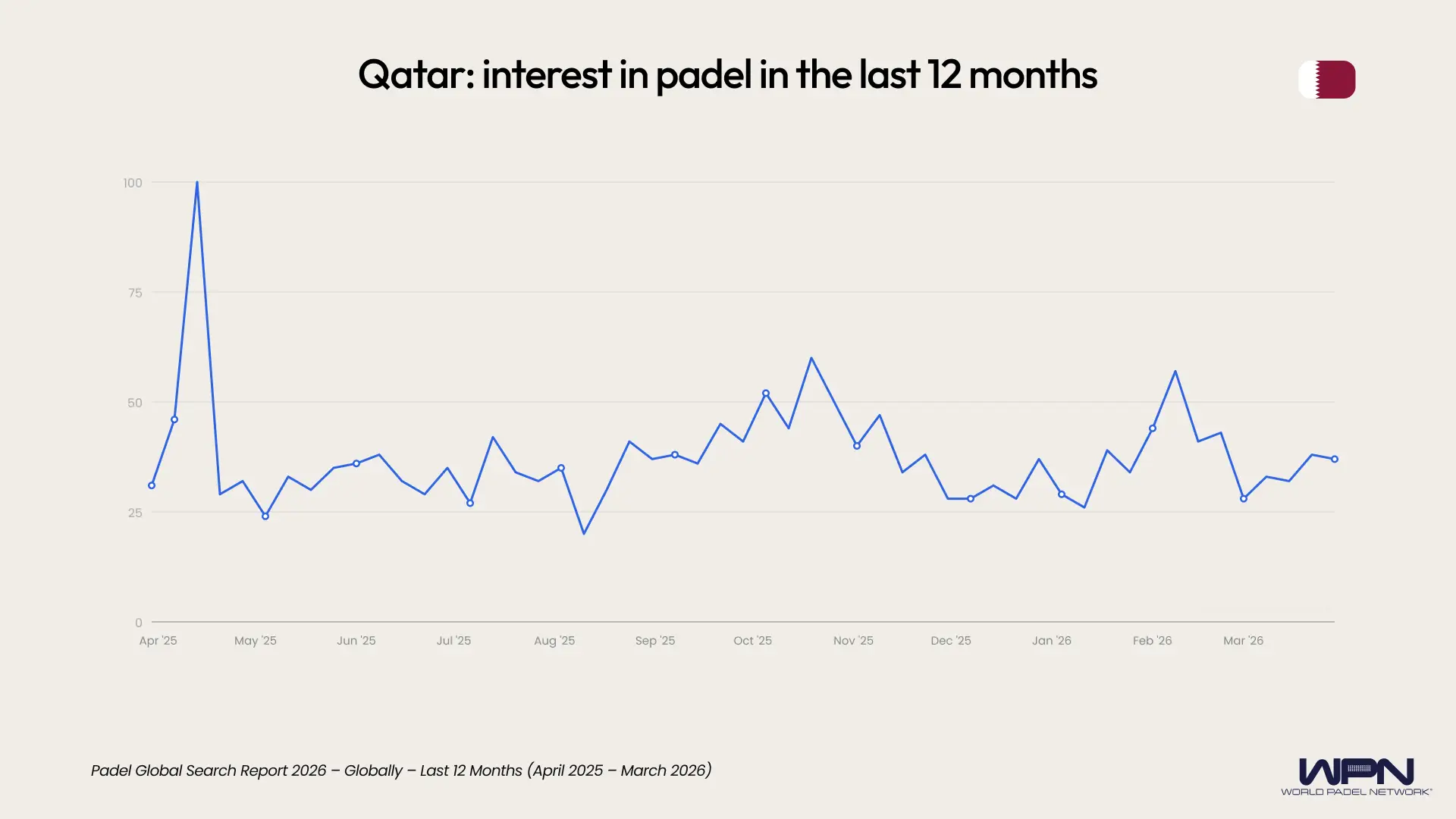
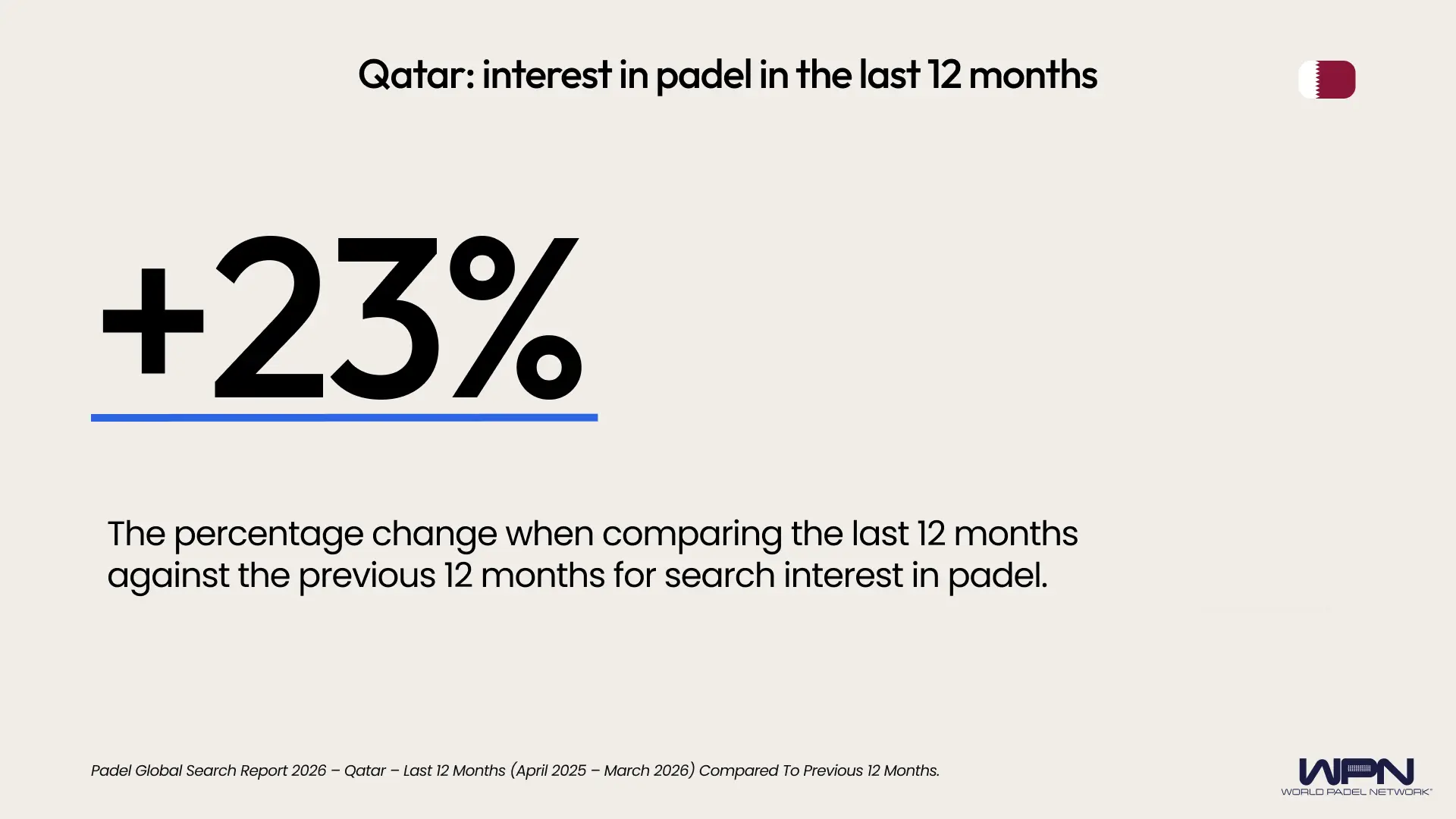
Qatar scored 14/100 in the all-time regional data and 32/100 in the 12-month global comparison, placing it alongside Tunisia and Croatia at the lower end of the top 20. The domestic data shares some characteristics with its Gulf neighbour the UAE – but at a lower intensity.
The average for the year was 37.5/100. Most weeks landed in a narrow band of 27 – 44/100, with limited sustained movement.
The spike came in the week of 13 April 2025, when interest surged to 100/100 – jumping from 46/100 the previous week and dropping back to 29/100 immediately after. This almost certainly corresponds to the Qatar Major, which was hosted in Doha. It is the sharpest single-week spike in the report, and removing it reveals a flat underlying trend.
October 2025 was the strongest non-spike period, with weekly scores reaching 52, 44, 60, and 50/100 – noticeably above the surrounding months. This coincides with the start of the cooler season in Qatar, when outdoor sporting activity picks up and the social calendar resumes after the summer. The pattern echoes the mild winter lift seen in the UAE, though the October cluster is more pronounced.
December and January were the weakest stretch, with readings dropping as low as 26/100 in mid-January. This is somewhat counterintuitive for a Gulf market – the cooler months might be expected to sustain interest – but may reflect the holiday period and year-end disruption rather than a climate effect.
The data are more volatile than the UAE’s, with sharper week-to-week swings. Qatar’s smaller population (around 2.9 million) means small absolute changes in search volume register as larger index movements. A reading of 57/100 one week in February was followed by 41/100 the next – typical of a small-country dataset where individual weeks carry more noise.
Qatar’s profile is one of steady, low-level demand with an established but compact padel community. Like the UAE, the search data suggest a market that has found its level for now rather than one in an active growth phase. The April spike shows the market can respond to major events, but the baseline interest between events remains flat.
Norway
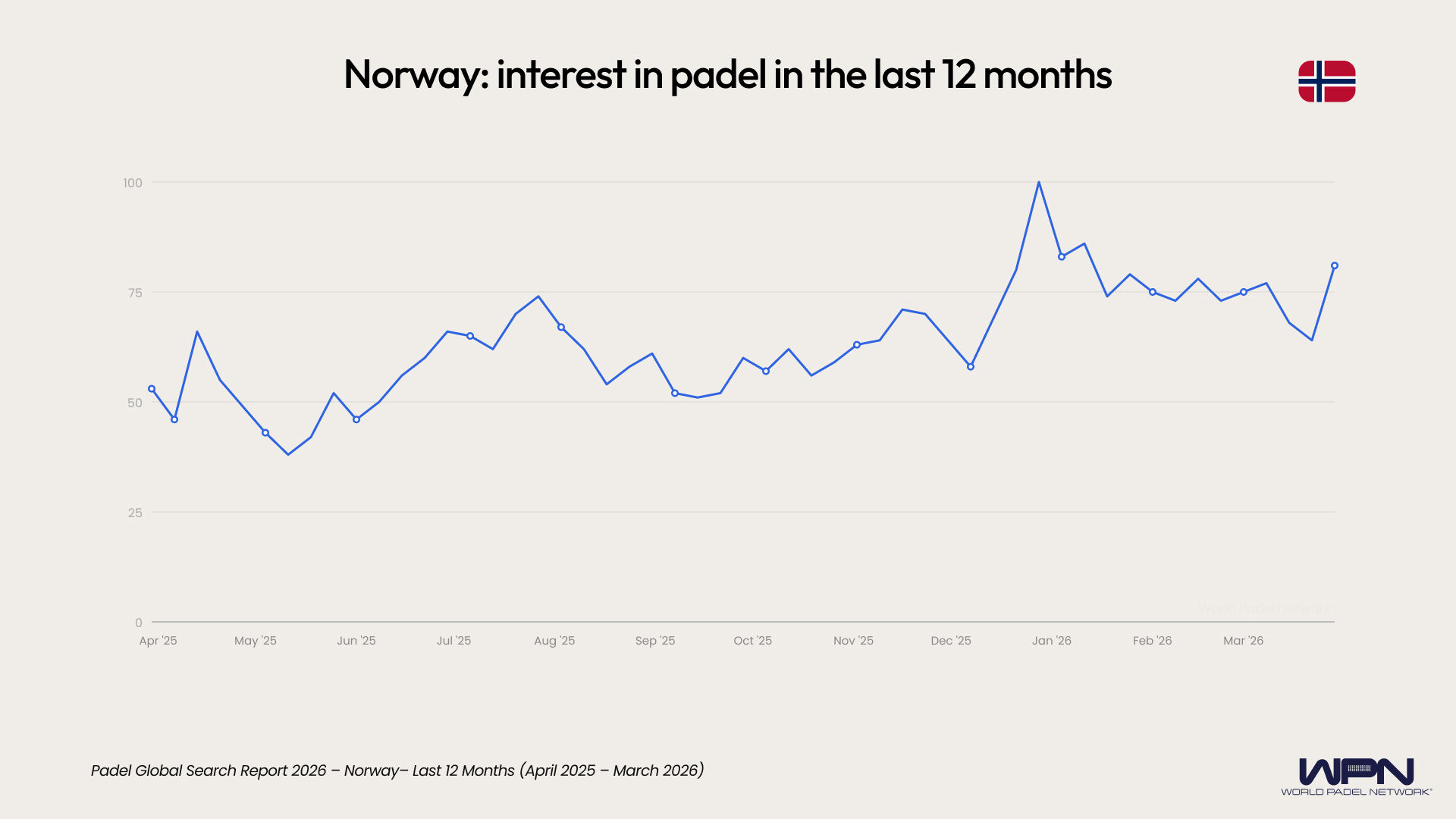
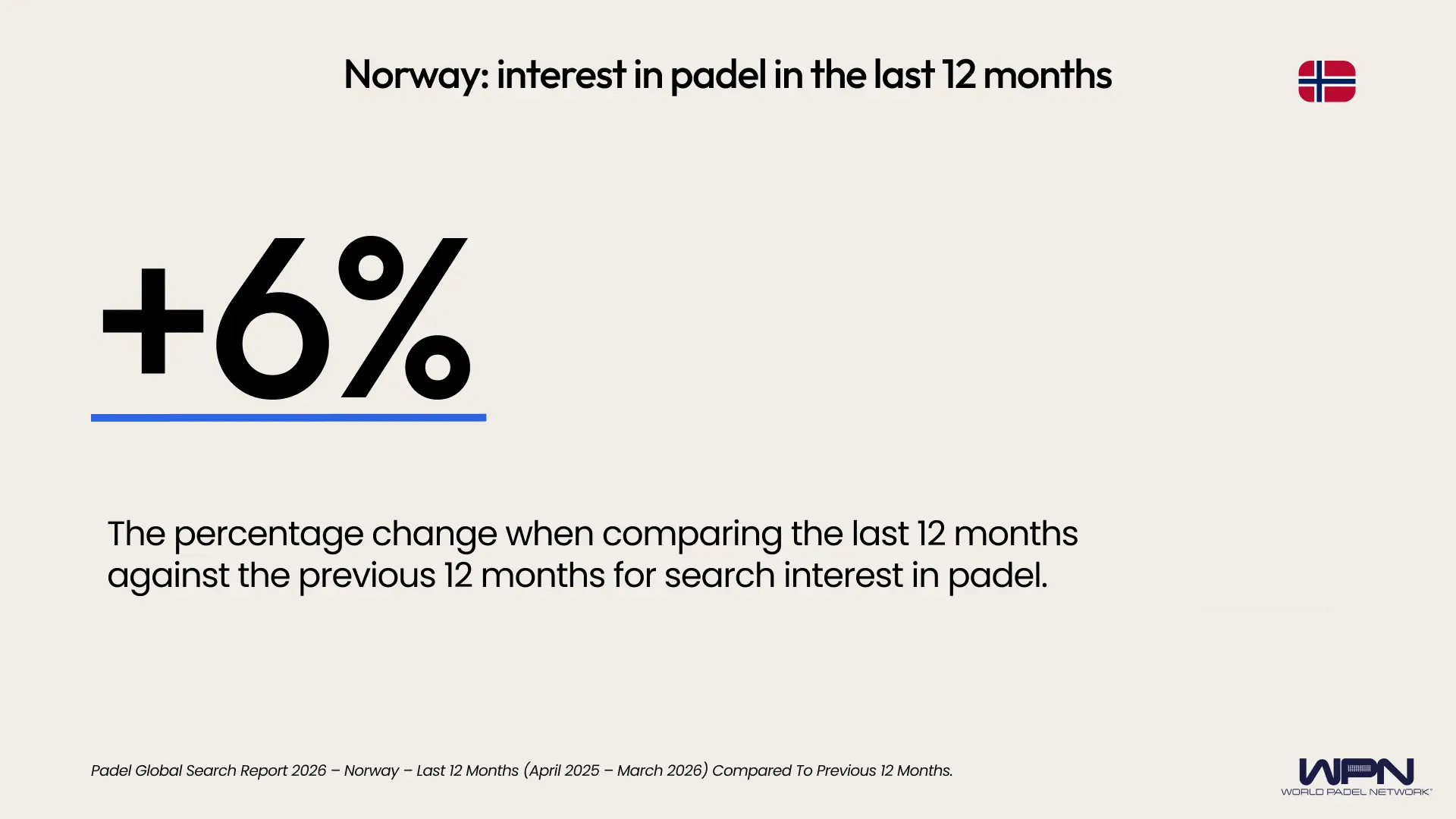
Norway scored 16/100 in the all-time regional data and 34/100 in the 12-month global comparison. It is one of several Scandinavian markets where padel gained early traction – though not as early or as strongly as Sweden, which once held the 2nd spot globally. The domestic data over the past year shows a market with a clear upward trajectory and a distinctly winter-weighted seasonal pattern.
The average for the year was 63.6/100. The trajectory climbed steadily from a modest start – May was the weakest month at 43.8/100 – through a summer plateau in the 60s and into an autumn acceleration. November averaged 66.4/100. December climbed to 76.8/100. January 2026 reached 80.5/100. The peak came in the final week of December at 100/100.
That December peak is significant. Norway’s long, dark winters make indoor sport a natural draw, and padel’s growth across the colder months mirrors the pattern seen in the UK and Ireland. Interest held in the mid-70s through February and March 2026, well above anything recorded in the first half of the year.
The Scandinavian context is worth noting. Sweden – once the clear leader in Nordic padel – has dropped out of the global top 20, sitting at 28/100 over the past 12 months. Norway, at 34/100, has overtaken it. This does not necessarily mean Norway is the larger market in absolute terms, but it does suggest that Norway’s padel growth curve still has momentum while Sweden’s may have plateaued.
Croatia
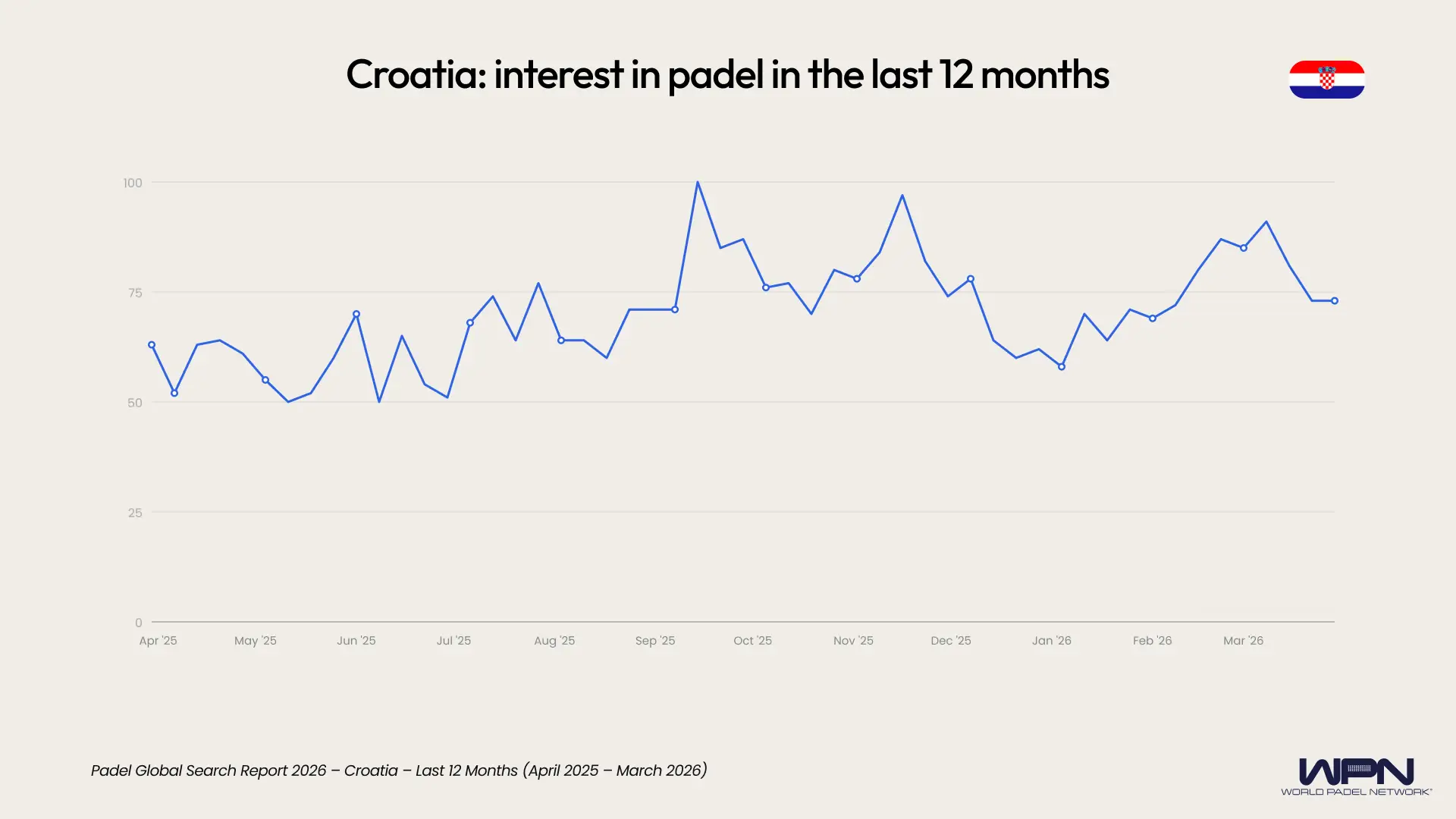
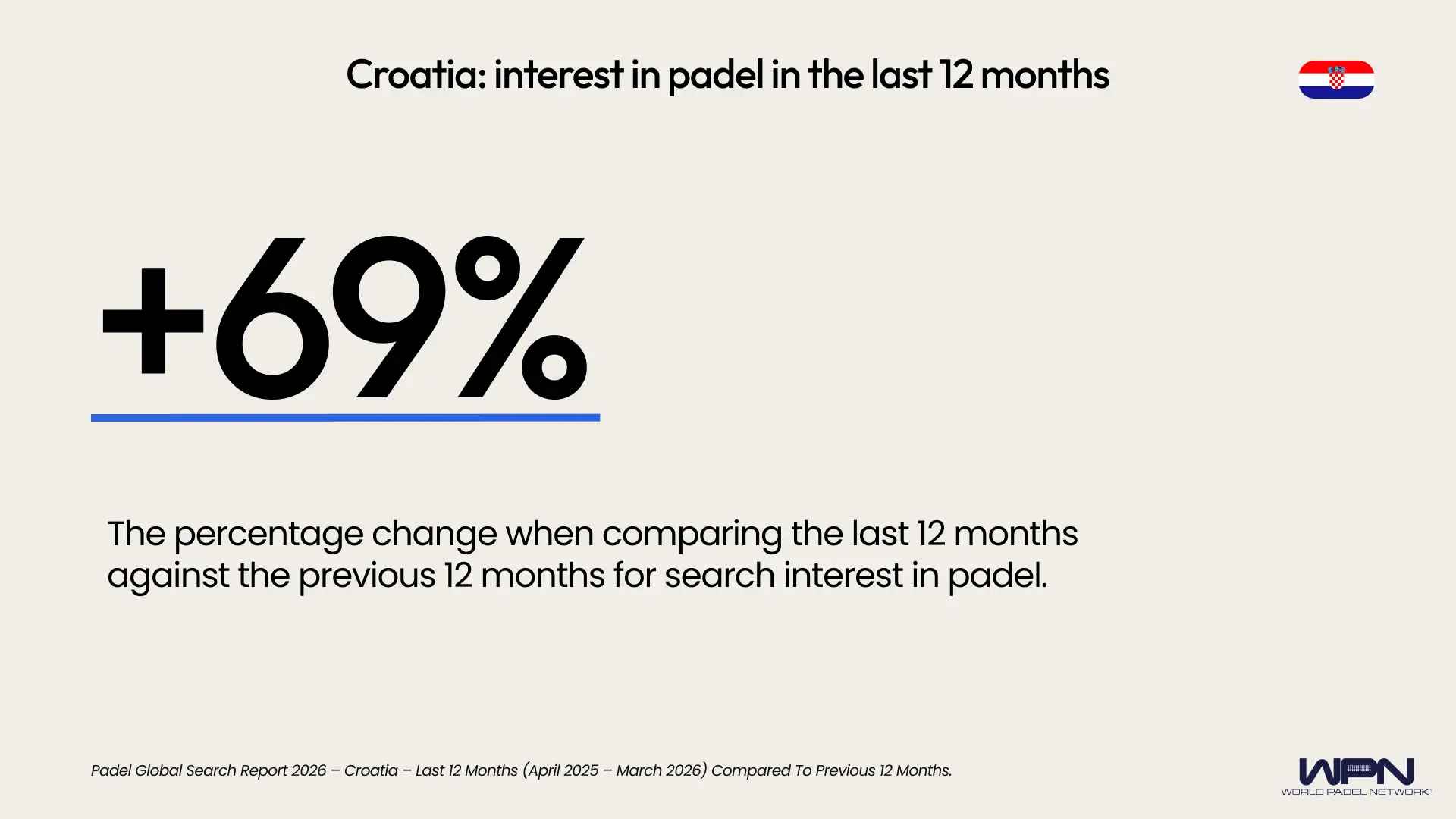
Croatia is one of six countries to enter the global top 20 for the first time, scoring 32/100 in the 12-month comparison. That ranking understates what is happening domestically. Croatia’s internal average of 70.2/100 places it alongside Spain, Italy, and the UK – the top tier of countries examined in this report.
The peak came in the week of 14 September 2025 at 100/100. September through November averaged approximately 81.6/100, with no week dropping below 70/100 across those three months. This suggests a strong autumn padel season, though specific tournaments may have driven the individual peak.
The trajectory across the year is clearly upward. April and May 2025 averaged in the mid-to-high 50s. Summer brought a gradual climb into the 70s. The autumn surge pushed into the 80s and 90s. A December dip followed – scores dropped to 60 – 78/100 over the holiday period – but the recovery was swift. February and March 2026 produced some of the strongest non-peak readings of the year, with scores of 87, 85, and 91/100 across late February and early March.
Croatia’s profile combines features seen in several other markets: a strong autumn season, Switzerland’s clean upward trajectory, and the December dip common to Southern European markets. It is one of the more complete growth stories in the dataset – a market that has arrived quickly and shows no sign of levelling off.
Tunisia
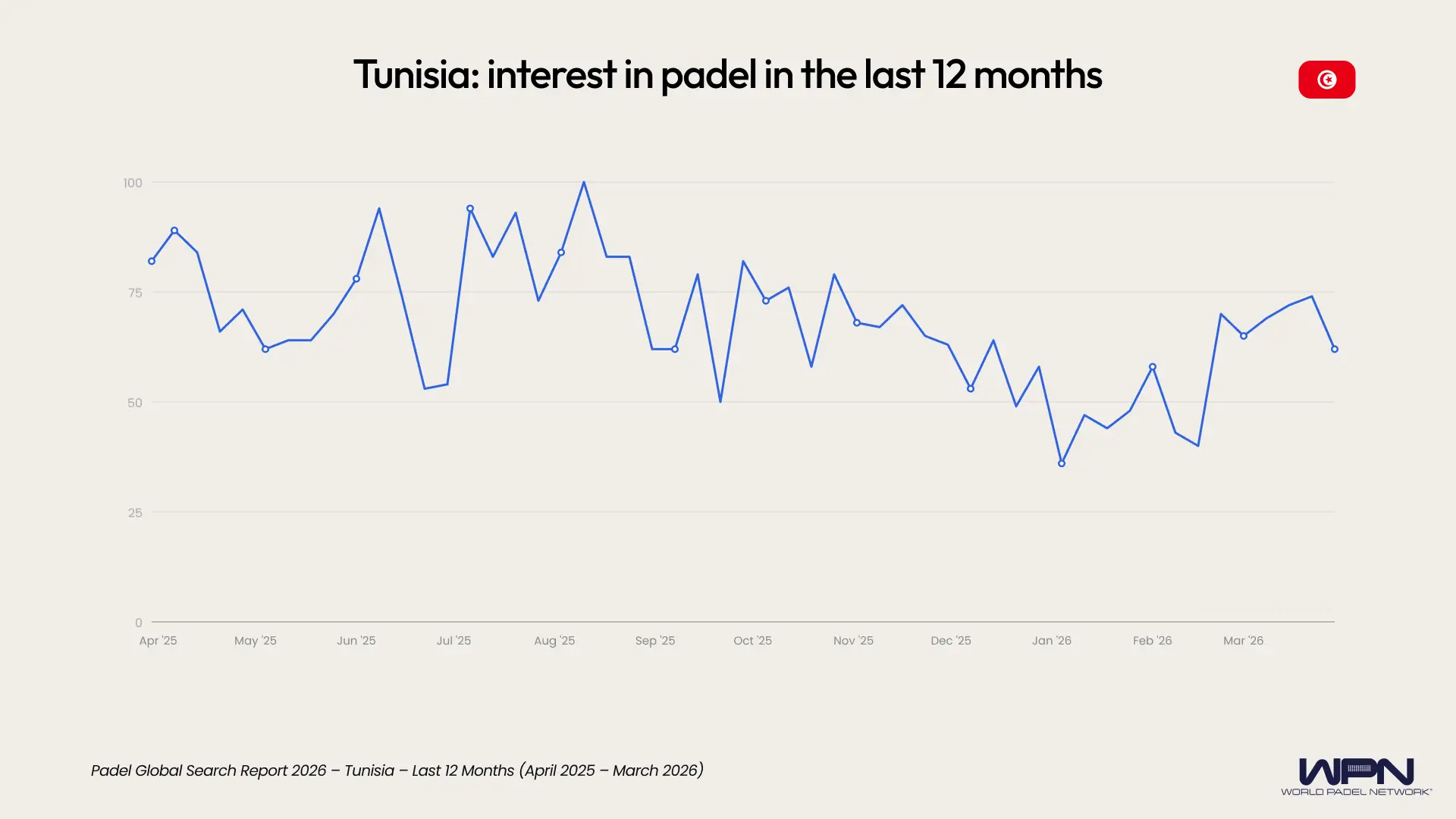
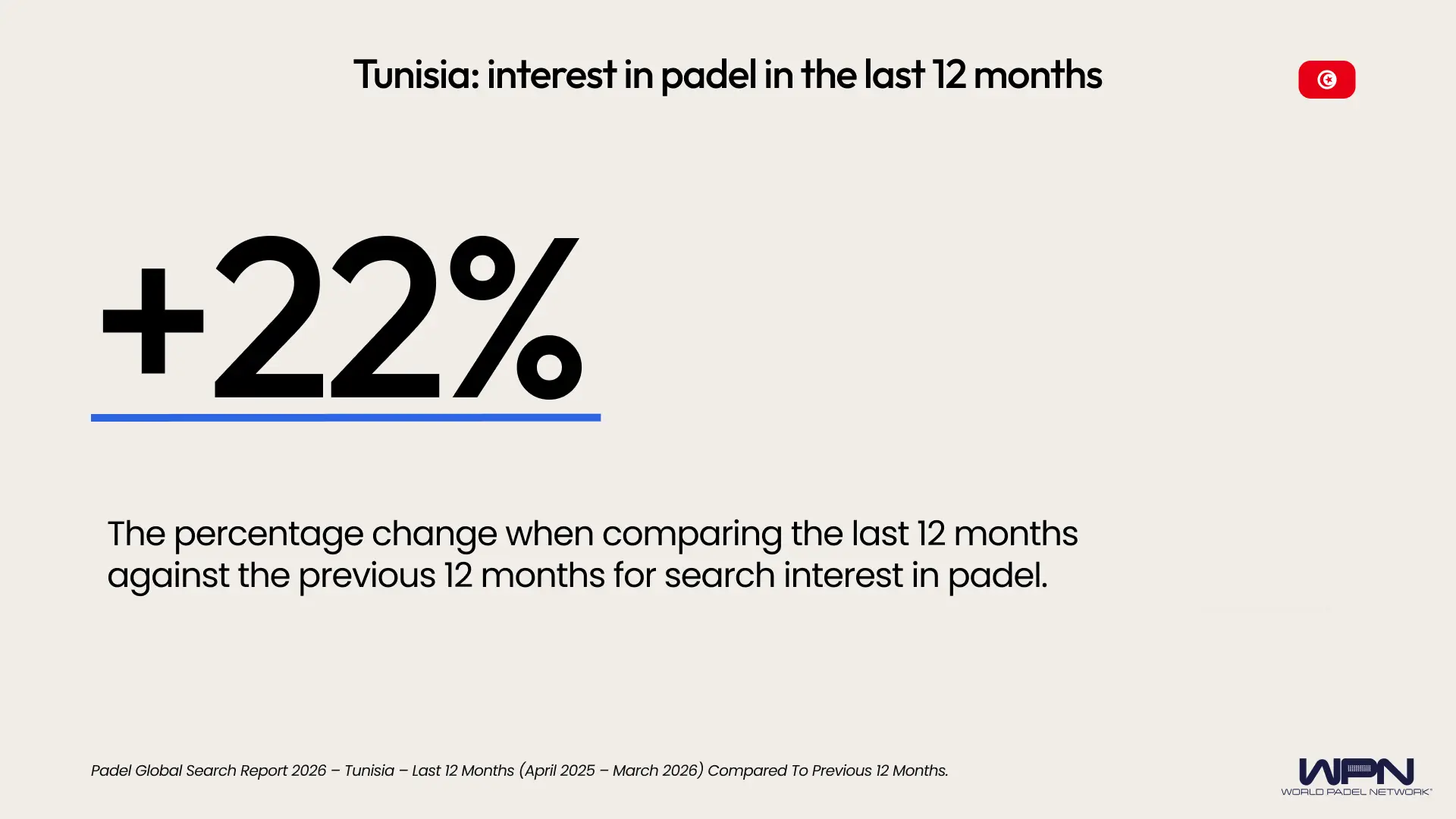
Tunisia is one of six countries to enter the global top 20 for the first time, scoring 32/100 in the 12-month comparison – up from 7/100 in the all-time data. It is also the first North African market to appear in the rankings. The domestic data reveals a market with strong overall intensity but the sharpest seasonal swing of any country in this report.
The average for the year was 68/100 – placing Tunisia in the upper half of the countries examined. But that average conceals a dramatic split between the two halves of the year.
The first half was exceptionally strong. April opened in the high 80s. July and August were the standout months, averaging approximately 84/100 between them, with the peak hitting 100/100 in the week of 10 August 2025. This is a summer-peaking market – Tunisia’s Mediterranean climate and its position as a tourism destination likely contribute to elevated interest during the warmer months, when outdoor activity and visitor numbers are at their highest.
From September onwards, the picture changed. Interest dropped through the autumn – October still held some strong weeks but the underlying trend was downward. November averaged 67/100. December fell to 56/100. January 2026 was the weakest month at 43.8/100, with one week hitting 36/100 – the lowest reading in the dataset. The drop from the August peak to the January floor represents a 64-point swing, comfortably the largest seasonal range of any country examined.
February remained subdued before a March recovery brought scores back into the high 60s and low 70s. The closing weeks of the dataset sit above the winter lows but well below the summer highs, suggesting Tunisia is beginning its seasonal climb back toward the stronger months.
Comparing the first and last four weeks shows a decline from 80.2/100 to 69.2/100 – but this is likely a seasonal effect rather than a structural one. The first four weeks fell in peak spring; the last four in early spring. A meaningful year-on-year comparison will require data from the next summer period.
Tunisia’s arrival in the top 20 is notable as the first signal of padel gaining measurable traction in North Africa. The strength of the summer readings – routinely in the 80s – suggests a market with genuine demand, even if the winter months show that demand is heavily seasonal. Whether that seasonality smooths out as the market matures, or whether Tunisia remains a summer-dominant padel market, is an open question.
Austria
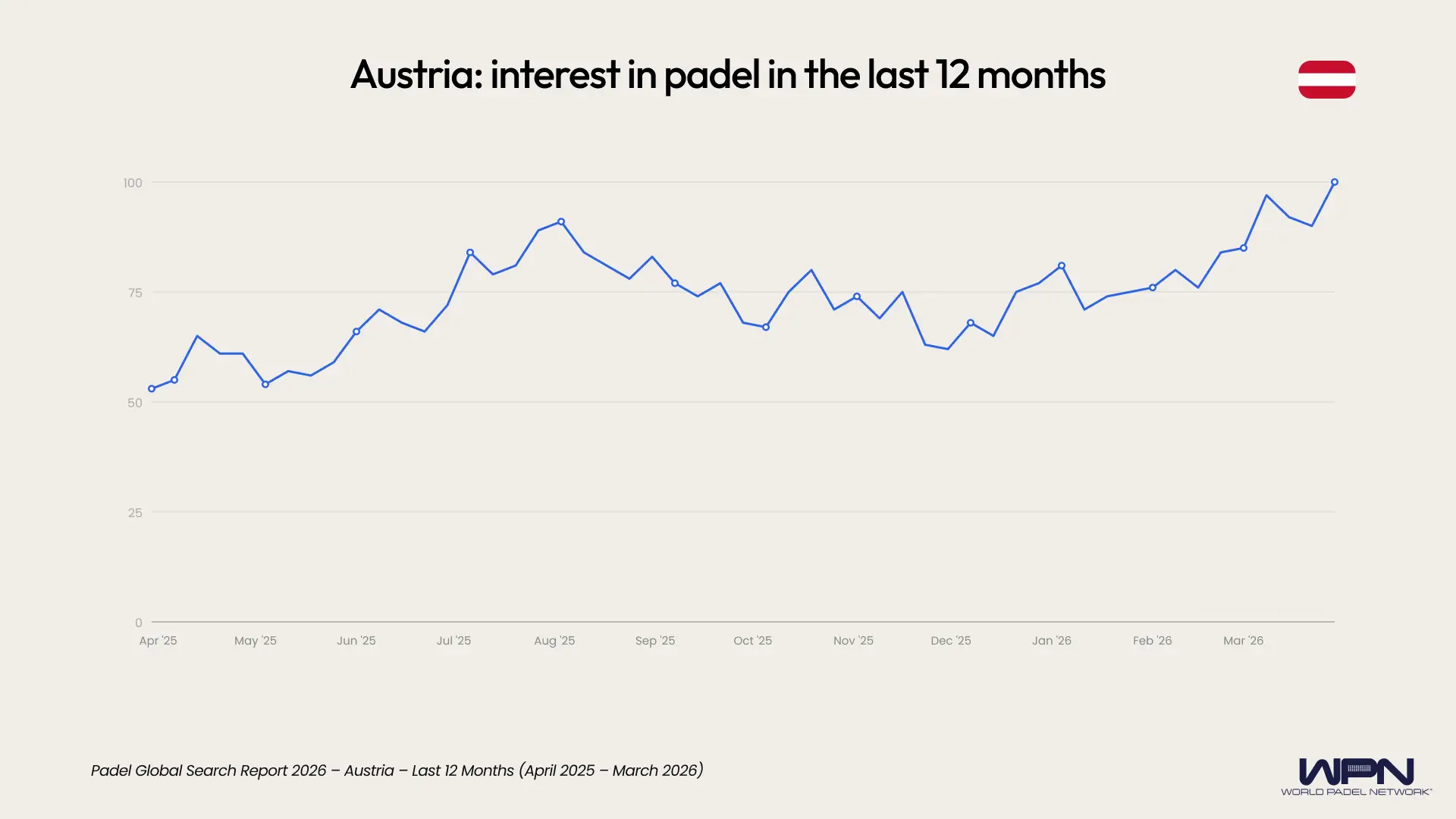
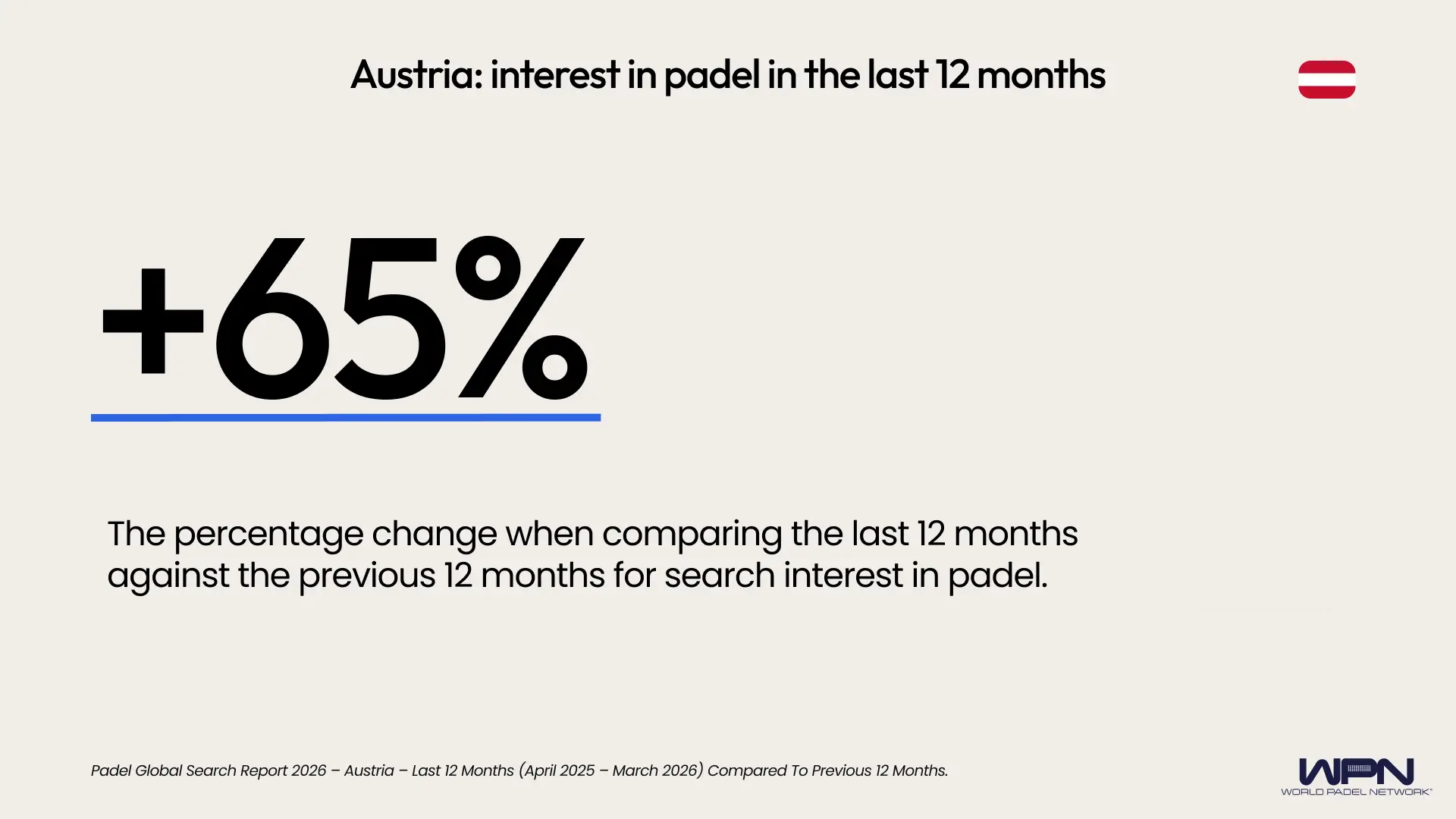
Austria scored just 6/100 in the all-time regional data and 31/100 in the 12-month comparison – narrowly missing the global top 20 but worth examining given the strength of the domestic data. Like its neighbour Switzerland, the domestic data tells a considerably stronger story than the global ranking suggests. And like Switzerland, the trajectory is still climbing.
The average for the year was 73.8/100. The growth curve is clean and sustained. April 2025 averaged in the low-to-mid 60s. June lifted into the high 60s. July and August produced the first extended high-water mark, with scores routinely in the low-to-mid 80s and a peak of 89/100 in late July. From there, interest eased slightly into the 70s through autumn and early winter – but never dropped far.
The closing stretch is the most striking feature of Austria’s data. From late February 2026 onwards, scores surged. The peak came in the last week of the dataset (w/c 29 March 2026) at 100/100.
There was no meaningful December dip. Scores held in the low-to-mid 70s over the holiday period, with the final week of December rising to 77/100. January and February maintained that level before the March surge pushed interest to new highs. This mirrors the pattern seen in Switzerland and contrasts with the sharp winter drops in Spain, Portugal, and the Southern Hemisphere markets.
Austria and Switzerland together form a Central European Alpine cluster with remarkably similar profiles: clean upward growth, high domestic averages, no seasonal dip, and continued acceleration at the end of the dataset.
India
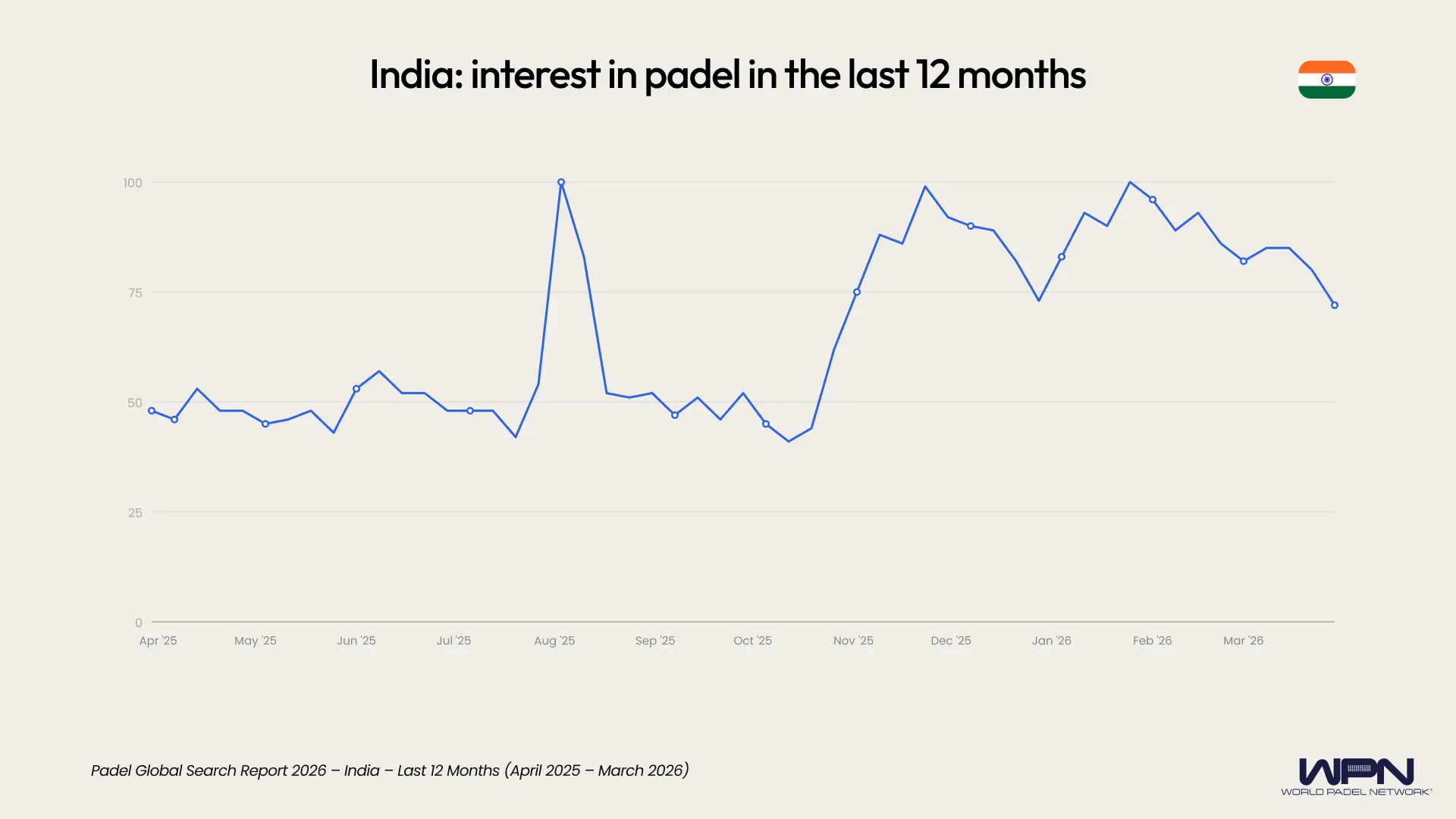
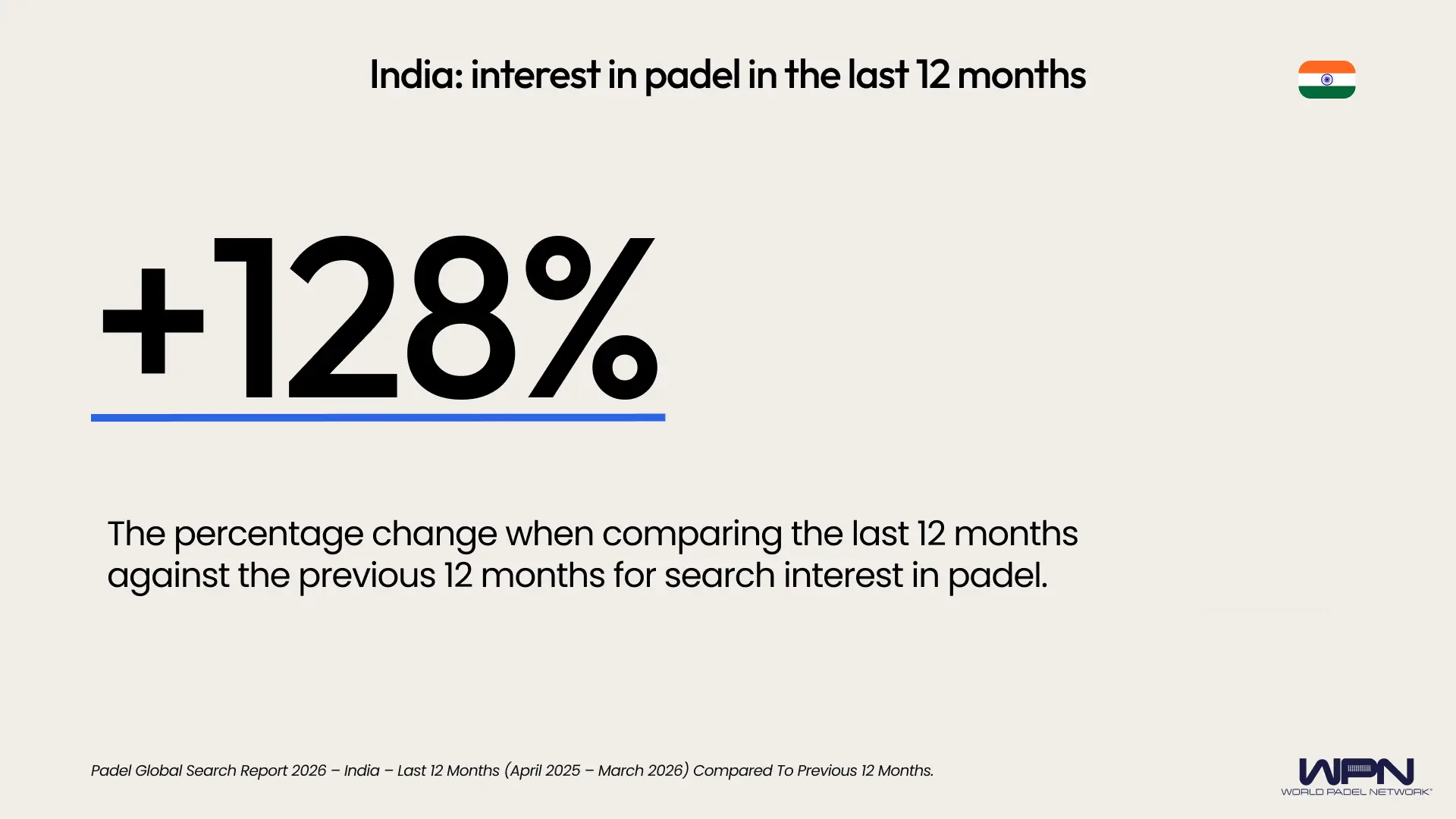
India scored just 1/100 in the 12-month global comparison – one of the lowest readings in the dataset. On a global scale, padel search interest in India barely registers. But the domestic data tells a story that may carry more long-term significance than any other country in this report.
The year splits cleanly into two phases. From late March to October 2025, weekly scores averaged around 52/100 – flat, stable, and unremarkable. There was one isolated spike to 100/100 in the week of 3 August 2025, followed by 81/100 the next week, before interest dropped straight back to the low 50s. That spike has the hallmarks of a single event. Remove it and the first seven months of the dataset are essentially level.
Then, in late October, the picture changed. Weekly scores climbed from 41/100 to 64, then 74, then 90/100 within three weeks. Unlike the August spike, interest did not retreat. From November 2025 through March 2026, scores stayed in the 72 – 100/100 range, averaging approximately 87/100 across that five-month stretch. A second peak of 100/100 came in the week of 25 January 2026 – this time as part of the sustained elevated period rather than an isolated event.
The contrast between the two phases is stark. The first half averaged around 52/100. The second half averaged around 87/100. Something structural shifted in the Indian market around November 2025, and the search data suggest it has held, for now.
India’s 1/100 score on the global comparison is a reminder of the difference between relative and absolute scale. India has a population of over 1.4 billion people. Even a fraction of the padel awareness seen in smaller European markets would represent an enormous number of people searching, discovering, and potentially playing the sport. The domestic data – with five consecutive months in the 80s and 90s – suggests that discovery phase may now be underway.
However, it is too early to draw firm conclusions. The elevated period is only five months old, and the global ranking confirms that padel remains a niche interest in the context of India’s vast search landscape. But the step-change from flat to sustained high interest, mirroring the pattern seen in the US, makes India one of the most important markets to watch over the coming year.
Pakistan
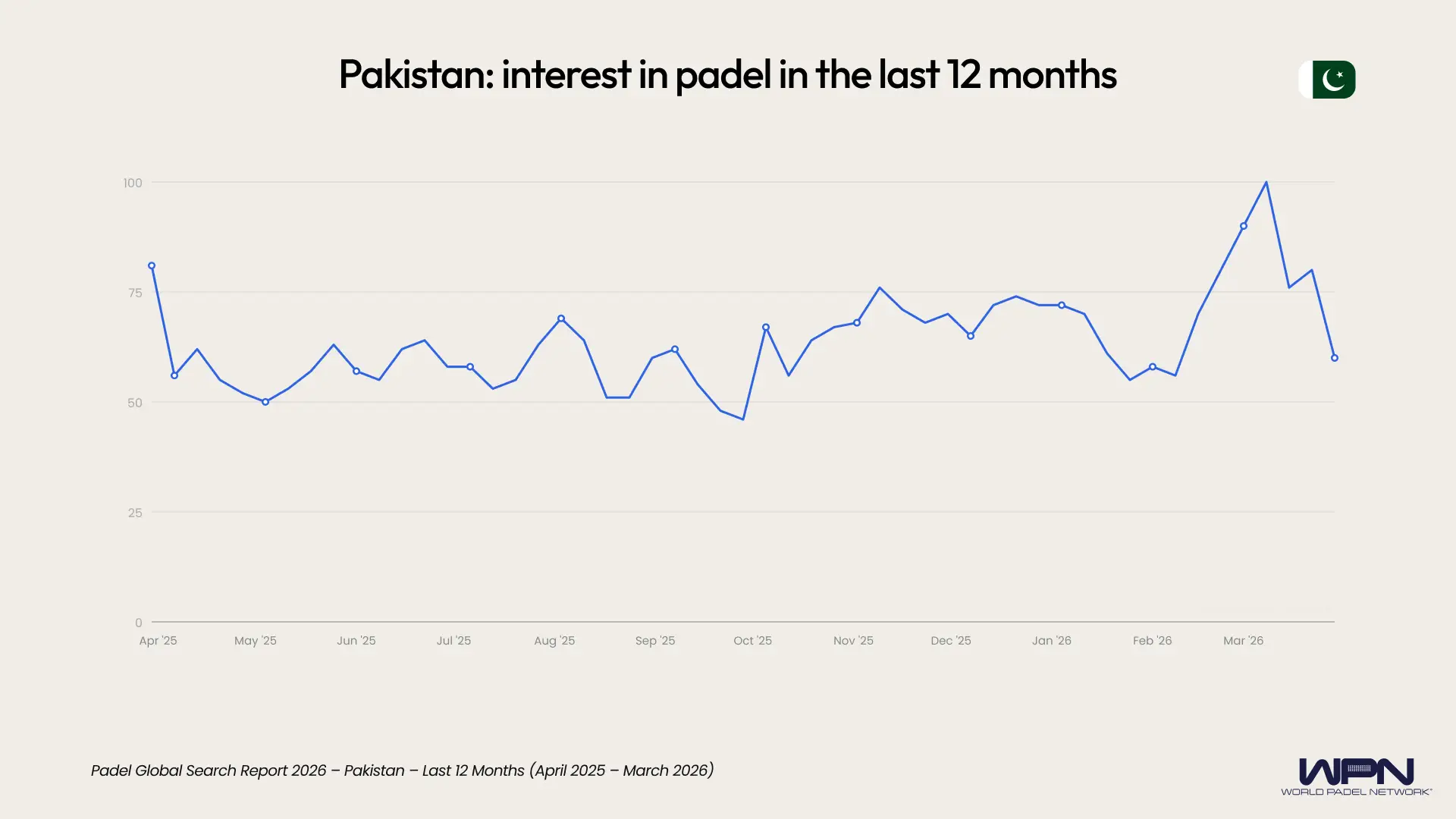
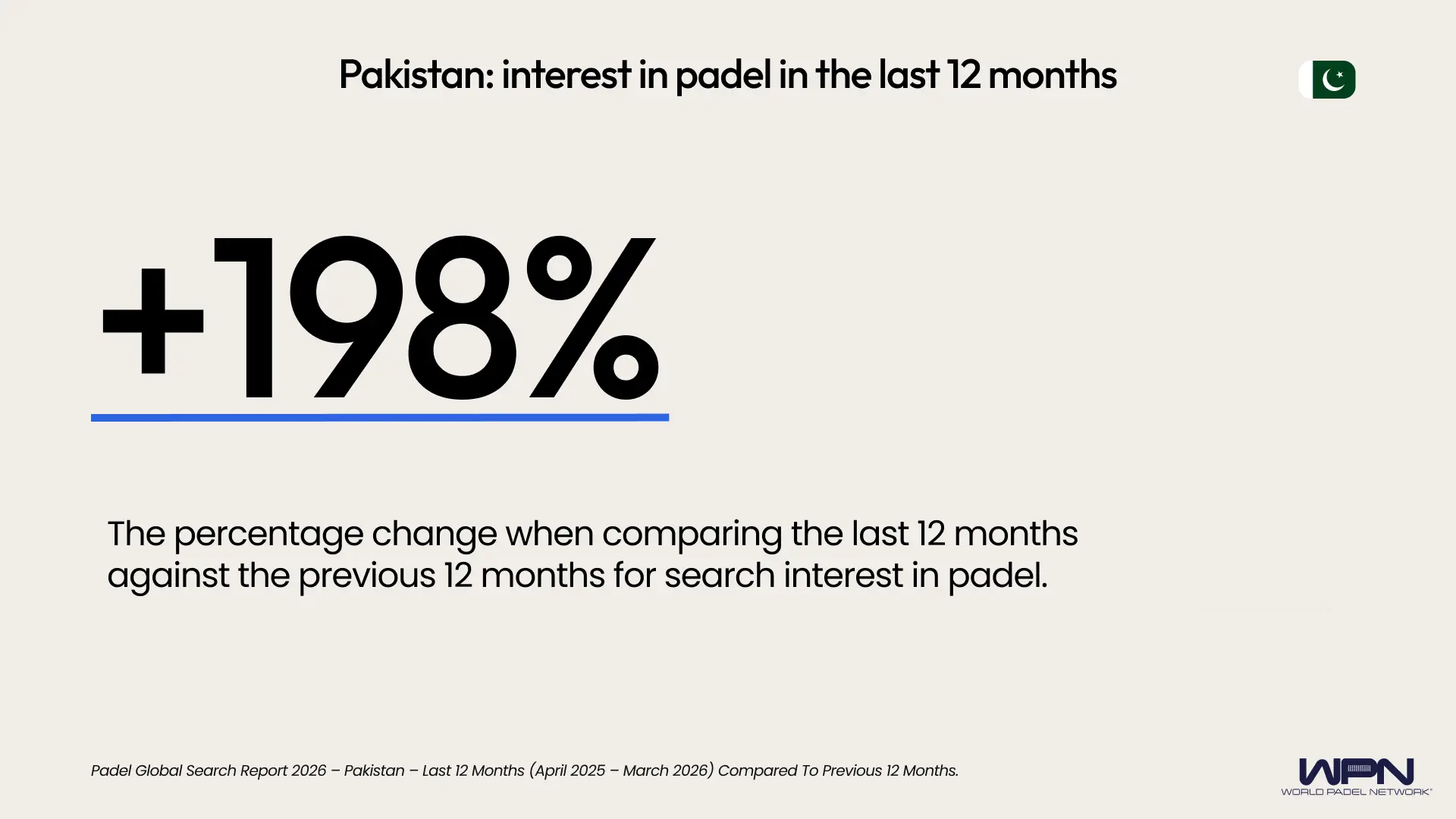
Pakistan scored 14/100 in the 12-month global comparison – notably higher than neighbouring India’s 1/100, despite India’s larger population. For a South Asian market with no established padel history, any measurable reading is significant. The domestic data shows a market that started quietly and grew progressively stronger across the year.
The average for the year was 64.3/100. The trajectory moved through three phases. From April to September 2025, weekly scores mostly sat in the 50 – 65/100 range, with September the weakest month at an average of around 53.5/100. The opening week (83/100) was an outlier above this range but interest quickly settled into the mid-50s.
From November, a step-up is visible. Weekly scores lifted into the high 60s and low 70s and held there through December. November averaged 71.2/100 and December 71.5/100 – a consistent elevated band that suggests a genuine shift in baseline interest rather than a temporary spike.
The most dramatic movement came at the end. From late February 2026 onwards, scores surged: 71, 84, 92, 100/100 across four consecutive weeks, with the peak of 100/100 arriving in the week of 8 March 2026. Interest eased to 72, 80, and 58/100 in the final three weeks – still above the first-half average – but the March spike was sharp enough that it is unclear whether it represents a sustained new level or an event-driven peak – perhaps the FIP Promises Padel Tour beginning in Karachi.
Pakistan and India together represent a South Asian signal worth watching. Both markets show late-period acceleration in their padel search data. Both have large populations. And both scored negligibly in the all-time data. If padel gains even a foothold in either market, the absolute numbers involved could be substantial. Pakistan’s data over the past year suggests that foothold may be forming – gradually, unevenly, but measurably.
Concluding Thoughts
Global search interest in padel is not just higher than it has ever been – it is consistently high, across more countries, and across more of the calendar year.
The long-term trajectory speaks for itself: 1,026% growth in annual average search interest between 2004 and 2025. In the last year, search interest has grown by 49% compared to the previous 12 months too. But the numbers that matter most for the industry are not the growth rates. They are the floor figures. When the weakest week of the year scores 56/100 – a level that would have been a record just two years ago – the conversation shifts from whether padel is growing to how the industry keeps pace with demand.
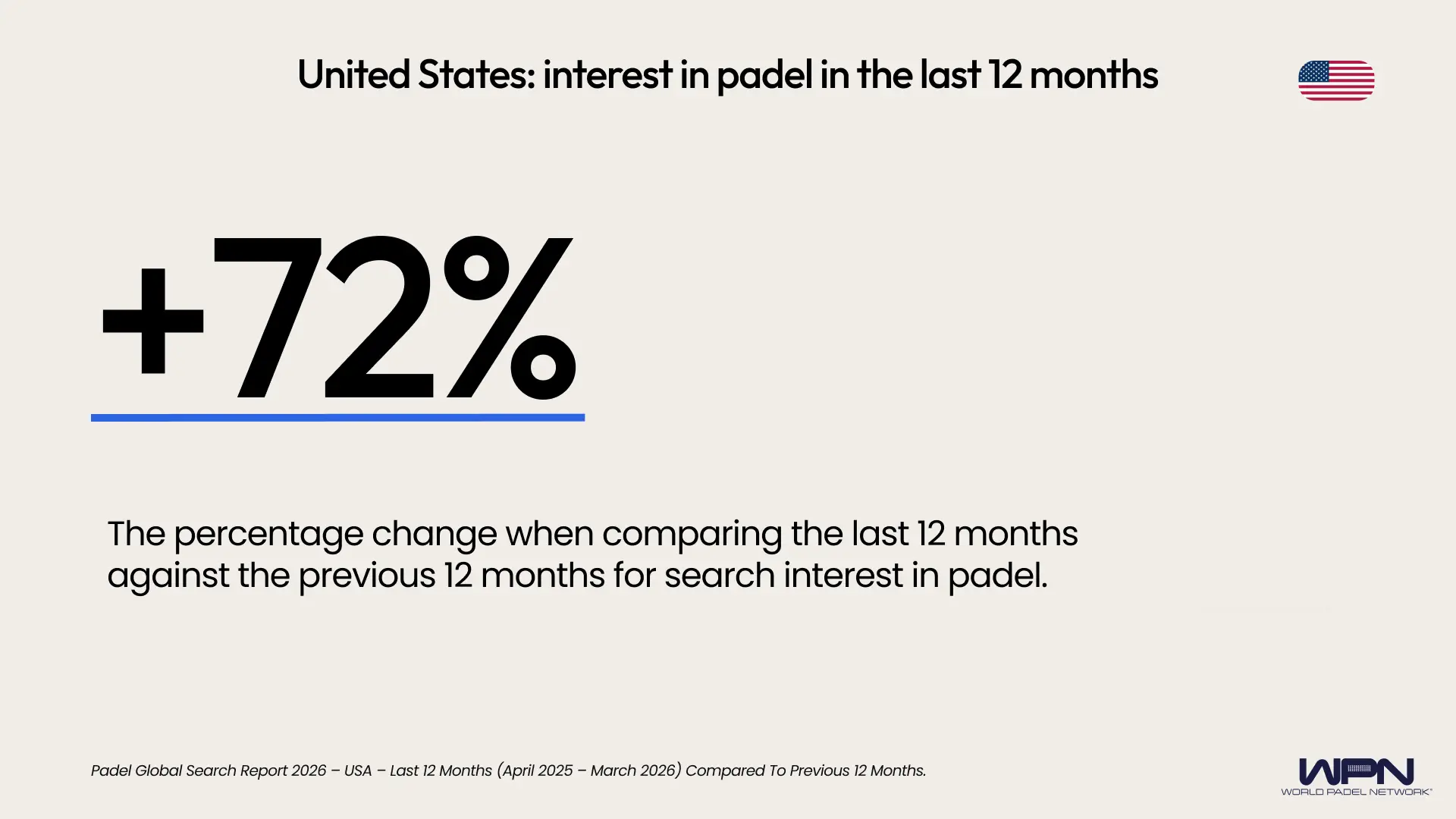
The geographic picture has widened considerably. Spain still leads, but the gap is closing. Portugal, Argentina, Denmark, Estonia, Belgium, and the Netherlands have all surged into contention. Six new countries have entered the top 20. Indonesia’s arrival as the first Southeast Asian market to break through suggests the sport’s next chapter will not be confined to Europe and Latin America. Meanwhile, the United Kingdom’s 121% increase and the United States’ 72% increase point to two major English-speaking markets still at the beginning of their padel journeys.
Each market has its own rhythm. Spain and Portugal run hot across multiple seasons. Italy peaks in summer and again in autumn. France has quietly consolidated into a steady, year-round market. The UK peaks in winter. The US is still finding its pattern. Understanding these differences – rather than treating padel as a single global trend – will be increasingly important for anyone making decisions about where to build, invest, or expand.
This report will be updated annually. In the months ahead, World Padel Network will publish country-specific deep dives examining individual markets in greater detail for subscribers to The Cortado.

Research by Jamie Rowe
Founder of World Padel Network — the trusted global padel platform. Jamie writes about padel market trends, club insights, and growth patterns across the global padel industry.